
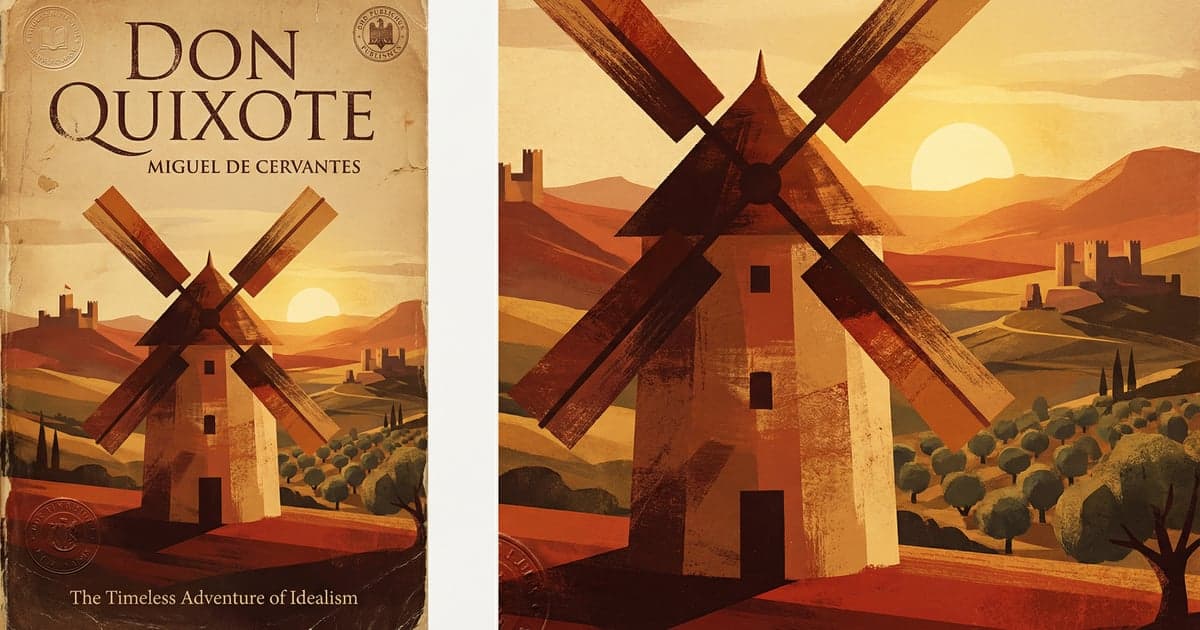
The danger is not that a man reads too many books. It is that a finished plot arrives in his body before the world has a chance to object. Quixote practices surrenders, empires, and a lady's title in an empty room. When the road finally appears, it is already cast. Mills, inns, and basins are not mis-seen. They are underemployed extras waiting for their cue.
People who love him try the obvious cure. They burn the shelf. They plaster the door. They invent a flying thief so he will stop looking. He supplies the missing name and the missing motive. Friston is not a character Cervantes plants as a joke only. He is what a story does when you remove its props: it hires a conspirator so the hero never has to be wrong.
Later he will go mad on purpose because Amadís did. Detection is not asking whether someone is ill. It is asking whether the bruises are being used as evidence or as scenery. If every collision upgrades the plot instead of revising it, you are not watching eccentricity. You are watching a narrative that has learned to metabolise contradiction.
The Central Lesson
Story-driven delusion is a plot that refuses unemployment. It casts objects, recruits companions, and hires enchanters so the hero never has to be wrong. Cervantes's joke is precise: the man can describe his own madness and still obey it, because the template is older than the bruise. Detection means asking, after each collision, whether the story got stronger. If it did, you are not looking at a mistake. You are looking at a machine.
Applying This to Your Life
Watch What Failure Is Allowed to Mean
After the mills, the fall is sabotage, not feedback. When a plan hits a wall and the wall becomes a villain, pause. Ask what identity would collapse if the object were only an object.
Notice the Help That Feeds the Plot
Walling up the library looks like care. It becomes proof of Friston. Interventions that argue inside the story's logic will be digested. Change the terms, or you have only added a scene.
Separate Imitation from Episode
The Sierra Morena penance is a copied chapter. If your crisis has a famous template (the grand gesture, the public ruin, the hermit year), check whether you are living a problem or staging a genre.
Other lessons in this book
More life-skill deep dives from the same classic.
Balancing Idealism and Pragmatism
Hold Quixote's vision and Sancho's earthiness in tension instead of choosing one as the only sane option.
5 chapters·Explore AnalysisLiving Inside a Narrative
Follow Part II's metafiction as Quixote becomes famous for a story others have already read, and ask when your own role is performance.
5 chapters·Explore AnalysisLoyal Friendship Under Absurdity
Learn from Sancho's willingness to stay with Quixote through ridicule, beatings, and promises that never arrive on schedule.
5 chapters·Explore AnalysisReading Appearance vs Reality
Track how Quixote turns inns into castles and ordinary life into enchantment, and ask what your own filters add.
5 chapters·Explore AnalysisWhen Noble Intentions Miss the Target
See how Quixote's hunger to right wrongs can still leave real people hurt when the script matters more than the scene.
5 chapters·Explore Analysis
Continue exploring
Explore this theme
The same lessons in other books
See how other books teach the same life skills.

The Essays of Montaigne
Choosing Real FriendshipHear essay 27 answer La Boétie: because it was he, because it was I.
The Idiot
Maintaining Goodness Without NaivetySit with Myshkin on the train in chapter 1: honesty with no angle, and a city that can only call it idiocy.
Jude the Obscure
When Desire Becomes a TrapTrack the pig, the dimple, the false pregnancy, and the second marriage arranged over gin.
Where the lesson lives in the book
He Rehearses the Giant Before He Meets One
Alonso Quixano does not wander into knighthood. He practices it. He crowns himself Emperor of Trebizond in his head, recites the giant Caraculiambro's surrender, and names a farm girl who never asked to be named. The plot is installed before the first mile. What looks like sudden madness is a finished rehearsal.
Key Insight:
Story-driven delusion starts as homework. By the time the person rides out, the script has already decided what every object on the road will be allowed to mean.
“saw himself crowned by the might of his arm Emperor of Trebizond at least”
The Missing Room Proves the Magician
The housekeeper and niece wall up the library and invent a flying magician. Quixote does not collapse. He corrects the name to Friston and supplies the motive: an enemy who already knows the future combat. Removing the books does not remove the plot. It gives the plot a villain who can explain their absence.
Key Insight:
When you take the evidence away, a strong story will hire an enchanter. Intervention that looks like rescue can become the next scene in the same book.
“He must have said Friston”
The Sails Were Always Going to Be Giants
Sancho names mills. Quixote names giants. After the fall he does not revise. Friston turned the giants into mills to steal the glory. The bruise is not data. It is sabotage. Sancho's warning is filed as the talk of a man who does not understand romances.
Key Insight:
A story that needs you to be the hero cannot afford an ordinary object. Failure is recast as enemy action so the identity stays intact.
“did I not tell your worship to mind what you were about, for they were only windmills?”
The Bleating Breaks the Heraldry
Two flocks become armies with banners and lineages until Sancho hears ewes. Dust, noise, and a charge still happen. Then the bleating arrives and the coats of arms dissolve. For a moment the overlay fails in public, and the cost is paid in teeth and shame rather than in a change of mind.
Key Insight:
Delusion is not always private. It can conscript a companion into a battle that only one person is fighting. Listen for the bleating before you ride.
“I hear nothing but a great bleating of ewes and sheep,”
Madness Performed on Purpose
In the Sierra Morena he copies Amadís. He tells Sancho he is mad and must stay mad until a letter returns from a lady who does not exist. The fit is not a seizure. It is a genre requirement. He knows he is imitating, and he still treats the imitation as duty.
Key Insight:
The most stubborn delusion is the one that can describe itself. If the template says the lover must go mad in the mountains, sanity looks like a missed cue.
“mad I am, and mad I must be until thou returnest with the answer to a letter that I mean to send by thee to my lady Dulcinea;”