
Lessons
Lessons from Don Quixote
Six lessons from this classic work, traced chapter by chapter.
0:00 / 0:00
A gentleman in an unnamed village of La Mancha stops sleeping and keeps reading until the books of chivalry dry his brains. He sells tillage land to buy more of them, then decides that no history has more reality than the romances on his shelf. He names himself Don Quixote. He polishes his great-grandfather's rusted armour and christens his skinny horse Rocinante. Aldonza Lorenzo, a farm girl who never knew his love, is raised to Dulcinea del Toboso without being asked. He rides out by the back door so the household cannot stop him. The first sally ends at an inn he takes for a castle: a mock knighting, a beating on the road, and a cart ride home. Cervantes published the first part in 1605 and the second a decade later. Across two volumes the book will not settle whether the knight is mad, noble, or both at once.
Continue the summary
Don Quixote is a hidalgo bordering on fifty: thin, stubborn, and certain that bruises cannot revise a romance. Sancho Panza, a practical peasant lured by the promise of governing an island, follows on his ass and names hunger while his master names giants. The priest and the barber try to burn the books, then later cage the man those books made. Samson Carrasco, a bachelor who has already read Part I, turns the sequel into a contest he intends to win. The Duke and Duchess have also read the book, and they turn the knight into house entertainment. A farm girl on the road to El Toboso becomes an enchanted Dulcinea because Sancho cannot produce the lady his master demands.
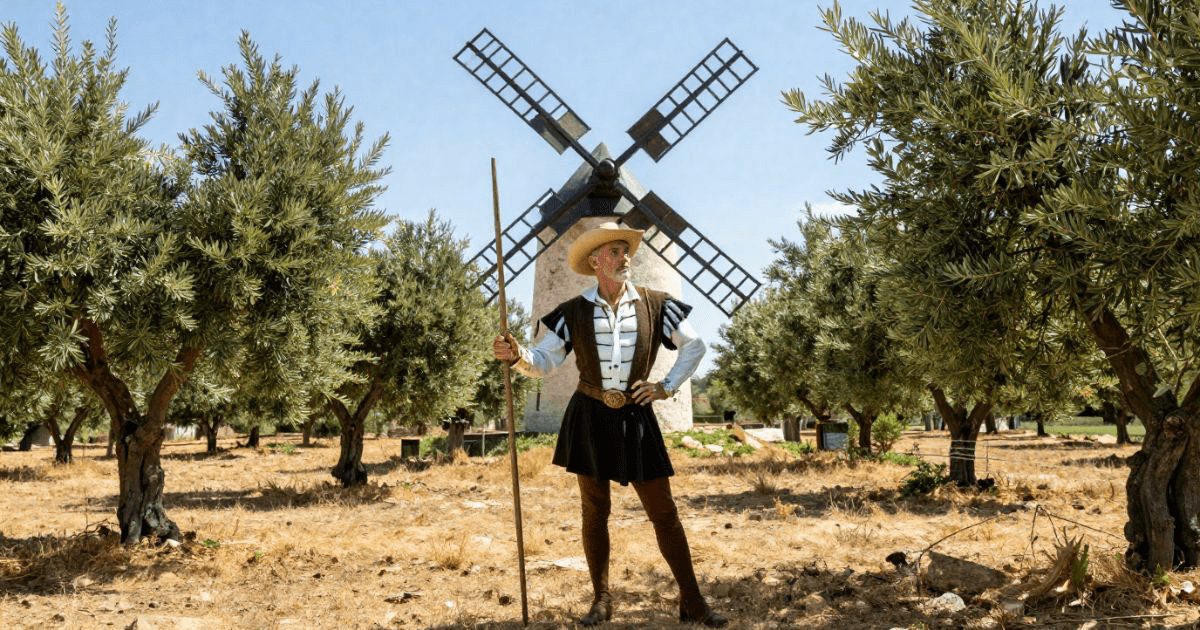
Thirty windmills become giants. Quixote charges, shatters his lance, and blames the enchanter Friston for stealing his glory. A barber's basin becomes Mambrino's helmet next, because once the world can be renamed, anything can. He frees a chain of galley slaves in the name of liberty; they stone him and steal the basin. In the Sierra Morena he performs a mad penance for Dulcinea, and the priest and the barber bring him home in an ox-cart cage. Part I closes there. Part II, published in 1615, opens on a man who is already famous. Sancho "enchants" a peasant girl rather than admit Dulcinea is not there. The Duke and Duchess stage Merlin's lashes, the wooden horse Clavileño, and a fake island called Barataria that Sancho governs well until the joke collapses. On a Barcelona beach the Knight of the White Moon, Carrasco in disguise, hurls Quixote and Rocinante to the earth and binds him to a year without adventures. Quixote keeps Dulcinea's honour and loses the road.
Cervantes wrote Don Quixote to bury the books of chivalry and invented the modern novel while doing it. The hero meets readers of his own first part. A rival sequel appears on the road, and Cervantes kills his knight so no false author can revive him. After the defeat a fever takes him. He wakes lucid, renounces Don Quixote of La Mancha for Alonso Quixano the Good, clears Sancho's accounts, and dies in his bed. Sancho begs him to live and take to the fields as shepherds. Quixote answers that in last year's nests there are no birds this year. The ending is not a verdict on madness. It is the cost of living inside a story until the story is the only country left.
The books cannot be allowed to be wrong, and Detecting Story-Driven Delusion starts on that first night of reading. Windmills, beatings, and a cage never revise him, because a story that makes you necessary will keep explaining the bruises until you need the story more than you need the road. Sancho names hunger while Quixote names giants, and Balancing Idealism and Pragmatism is the novel holding both names at once instead of picking a winner. That same filter turns an inn into a castle and a basin into a helmet, which is Reading Appearance vs Reality: the damage is in the renaming, not in the object. Sancho stays through ridicule and an island that arrives as a joke, and Loyal Friendship Under Absurdity is what keeps the quest going longer than it should. The galley slaves, freed in the name of liberty, stone the man who cut their chains; When Noble Intentions Miss the Target is the moment the script matters more than the people in front of him. Part II then puts him on a stage other people have already read, and Living Inside a Narrative is the Duke turning the quest into house entertainment the moment fame arrives.
The back door is still the only way out of the study. One hundred twenty-six chapters later, on a Barcelona beach, the Knight of the White Moon takes the road from him, and the last thing he can still give Sancho is a proverb about empty nests. Wide Reads has summaries, quotes, and audio on every chapter, from the rusted armour to the fever that returned him his name.
Why this matters
People still meet Quixote's trap in smaller rooms: a story that makes you necessary and keeps explaining the bruises, an audience that has already read the plot and starts writing scenes for you, an intervention that argues inside the delusion and only adds a scene. Cervantes does not mock this from a safe distance. He built the modern novel out of the gap between the heroic life he wanted and the clerking jobs his real one kept handing him. This guide keeps that argument tied to the windmills, the basin, Barataria, and the Barcelona beach.
Prestige deep dive
A Psychological Reading of Don Quixote
Don Quixote shows a man who authors a self from books, then treats every bruise as proof rather than as a reason to give the story back.
- The Wound Is a Life Without a Plot
- He Authors a Self and Then Has to Believe It
- Dulcinea Has to Stay Unmet
Theme breakdowns
Explore the lessons
Don Quixote is a case about a story that refuses to lose an argument with the facts: a hidalgo who polishes rusted armour and rides out the back door, a windmill that becomes a giant and a beating that becomes sabotage, a squire who names hunger while his master names glory and stays anyway, and a Duke and Duchess who read the same book and turn a man's whole life into house entertainment before a fever finally makes him sane and takes him from the only country he had left.
Each card traces a pattern through named chapters — summaries, quotes, and key insights tied to the scenes that prove it. Start with the featured lessons, then open the deep dives below.
Deep dives
Chapter-by-chapter breakdowns
Reading Appearance vs Reality
Track how Quixote turns inns into castles and ordinary life into enchantment, and ask what your own filters add.
Loyal Friendship Under Absurdity
Learn from Sancho's willingness to stay with Quixote through ridicule, beatings, and promises that never arrive on schedule.
Continue Exploring
Guides, life skills, and the full library.More ways to read Don Quixote: guides, life skills, and the wider library.