
A Life Too Small for the Story It Needs
Don Quixote is remembered as a joke about a madman and windmills. Its psychological core is sterner. A gentleman bordering on fifty, with a lance, a lean hack, and an income that barely covers lentils, finds that ordinary days cannot hold a self he is willing to inhabit. Chivalry books supply a finished plot. He does not drift into knighthood. He authors a name, a horse, and a lady, then spends two volumes defending that authorship against every fact that would shrink it. The book asks what a person will do when the story that makes life bearable starts losing arguments with the road.
The Wound Is a Life Without a Plot
The originating anxiety is not a childhood scene. It is emptiness with a timetable. Alonso Quixano keeps a greyhound, a housekeeper, a niece, and a diet the narrator can list. Little sleep and too much reading dry his brains until he loses his wits. That sentence is a medical joke and a name for hunger. He sells tillage land for more volumes and ranks a fictional knight above the Cid, because a story still has work for him and history does not.
Narrative identity fits this opening better than a diagnosis. Quixano is not short of food. He is short of a role large enough for his remaining years. The romances answer with a kit: a quest, a lady, enemies, and fame. Cervantes lets that project arrive fully costumed, then sends it out the back door before dawn.
The first sally already shows the bargain. An innkeeper dubs him as mockery, and Quixote receives it as sacrament. A self built from books can survive ridicule. It cannot survive a gap in the ritual.
He Authors a Self and Then Has to Believe It
Before he meets a giant he rehearses one. In his own mind he is already crowned Emperor of Trebizond. He cleans rusted armour, builds a pasteboard helmet, and spends days naming. Don Quixote, Rocinante, Dulcinea del Toboso: the titles come first, and the history is expected to catch up. That order is the book's picture of how a defended self works. You do not discover who you are and then announce it. You announce a part, then treat every later event as proof that the announcement was accurate.
Cognitive dissonance names the pressure that follows. Once the name is public, even if the public is only a niece and a hack, contradictory evidence becomes expensive. A basin that is only a basin threatens more than pride. It threatens the continuity of the person who required it to be Mambrino's helmet. Quixote's stubbornness is therefore not a side trait. It is maintenance. The story has hired him, and unemployment would mean going back to the lentils without a plot.
He also scripts other people before they speak. Aldonza Lorenzo never asked to be a lady. Innkeepers, muleteers, and galley slaves are cast as they walk into frame. Refusal then looks like enchantment rather than a fact. If everyone is already in the book, no one can surprise him into being ordinary.
Dulcinea Has to Stay Unmet
Dulcinea is the cleanest case of idealization in the novel because almost nothing about her is allowed to be specific. A farm girl from Toboso is raised into a princess who never appears on her own terms. Quixote can describe her perfections at length and still not produce her. Absence is not a delay in the plot. It is the condition of the plot. A lady who answered back could refuse the title, laugh, or ask him to go home. A blank cannot.
Object-relations language is useful here if it stays modest. Idealization protects the lover from the mixed reality of an actual person. Quixote does not want a relationship that could disappoint him. He wants a fixed star that justifies beatings. When later scenes offer him a coarse peasant woman and call her the enchanted Dulcinea, he is wretched in a precise way. The enchantment lets him keep the ideal and explain the smell. He would rather believe she has been stolen from her own beauty than believe he invented the beauty.
Sancho learns he can feed the knight with reports of her. The lady becomes a shared fiction: one man needs her perfect, the other needs the need to continue. Idealization, once it requires a collaborator, becomes a household task.
Sancho Keeps Two Ledgers Open
Sancho is not the reality principle in a peasant coat. He is a man who can name a windmill and still stay on the road for an island. The promise of governing Barataria is the fantasy's wage. He wants the reward structure of the romance without surrendering his proverbs, his hunger, or his fear. Double bookkeeping is his defence. One ledger records what his eyes report. The other records what the job requires him to say if the salary is ever to arrive.
That split makes him the book's most psychologically complete figure. He kneels for the island after a beating. He warns Quixote and then rides with him anyway. In Part II he governs the sham island with a practical mercy that surprises the people staging him, then walks away when the joke turns into war-drums and hunger. He is capable of leaving a story once he has tried the chair. Quixote is not. The difference is not intelligence. It is how much of the self was stored in the title.
At the deathbed the ledgers collapse into one plea. Sancho weeps and asks him to live, to get up, to try the fields in shepherd's dress. The companion who spent the book puncturing the plot cannot bear the plot's cancellation. He has been paid, in part, in companionship. When Quixote answers that in last year's nests there are no birds this year, Sancho is the one still trying to stock them. The ending's grief belongs as much to the squire as to the knight.
Enchantment Is How a Bruise Becomes Proof
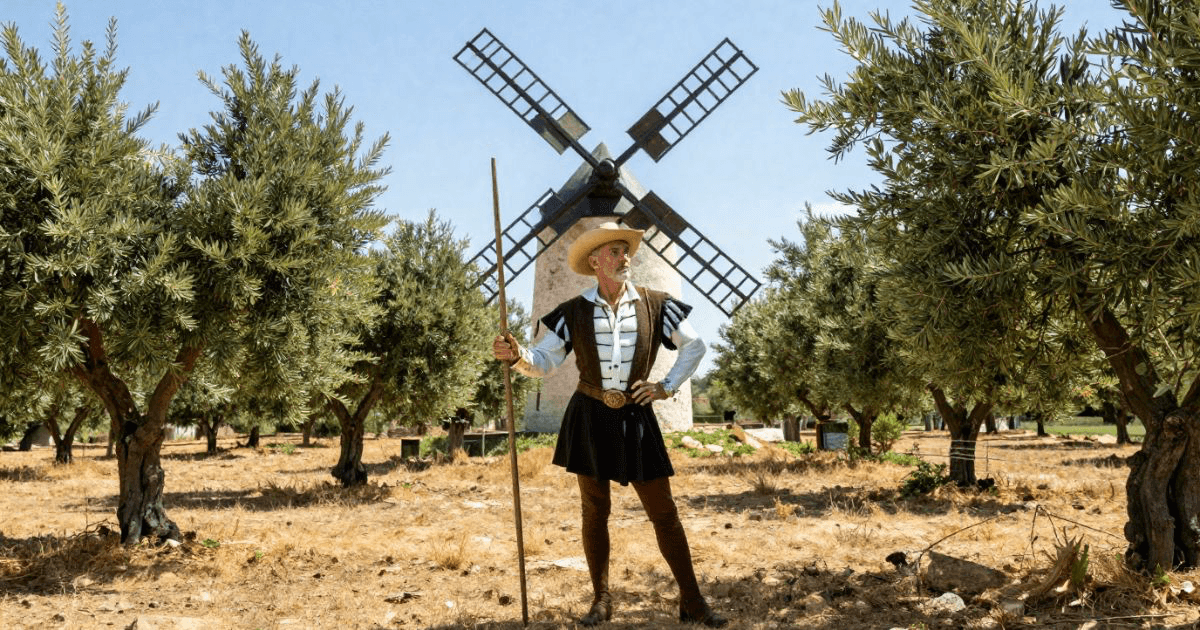
The windmills are the popular scene because they show the method in one charge. Sancho says they are mills. Quixote says they are giants. After the fall, Friston, or whatever enchanter is on duty, has transformed the giants to steal the glory. The bruise is not data. It is sabotage. Cognitive dissonance would predict exactly this repair: when an action fails, the believer changes the meaning of the evidence rather than the belief that made the action necessary.
The same repair runs through the basin, the flocks that bleat, the galley slaves who do not wish to be freed, and the blanketing at the inn. Each collision could revise him. Instead each collision extends the staff of unseen enemies. Enchantment is a brilliant defence because it cannot be falsified. Any witness who disagrees has already been got at. Any object that looks ordinary was ordinary only a moment ago. The theory eats the test.
There is a cost, and Cervantes keeps presenting the bill in other people's bodies. Freed prisoners attack their liberator. Shepherds and yanguesans answer a charge with sticks. The knight's need to be necessary is not a private theatre. It recruits bystanders into scenes they did not audition for. A psychological reading that stays inside Quixote's nobility misses that. The defence soothes him by spending other people.
The People Who Love Him Feed the Plot
The curate, the barber, the niece, and the housekeeper try the obvious cure. They burn and wall up the library. They invent a flying magician so he will stop looking for the missing room. He does not collapse. He corrects the magician's name and supplies the motive: an enemy who already knows the future contest. Care, offered inside his logic, becomes the next chapter. The intervention proves the enchanter it was meant to replace.
Later they haul him home in a cage, staged as enchantment so he will accept it. If the people closest to him must speak his cosmology to move him, love has joined the dialect or lost the conversation.
The Sierra Morena penance makes the adaptation explicit. He decides to go mad because Amadís did, and he tells Sancho he will stay mad until a letter returns from a lady who does not exist. The fit is a genre requirement he can describe. That is more unsettling than a seizure. A delusion that knows its template can recruit help, correspondence, and an audience. Sanity, from inside the template, looks like a missed cue.
The Deathbed Gives the Name Back
After the defeat a fever keeps him in bed for six days. Friends offer pastoral sequels, dogs, an eclogue. He wakes and renounces the part. He was Don Quixote of La Mancha. He is Alonso Quixano the Good. Amadís and the whole troop of descendants are now odious to him. He calls the books the peril that took his senses, makes a will, clears Sancho's accounts, and forbids his niece to marry a man who knows chivalry. Samson still suspects another craze. Even the lucidity has to argue with an audience trained to expect performance.
The sentence that closes the project is the proverb he gives Sancho: in last year's nests there are no birds this year. He was mad, he says, and now he is in his senses. Read one way, this is cure, repentance, and a Christian death that restores the name Good. Read another, it is suppression. The tension is not integrated. The story is fired, and the man who needed the story does not survive the firing by more than a few pages. Sanity arrives as the loss of plot. The book does not show him living a quiet year as Quixano. It shows him dying in the honesty of the return.
Cide Hamete's pen then warns other writers off. The knight is to be allowed to rest. That last gesture admits how strong the appetite to continue him remains, in Sancho, in Samson, in Avellaneda, in us. The ending resolves the chivalric errand by taking away the errant. It does not resolve the hunger that hired him. It only refuses to feed it again.
Why It Resonates Now
Modern readers live among finished plots that offer a self before the week has earned one. A cause, a workplace myth, or a private theory of enemies can do what the chivalry shelf did: make an ordinary life feel necessary and already authored. When the facts bruise that story, the cheap repair is still enchantment. The meeting was sabotaged. The basin was a helmet a moment ago. Quixote is current because a defence can look intelligent from inside the role.
Part II feels least antique. To be known through a version of yourself that other people stage and continue is ordinary now. The unease is not that Quixote dreamed. It is that a public dream recruits help, mockery, and false sequels, and that stepping out of it can feel like dying.
Limits of This Reading
This reading risks turning a comic epic into a case. Cervantes wrote a satire on books of chivalry, a tour of Spanish voices, and a machine for episodes. Much of the energy is joke, proverb, and inserted tale, not inner wound. The Curious Impertinent, the captive's story, and the debates on fiction have their own claims. A psychological frame that keeps returning to Quixote's hunger will underplay how often the book simply wants to talk.
Historical caution matters as much. Seventeenth-century ideas of madness, honour, and literary fashion are not cognitive dissonance or narrative identity. Those are later tools. They can slow a scene we think we already know. They cannot replace the book's own argument about reading, belief, and the danger of taking romances for histories. Quixote's deathbed piety will not sit quietly inside a secular story of suppressed meaning. For many readers the return to Alonso Quixano the Good is the point, not a loss. Sancho's governorship can also be read as a political joke about judgment, not as a psyche closing a ledger. Both readings should stay available.
Across the Shelf
Frankenstein is the nearest neighbour, though the materials differ. Victor authors a body and cannot live with what answers. Quixote authors a self and cannot live long once the self is taken back. In both books the making is the meaning, and the world's reply is experienced as betrayal rather than as information. Mary Shelley's maker wants to be acquitted. Cervantes's knight, at the last, wants the false continuations stopped. Read together, they suggest that a created life, whether flesh or title, does not stay the maker's private sentence. Other hands finish it, and the original author meets that fact as horror, as farce, or as both.