
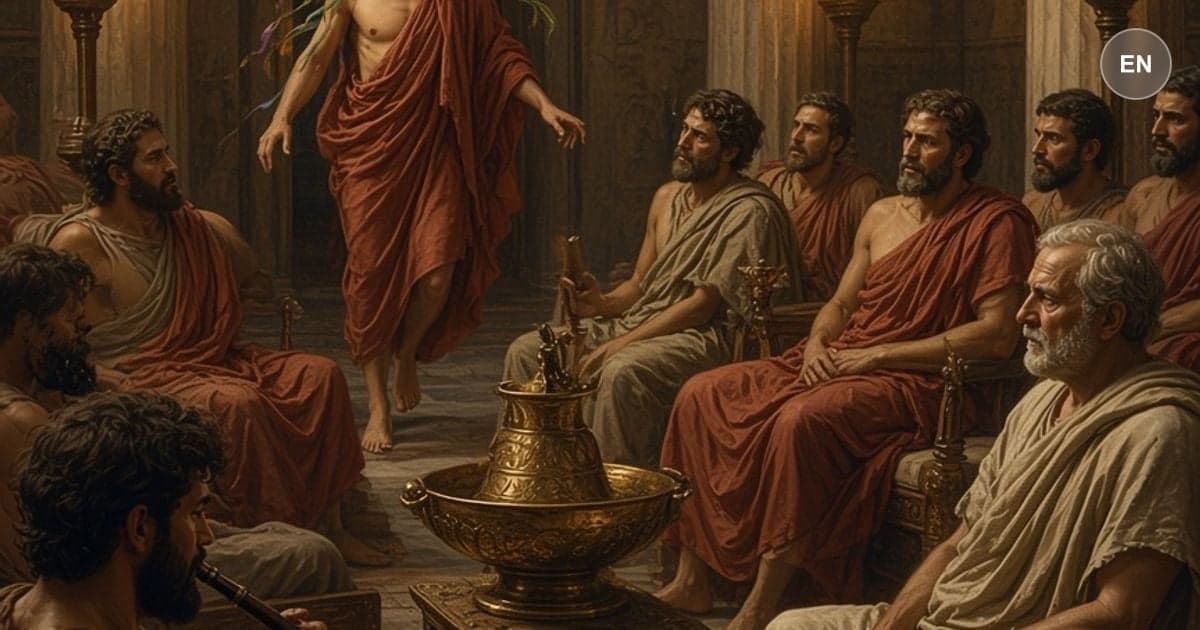
Diotima does not stop at the spirit in the gap. Mortals want the good forever, and forever, for a body that dies, means generation. They bring to birth in beauty: children, poems, laws. Cities raise temples for Solon and Lycurgus because of those works, not for the sake of mortal children. The chapter stops on that honour. A further step has not yet been named.
The next speech names it. These are the lesser mysteries. The lover starts with one beautiful body and is not meant to stay there. Beautiful practices, beautiful souls, then the vast sea of beauty. The person who treats one face as the whole has climbed the first rung and called it the shore.
Alcibiades is the proof in the room. He wants Socrates and offers everything he has. Socrates will not be possessed. A gift, a night, a prize of valour pushed back: none of it converts the teacher into property. Climbing past possession means the want can be real and the ownership can still be refused.
The Central Lesson
Diotima says mortals hold the good by bringing it to birth in beauty, and that temples are raised for those works, not for the sake of mortal children. She then names the lesser mysteries and a climb toward the vast sea of beauty, past one body and one face. Alcibiades arrives to show the opposite mistake in the flesh: he wants Socrates, offers everything, and does not get him. The ladder is not a way to own the beloved more completely. It is a way to stop treating ownership as the point.
Applying This to Your Life
Ask What Is Trying to Be Born
Diotima treats lasting possession as generation in beauty, not as keeping a person. If a want produces only a claim on someone, it has not yet asked what work, law, or care it is trying to bring to birth.
Do Not Stop at One Face
The ladder begins with one beautiful body. It does not end there. When a single person is asked to be the whole of beauty, the climb has been renamed as a possession.
Hear the No That Money Cannot Buy
Alcibiades offers himself and his fortune. Socrates will not trade. Adding a larger gift does not change a refusal. Learn that before experience has to teach it.
Other lessons in this book
More life-skill deep dives from the same classic.
Hearing a Story at Second Hand
What Seemed Worth Remembering
Follow Apollodorus on the road from Phalerum, and the half-asleep witness at dawn, and name who was in the room.
3 chapters·Explore AnalysisLove That Asks for Courage
Bare Feet on the Ice
Sit with Phaedrus on Alcestis, Orpheus, and Achilles, then with Alcibiades on the ice at Potidaea.
2 chapters·Explore AnalysisThe Missing Half
Like a Flat Fish
Stay with Aristophanes' cut, then with the speeches that will not let that myth be the last word.
3 chapters·Explore AnalysisTwo Kinds of Desire
Two Goddesses, Two Loves
Hear Pausanias refuse a single Love, then watch Eryximachus carry the split into the body and the seasons.
2 chapters·Explore AnalysisWanting What You Lack
Socrates Is Easily Refuted
Watch Agathon's praise fail one question, then hear Diotima refuse to call Love a god.
3 chapters·Explore Analysis
Continue exploring
Explore this theme
The same lessons in other books
See how other books teach the same life skills.
The Idiot
Maintaining Goodness Without NaivetySit with Myshkin on the train in chapter 1: honesty with no angle, and a city that can only call it idiocy.
Northanger Abbey
Separating Fiction from RealityStop letting Gothic plots supply the story: laundry bills become clues, an old abbey becomes a crime scene, and real cruelty arrives without a villain's mask.
The Blue Castle
Building a Life of Your OwnLeave Elm Street for Mistawis, lock a house that is yours, and keep the Blue Castle after the excuse to live is withdrawn.
Where the lesson lives in the book
Diotima on Birth in Beauty
Love wants the everlasting possession of the good, and mortals can hold that only by generation. They bring to birth in beauty, whether children of the body or children of the soul: poems, laws, and the honour later cities give Solon and Lycurgus. Temples are raised for those works, not for the sake of anyone's mortal children. She has not yet named a further step.
Key Insight:
Possession that lasts, for a mortal, is not keeping one person. It is bringing something to birth that outlasts the body.
“which were never raised in honour of any one, for the sake of his mortal children.”
Diotima's Ladder
This speech opens on the lesser mysteries. The climb begins with one beautiful body, then beautiful bodies, then beautiful souls and practices, until the lover contemplates the vast sea of beauty and, on that shore, a beauty that does not come and go. Socrates offers the encomium to Phaedrus. The ladder is the correction of stopping at one face.
Key Insight:
One beloved person can be a true beginning. Treating that person as the whole of beauty is where the climb stops too soon.
“contemplating the vast sea of beauty”
Alcibiades Praises Socrates
Alcibiades crowns Agathon with the ribands held in front of his eyes, then finds Socrates already on the couch. He offers himself, his friends, and his fortune for help toward virtue. Socrates will not make the trade. The morning is not a purchase. He warns Agathon not to be a fool and learn by experience.
Key Insight:
A larger gift does not buy a no that was never for sale. Love that tries to own the teacher has mistaken the ladder for a transaction.
“do not be a fool and learn by experience, as the proverb says.”