Diotima calls the teaching she has just given the lesser mysteries of love, which even Socrates may enter. The greater and more hidden ones crown those. If he pursues them in the right spirit, they will lead him on. She does not know whether he can attain them. She will do her utmost. He must follow if he can. The right path begins in youth. Guided well, the lover visits beautiful forms and loves one form only, and from that love he creates fair thoughts. He then sees that the beauty of one form is akin to the beauty of another, and that the beauty in every form is the same. He loosens his violent love of the one, treats it as a small thing, and becomes a lover of all beautiful forms.
The next stage sets the beauty of the mind above the beauty of the outward form. A virtuous soul with little comeliness is enough to love and tend. He brings thoughts to birth that may improve the young, until he is compelled to see the beauty of institutions and laws, and to see that their beauty is of one family, while personal beauty is a trifle. After laws he goes on to the sciences. He is no longer a servant in love with one youth or one institution. He draws towards the vast sea of beauty and creates many fair thoughts in a boundless love of wisdom. At last a single science opens: the science of beauty everywhere.
Near the end he suddenly perceives a nature of wondrous beauty, and she calls that nature the final cause of the earlier toil. It does not grow or decay. It is not fair in one view and foul in another. It is not a face, or hands, or a speech, or a piece of knowledge, or an animal, or a place in heaven or on earth. It is beauty absolute, separate, simple, and everlasting, given without change to beauties that come and go. The true order starts from the beauties of earth and mounts for the sake of that other beauty, using the earlier ones as steps only: from one to two, from two to all fair forms, from fair forms to fair practices, from fair practices to fair notions, and from fair notions to the notion of absolute beauty, until he knows what the essence of beauty is. That life, she says, is the one a person should live. Gold, garments, and fair youths would not be the measure of it. Communion with that beauty, seen by the eye of the mind, lets a person bring forth realities rather than images, nourish true virtue, become the friend of God, and be immortal if a mortal may. Socrates tells Phaedrus, and the whole company, that these were her words. He is persuaded, and he tries to persuade others that love is the best helper towards this end. Every man, he says, ought to honour Love and walk in his ways. He offers the speech to Phaedrus as an encomium of love, or under any other name Phaedrus prefers.
Coming Up in Chapter 11
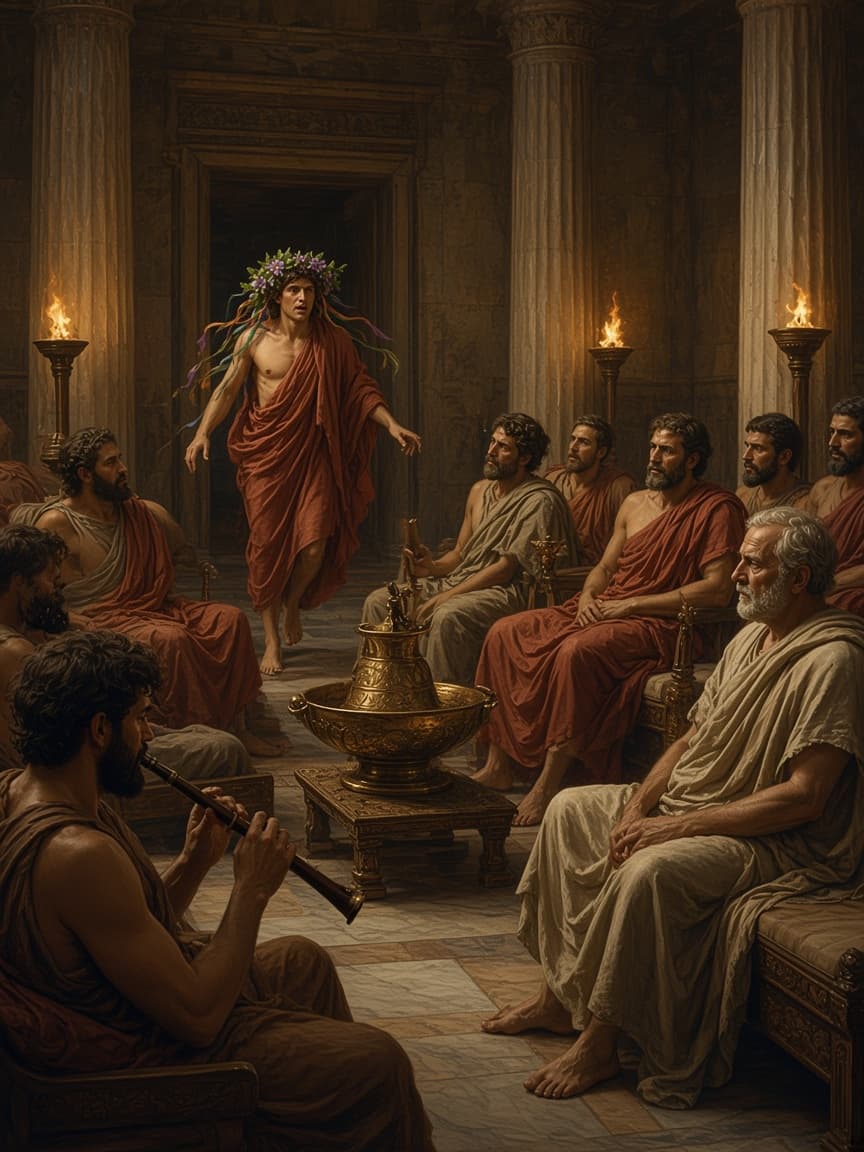
Applause will barely settle before a great knocking and a flute-girl interrupt the house. Alcibiades will arrive drunk, crowned with ivy and violets, shouting for Agathon. He will sit between Agathon and Socrates without seeing him, then start up when he finds Socrates lying in wait on the couch.