
Lessons
Lessons from Symposium
Six lessons from this classic work, traced chapter by chapter.
0:00 / 0:00
Apollodorus is stopped on the road from Phalerum and asked for the speeches at a supper he did not attend. Two days earlier Glaucon had already asked, and that version, passed through Phoenix, was muddled. The witness was Aristodemus, a small man who never wore shoes, and he fell asleep before the end. Plato's Symposium is that report: a night at the tragic poet Agathon's house, the day after Agathon won his first prize, retold by a man who heard it from a man who was not fully awake. The sentence later ages quote arrives in the middle of the night. The dialogue spends the rest of the evening refusing to let that sentence finish the argument.
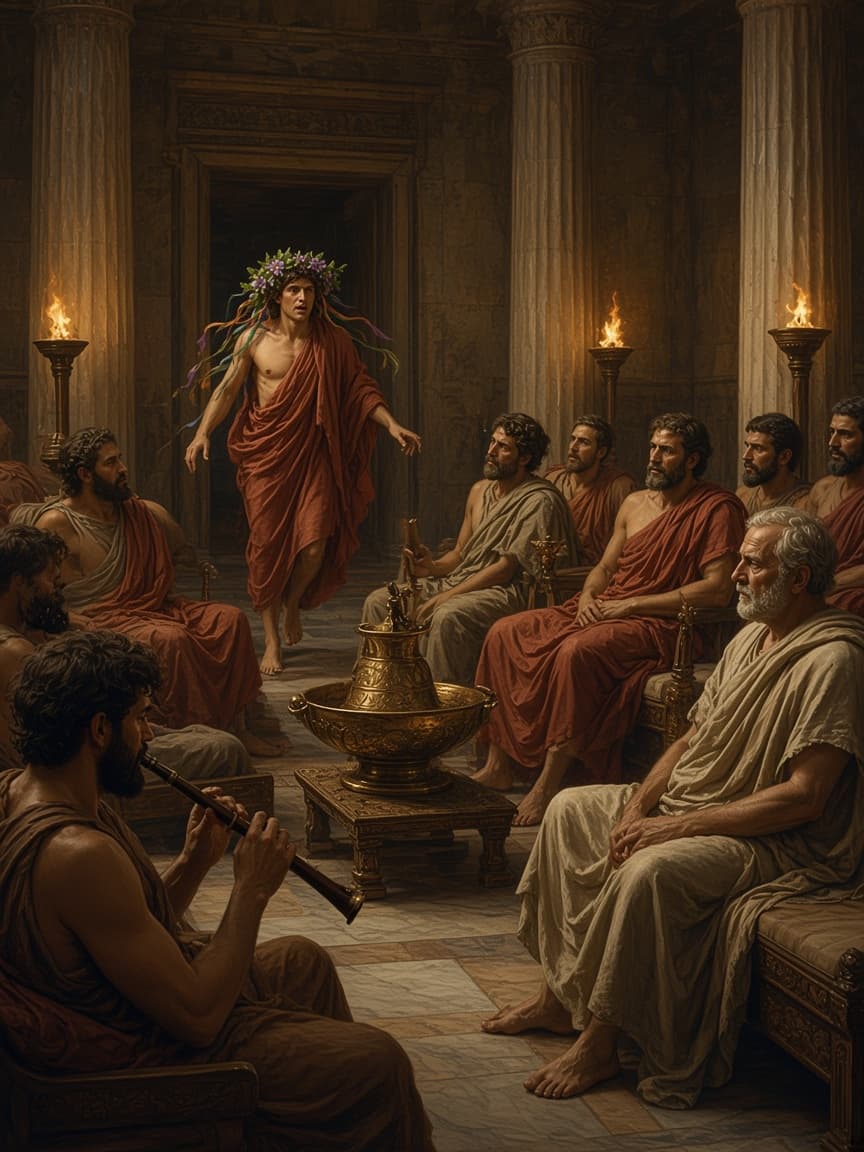
The case has more voices than the proverb keeps. Phaedrus wants Love praised as the eldest god and the source of courage, and he brings Alcestis, Orpheus, and Achilles. Pausanias will not allow one Love: a common desire wants the body, a heavenly desire wants the soul and lasts. Eryximachus, the physician, finds that split in medicine, in music, and in the seasons. Aristophanes, recovered from a hiccough that delayed his turn, tells of people cut in two, still searching for the other half. Agathon, the host, praises the god himself as young, fair, and the cause of every virtue. Socrates does not add another hymn. He asks whether Love wants what it already has. Diotima of Mantineia is not at the table. She arrives only as a lesson he retells. Alcibiades arrives last, drunk, head flowing with ribands, and crowns Agathon without seeing the man already on the couch beside him.
The night moves by refusals, not by a single definition. The company dismisses hard drinking and sends the flute-girl away, then agrees that each guest, left to right, will praise Love as well as he can. Phaedrus makes Love a dare: an army of lovers would not desert, and a lover would rather die than be seen acting basely. Pausanias refuses a single name for desire, and ties the heavenly kind to a lasting care for the soul. Eryximachus carries the split out of the bedroom and into the body of the world. Aristophanes makes the cut so vivid that the rest of the book has to answer it: Zeus slices the old double people like an egg divided with a hair, Apollo turns the faces, and the navel is left as a memorial. Agathon's praise is the hinge. He has described Love as already complete, and Socrates shows that desire wants what it lacks. Diotima answers that Love is not a god but a great spirit, child of Plenty and Poverty, always in the gap. She then says mortals bear children in beauty, and that a soul can climb from one beautiful body toward a beauty that does not come and go. Alcibiades breaks the order with a speech that is also a confession: he wanted Socrates, and Socrates would not be possessed. At dawn the others are asleep or gone, and Socrates is still claiming that the genius of comedy and the genius of tragedy are the same.
Plato wrote the dialogue in the years after the trial and the death. He does not award the prize to one speech. He lets each case stand at full length, including the myth later ages quote as if it were the book. The frame is already a warning about that habit. Apollodorus admits he will keep only what seemed worth remembering, and what the chief speakers said. Aristodemus does not recollect all that was said. The ending is not a verdict. It is a room that will not close on the sentence people came prepared to hear, and a last claim the two poets are too drowsy to follow.
The pressure starts with a story that has already changed hands. Hearing a Story at Second Hand is Apollodorus on the road from Phalerum, and it is the witness who slept before dawn: the listener still has to name who was in the room. Love That Asks for Courage is Phaedrus on Alcestis, Orpheus, and Achilles, then Alcibiades on the ice at Potidaea, where Socrates marched with bare feet in a severe frost and pushed the prize of valour back. Two Kinds of Desire is Pausanias refusing one Love, then Eryximachus finding the common and the heavenly in the body and the seasons. The Missing Half is the cut Aristophanes makes so memorable that it becomes the proverb the later speeches will not leave standing. Wanting What You Lack is the question that stops Agathon, and Diotima's refusal to call Love a god. Climbing Past Possession is the ladder she names after the lesser mysteries, and Alcibiades, who wanted Socrates and did not get him. One night, and the proverb is not allowed to finish it.
Wide Reads follows the twelve speeches with summaries, quotes, and audio. The image to keep is not the other half. It is Alcibiades at the door, holding the ribands in front of his eyes, crowning Agathon, and sitting down beside Socrates without seeing him.
Why this matters
People still open this dialogue after they have quoted the missing half and treated that proverb as the book. Plato lets Aristophanes charm the room, then spends the rest of the night against the habit of stopping there. This guide keeps that pressure tied to the second-hand report in chapter 1, the question that stops Agathon in chapter 7, the ladder in chapter 10, and Alcibiades at the door in chapter 11.
Theme breakdowns
Explore the lessons
Symposium is Plato's account of a victory supper in 416 BC that a man who was not there repeats years later: guests send the flute-girl away and praise Love in turn, Aristophanes tells of people cut in two and still searching for the other half, Agathon praises Love as already complete, and Socrates shows that desire wants what it lacks, until Diotima of Mantineia names Love a spirit born of Plenty and Poverty and a ladder past owning one beautiful body, and Alcibiades arrives with ribands, holds them in front of his eyes, crowns the host, and confesses he could not possess the man on the couch.
Each card traces a pattern through named chapters — summaries, quotes, and key insights tied to the scenes that prove it. Start with the featured lessons, then open the deep dives below.
Deep dives
Chapter-by-chapter breakdowns
Two Kinds of Desire
Hear Pausanias refuse a single Love, then watch Eryximachus carry the split into the body and the seasons.
if there were only one Aphrodite there would be only one Love; but as there are two goddesses there must be two…
The Missing Half
Stay with Aristophanes' cut, then with the speeches that will not let that myth be the last word.
Each of us when separated, having one side only, like a flat fish, is but the indenture of a man, and he…
Continue Exploring
Guides, life skills, and the full library.More ways to read Symposium: guides, life skills, and the wider library.