
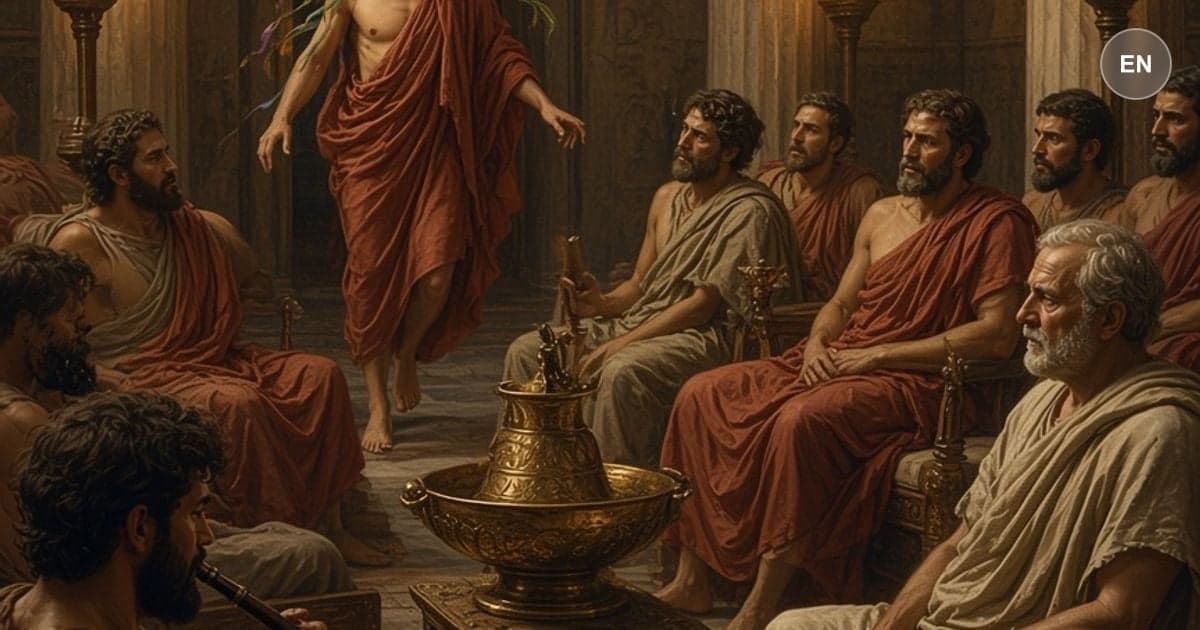
Agathon's speech is the hinge because it is so successful. He refuses to praise only the benefits. He praises the god: young, fair, the cause of virtue. The room has been climbing toward a Love that is already everything it gives. Socrates asks the question that speech cannot survive. Does Love want what it already has?
Agathon cannot refute him. Socrates will not take the win as a personal triumph. He says Socrates is easily refuted. The truth is what Agathon cannot answer. Diotima then keeps Socrates from the cheap next step. If Love is not fair, that does not make Love foul. Love stands in the gap, born of Plenty and Poverty, wanting the everlasting possession of the good.
Wanting is not a defect to hide and not a finished portrait to praise. It is the sign that the good is not yet held. Treat a lack as information. Do not insult it, and do not dress it up as a god who already has everything.
The Central Lesson
Agathon praises Love as young, fair, and the cause of every virtue. Socrates asks whether Love wants what it already has, and Agathon cannot refute the truth. Diotima then refuses the insult that follows: Love is not a god, and not foul, but a spirit born of Plenty and Poverty, the love of the everlasting possession of the good. Desire is the evidence of a lack. The work is to name the lack without calling it either a finished glory or a disgrace.
Applying This to Your Life
Stop Praising the Finished Version
Agathon's toast makes Love already beautiful and good. If your praise describes a want as if it were a completed possession, you have described a gift, not a desire.
Ask What Is Missing
Socrates' question is small and decisive. If someone desires a thing, they do not yet hold it in the way they want. Name the lack before you name the virtue.
Do Not Call the Gap Foul
Diotima tells Socrates to hush. Not fair does not mean foul. A middle state can carry the work. Insulting the want, or worshipping it as already complete, both miss the gap.
Other lessons in this book
More life-skill deep dives from the same classic.
Climbing Past Possession
The Vast Sea of Beauty
Follow birth in beauty and the ladder, then Alcibiades, who wanted Socrates and did not get him.
3 chapters·Explore AnalysisHearing a Story at Second Hand
What Seemed Worth Remembering
Follow Apollodorus on the road from Phalerum, and the half-asleep witness at dawn, and name who was in the room.
3 chapters·Explore AnalysisLove That Asks for Courage
Bare Feet on the Ice
Sit with Phaedrus on Alcestis, Orpheus, and Achilles, then with Alcibiades on the ice at Potidaea.
2 chapters·Explore AnalysisThe Missing Half
Like a Flat Fish
Stay with Aristophanes' cut, then with the speeches that will not let that myth be the last word.
3 chapters·Explore AnalysisTwo Kinds of Desire
Two Goddesses, Two Loves
Hear Pausanias refuse a single Love, then watch Eryximachus carry the split into the body and the seasons.
2 chapters·Explore Analysis
Continue exploring
Explore this theme
The same lessons in other books
See how other books teach the same life skills.
The Idiot
Maintaining Goodness Without NaivetySit with Myshkin on the train in chapter 1: honesty with no angle, and a city that can only call it idiocy.
Northanger Abbey
Separating Fiction from RealityStop letting Gothic plots supply the story: laundry bills become clues, an old abbey becomes a crime scene, and real cruelty arrives without a villain's mask.
The Blue Castle
Building a Life of Your OwnLeave Elm Street for Mistawis, lock a house that is yours, and keep the Blue Castle after the excuse to live is withdrawn.
Where the lesson lives in the book
Agathon Praises the God Himself
Agathon says the earlier speakers praised the benefits of Love and forgot the god. He praises Love as young, fair, delicate, and the cause of every virtue. The speech is half playful and still dedicated to the god. It leaves Love already complete: beautiful, good, and not in want of the things he is said to give.
Key Insight:
A portrait of a finished god cannot explain desire. Agathon has praised the gift as if the giver already held everything the gift is for.
“Such is the speech, Phaedrus, half-playful, yet having a certain measure of seriousness, which, according to my ability, I dedicate to the god.”
Socrates Shows Love Wants What It Lacks
Socrates does not add another praise. He asks Agathon whether Love desires what it already possesses. The good is also the beautiful. Wanting the beautiful, Love wants the good. Agathon says he cannot refute Socrates. Socrates answers that Agathon cannot refute the truth, for Socrates is easily refuted.
Key Insight:
The hinge of the night is one question. If Love is already fair and good, it does not want what Agathon spent the speech giving it.
“Say rather, beloved Agathon, that you cannot refute the truth; for Socrates is easily refuted.”
Diotima Says Love Is Not a God
Socrates retells Diotima. He had called Love a mighty god, and fair. She proved Love is neither fair nor good, and told him to hush when he asked if Love was therefore foul. Love is a great spirit between god and mortal, child of Plenty and Poverty. The speech ends on a general description: love is the love of the everlasting possession of the good.
Key Insight:
A lack is not an insult. Diotima refuses both poles: not a god who already has the good, and not something foul because it wants.
“the love of the everlasting possession of the good”