
The Grapes of Wrath

John Steinbeck
Tom Joad walks out of prison into an Oklahoma that is blowing away. The dust has come, the bank has come, and the tractors are coming next. Steinbeck published the novel in 1939, at the height of the Depression and the Dust Bowl migration, and it became both a Pulitzer winner and a target of bans. The Joads are not symbols who learn a tidy lesson. They are a family trying to stay human while the country treats them as surplus.
Tom Joad is the son returning from McAlester after killing a man in a fight. Ma Joad is the center who will not let the family break. Pa Joad loses authority as the road takes over. Jim Casy is the former preacher who stops preaching and starts asking what holiness means beside hungry people. Rose of Sharon carries a pregnancy toward a California that may not want her baby. Connie Rivers is the young husband who cannot survive the shame of failure. Al Joad tends the truck like it is the family's last organ. Uncle John carries guilt like luggage. Grampa and Granma die on the way west.
The novel opens with dust and a turtle, then follows the Joads from a yard sale in Oklahoma to Route 66, from Hooverville to the Weedpatch camp where migrants govern themselves, from peach picking at starvation wages to a strike where Casy is killed and Tom is marked. Rose of Sharon's baby is born dead in a flood. The book ends not with triumph but with an act of care so stark it refuses comfort: a starving stranger nursed by a woman who has lost everything except her body as shelter.
Steinbeck alternates the Joad family's story with intercalary chapters that widen the lens: landowners, gas stations, rotting fruit, the machinery of plenty that excludes the people who pick it. He never treats poverty as a personal moral failure, or migration as adventure, or violence against organizers as an accident.
Holding a Family Together Under Displacement is Ma keeping the unit moving when Pa falters. Recognizing Systemic Economic Violence is tractors, company stores, and fruit left to rot while workers starve. Building Solidarity When Power Divides You is Weedpatch, the strike, and strangers sharing the road west. Keeping Dignity When Institutions Fail is the diner kindness and camp committees. When Private Anger Must Become Collective Action is Tom after Casy's death. Caring for the Vulnerable When Resources Run Out is Rose of Sharon at the end.
The turtle crosses the road. The family crosses a continent. Wide Reads posts summaries, quotes, and audio on all thirty chapters, from Oklahoma dust to the flood where mercy becomes the only harvest left.
The Essential Truths through The Grapes of Wrath
Life skills and patterns this book helps you develop—drawn from its themes and characters.
Holding a Family Together Under Displacement
Follow Ma Joad keeping the unit moving when Pa falters and every breakdown threatens to split them.
Recognizing Systemic Economic Violence
See tractors, company stores, and fruit left to rot while workers starve beside the fields.
Building Solidarity When Power Divides You
Watch Weedpatch self-government, the strike, and strangers sharing the road west.
Keeping Dignity When Institutions Fail
Notice diner kindness, camp committees, and the refusal to be treated as less than human.
When Private Anger Must Become Collective Action
Track Tom after Casy's death, carrying forward what one man cannot finish alone.
Caring for the Vulnerable When Resources Run Out
End with Rose of Sharon giving what the system would not when the flood takes everything else.
Table of Contents
Oklahoma Drought and the Turtle
Oklahoma is dying. The rain stopped coming, the topsoil dried to powder, and now the wind carries it...
Tom Joad Released from Prison
Tom Joad walks out of McAlester State Prison wearing cheap state-issued clothes and carrying almost ...
The Turtle's Journey
A turtle crosses a road in the Oklahoma heat. That is the whole plot. But Steinbeck makes it matter ...
Tom Meets Casy at the Joad Home
Tom Joad walks up to his family's farmhouse expecting a hard reunion. What he finds instead is a str...
Tractor Drivers Evict Tenants
A tractor rolls across Oklahoma farmland, and the man driving it is someone the tenant families reco...
Tom Finds Muley Graves
Out in the dark Oklahoma fields, Tom and Casy stumble onto something unexpected: a neighbor who neve...
Used Car Salesmen
Somewhere between leaving and arriving, there is a used car lot. This chapter steps away from the Jo...
Tom Reunites with the Joads
Tom Joad walks back into his family's life just as that life is being packed into boxes and loaded o...
The Yard Sale
Across the farm country of Oklahoma, families are holding yard sales that look less like commerce an...
Departure from Oklahoma
Before the sun comes up, the Joads are already loading the truck. Chickens, tools, blankets, childre...
Abandoned Farmhouses
Steinbeck pulls the camera back here. Instead of following the Joads down the road, he stops and tur...
Route 66 West
Route 66 is a river of desperation moving west. The Joads join it, their truck loaded past its limit...
Breakdown, Granpa's Death, and Connie
The truck breaks down on a sweltering highway, and the Joads spill out into the heat with their tool...
Roadside Camps and Ma's Leadership
Every night along Route 66, a new village appears. Trucks pull off the road, fires get lit, and stra...
Truck Stop Diner
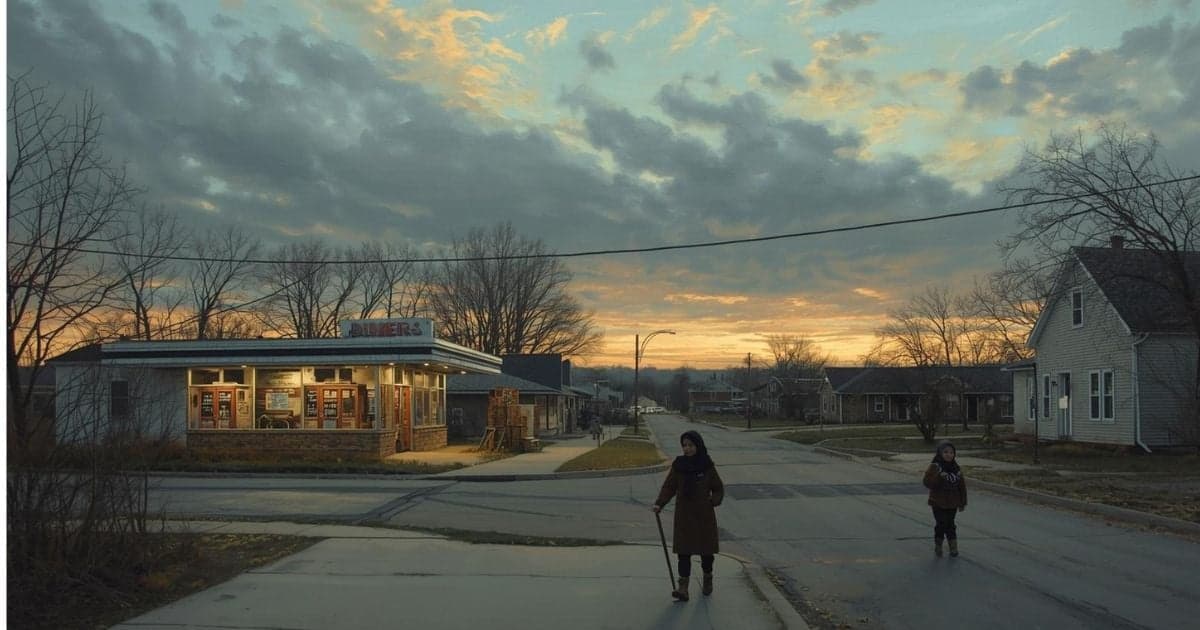
A roadside diner sits along Route 66 like a small island of warmth in an indifferent landscape. Al a...
Arizona Border and Granma's Death
Ma Joad sits beside Granma in the dark cab of the truck as the family crosses the Arizona desert int...
Rules and Community at Roadside Migrant Camps
Every night along the highway, something remarkable happens. Strangers pull their battered vehicles ...
Arizona Federal Camp and Deputies
Near a federal camp on the Arizona border, the Joads get their first real look at how the law works ...
California Landowners and the Migrant Threat
Before the Joads arrive in California, Steinbeck pulls back the curtain on the world waiting for the...
Hooverville Camp, Casy Arrested, Connie Leaves
The Joads pull into Hooverville and the dream curdles on contact. This is not the California of oran...
Waves of Migrants Pour into California
Thousands of families are pouring into California, and the state is not ready for them. Trucks clog ...
Weedpatch Government Camp
After weeks of filth, fear, and being chased off land like animals, the Joads roll into Weedpatch an...
Camp Entertainment Night
For one night at Weedpatch, the music wins. A harmonica starts it, a fiddle joins in, and before lon...
Camp Committee Meeting and Democracy in Practice
Inside the Weedpatch camp, democracy is not a speech or a symbol. It is a raised hand, a dispute ove...
Fruit Rotting While Workers Starve
California is drowning in fruit. The orchards are heavy with oranges. The vineyards are full. The la...
Tom Gets Work at Hooper Ranch Orchard
Hunger is the best recruiter a bad employer ever had. The Joads leave Weedpatch, the one decent plac...
Peach Picking, Low Wages, and the Company Store
Inside the Hooper Ranch fence, the Joads pick peaches from sunup to sundown, their hands raw, their ...
Strike at the Ranch, Casy Killed, Tom Injured
Jim Casy is dead. Tom Joad found him in the dark outside Hooper ranch, not the wandering preacher he...
Boxcar Camp, Flood Rises, Rose of Sharon in Labor
Rain falls without mercy on the boxcar camp, and the Joads are already out of margin. The floodwater...
Rose of Sharon Nurses a Starving Man, Family Moves On
A barn on higher ground. Rain still falling outside. Inside, the Joads find two people who have noth...
Common Questions About The Grapes of Wrath
Trending search questions mapped to the essential truths in this book—what readers actually ask Google about society & class, family dynamics, morality & ethics, and personal growth.
What is The Grapes of Wrath about?
Tom Joad walks out of prison into an Oklahoma that is blowing away. The dust has come, the bank has come, and the tractors are coming next. Steinbeck published the novel in 1939, at the height of the Depression and the Dust Bowl migration, and it became both a Pulitzer winner and a target of bans. The Joads are not symbols who learn a tidy lesson. They are a family trying to stay human while the country treats them as surplus.
What are the main themes in The Grapes of Wrath?
The major themes in The Grapes of Wrath include Solidarity, Dignity, Resilience, Dignity Under Pressure, Displacement. These themes are explored throughout the book's 30 chapters, offering insights into human nature and society that remain relevant today.
Why is The Grapes of Wrath considered a classic?
The Grapes of Wrath by John Steinbeck is considered a classic because it offers timeless insights into society & class and family dynamics. Written in 1939, the book continues to be studied in schools and universities for its literary merit and enduring relevance to modern readers.
How long does it take to read The Grapes of Wrath?
The Grapes of Wrath contains 30 chapters with an estimated total reading time of approximately 3 hours. Individual chapters range from 5-15 minutes each, making it manageable to read in shorter sessions.
Who should read The Grapes of Wrath?
The Grapes of Wrath is ideal for students studying classic fiction, book club members, and anyone interested in society & class or family dynamics. The book is rated intermediate difficulty and is commonly assigned in high school and college literature courses.
About John Steinbeck
Published 1939
John Steinbeck (1902-1968) was born in Salinas, California, and grew up between Monterey County farms and the Pacific. He worked ranch jobs, labored beside migrants, and watched the valley that fed the nation treat the people who picked its crops as disposable long before he wrote this book.
The Grapes of Wrath appeared in 1939, fueled by newspaper reporting on Dust Bowl refugees and seven years after he published the shorter The Harvest Gypsies. The novel won the Pulitzer Prize and became a John Ford film. It was also burned, banned, and denounced by growers who recognized themselves in its indictment.
Steinbeck's gift here is scale without abstraction. He can name a bank's logic in one chapter and a family's grief in the next, and he refuses to let the reader choose which one is real. He leaves the Joads walking into floodwater, not into a policy victory, which is why the book still finds readers whenever work stops paying enough to live.
Why This Author Matters Today
Reading John Steinbeck is an act of self-discovery — one that tends to be more unsettling, and more rewarding, than you expect. Their work doesn't offer easy answers. It offers something rarer: the right questions. Questions about what we owe each other, what we owe ourselves, and what kind of person we are quietly becoming through the choices we make every day.
What makes John Steinbeck indispensable isn't just their insight into human nature — it's their honesty about its contradictions. They understood that people are capable of extraordinary courage and ordinary cowardice, often in the same breath. That we can hold convictions firmly and abandon them the moment they cost us something. That the gap between who we think we are and who we actually are is where most of life's real drama lives.
In an age of noise, distraction, and the constant pressure to perform certainty we don't feel,John Steinbeck is a corrective. Their pages slow you down and ask you to look more carefully — at the world, yes, but especially at yourself. Few writers have done more to show us that thinking well is not an academic exercise but a survival skill, and that the examined life is not a luxury but the only honest way to live.
Wide Reads is different.
not a sparknotes, nor a cliffnotes
Two ways in
Read & listen to the summary
Walk with the characters. Hear the story told completely — chapter by chapter, with audio. Feel what they feel. The meaning arrives because you experienced it, not because someone listed bullet points. Every chapter has a summary that speaks.
Start with this.
Read the original text
The manuscript. The actual words the author wrote. Every book on Wide Reads includes the original text alongside the summary — so you can read Austen as Austen wrote her, Dostoevsky as he wrote his. Use the summary as a guide, then step into the source.
Then step into the source.
Either way, the door opens inward.
As you enter the realm — each chapter goes deeper
— and most of all, Why does this matter?
Get the Full Book
Purchase the complete book to access all chapters and support classic literature

Available in paperback, hardcover, and e-book formats
You Might Also Like



Free to read • No account required