
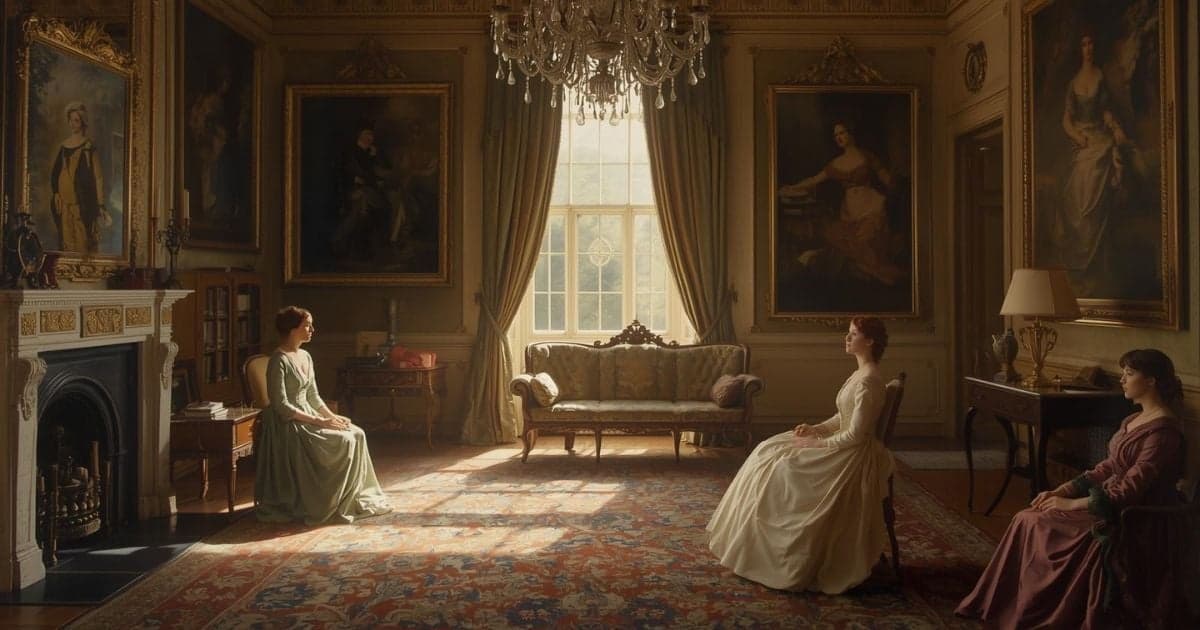
The title looks like a verdict. It is not. Austen does not ask which sister is the correct instrument. She asks what each instrument costs when money is short and other people are watching. Elinor's composure is a form of loyalty: she will not make her mother and sister live inside her weather. Marianne's volume is a form of loyalty too: she will not pretend a feeling is smaller than it is. Both look like virtue from inside the theory that produced them.
The error is treating the defense as the whole self. Elinor's government protects the cottage and isolates the woman who runs it. Marianne's transparency makes her alive in a room and indefensible in a crowd. Lucy can load a secret onto the first sister because Elinor will not make a scene. Willoughby can spend the second sister's reputation because Marianne has already published the attachment. Each defense invites a different predator.
Cleveland is where the argument leaves the drawing-room and enters the body. Marianne's walks in the wet are not poetry. They are a method that has run out of other tools. Elinor's later tears in the Barton parlor are not a conversion. They are what happens when a rule that kept everyone else alive is no longer needed for an hour. Integration is not a blend of temperaments. It is knowing which honesty the hour can bear, and refusing to make a career of either cliff.
The Central Lesson
Sense and sensibility are not two people. They are two defenses, each honest from the inside, each expensive when it becomes the only available face. Elinor's government keeps a household standing and can starve the woman who runs it. Marianne's volume keeps a feeling unfalsified and can hand that feeling to a room that will not protect it. Austen does not pick a winner. She waits until Cleveland, and then the Barton parlor, to show what happens when a theory of honesty outlives the hour that required it. The work is not becoming less feeling or less thinking. It is knowing which honesty the hour can bear, and refusing to make a career of either cliff.
Applying This to Your Life
Name the Theory You Are Defending
Elinor thinks composure is care. Marianne thinks volume is truth. Before you call yourself honest, say which rule you are actually obeying. If the rule always leaves you unsupported, or always leaves you exposed, it is a defense, not a character.
Do Not Let the Body Finish the Argument
Marianne's wet twilight walks treat proximity as proof. When a feeling has no other outlet, it will use sleep, appetite, and weather. That is not authenticity. It is a method that has run out of tools. Put a door on the grief before the fever does it for you.
Save One Room Where Government Can Fail
Elinor is not wrong to keep house. She is wrong only if there is never a parlor in which the face can go. Strength that cannot break when the news is finally good is not strength. It is a job you forgot you were allowed to quit.
Other lessons in this book
More life-skill deep dives from the same classic.
Keeping a Confidence at Personal Cost
A Secret You Did Not Choose
Hold Lucy Steele's engagement with Elinor: the one person who most needs to speak is the one who promised she would not.
11 chapters·Explore AnalysisReading Hidden Character
Charm Is a First Draft
See past Willoughby's shooting-jacket and Lucy's sweetness to the fortune and the secret they were always protecting.
12 chapters·Explore AnalysisRecognizing Quiet Constancy
The Man Who Will Not Perform
Watch Colonel Brandon wait through Eliza, the flannel waistcoat, and Marianne's fever while charm spends itself elsewhere.
12 chapters·Explore AnalysisRecovering from Heartbreak
Grief That Still Keeps House
Follow Willoughby's cut at the party and the letter that names money, then Elinor's private knowledge that Edward was never free.
14 chapters·Explore AnalysisSurviving Economic Precarity
The Ledger Behind Feeling
Sit with Fanny talking a deathbed promise down to nothing, then the cottage, London, and a marriage market that treats five hundred a year as a verdict.
14 chapters·Explore Analysis
Continue exploring
Explore this theme
The same lessons in other books
See how other books teach the same life skills.
The Idiot
Maintaining Goodness Without NaivetySit with Myshkin on the train in chapter 1: honesty with no angle, and a city that can only call it idiocy.
Northanger Abbey
Separating Fiction from RealityStop letting Gothic plots supply the story: laundry bills become clues, an old abbey becomes a crime scene, and real cruelty arrives without a villain's mask.
The Blue Castle
Building a Life of Your OwnLeave Elm Street for Mistawis, lock a house that is yours, and keep the Blue Castle after the excuse to live is withdrawn.
Where the lesson lives in the book
Two Theories of Honesty
Norland is already lost when Austen introduces the sisters. Elinor, at nineteen, has strong feeling and a practiced government of it. Marianne, at seventeen, treats moderation as a kind of fraud. Mrs. Dashwood prefers Marianne's weather because it looks like love. The household has already chosen which face counts as sincere.
Key Insight:
A family often mistakes volume for truth. Elinor's silence is not emptiness. Marianne's display is not fullness. Each sister is defending a theory of what it means not to lie.
“her feelings were strong; but she knew how to govern them: it was a knowledge which her mother had yet to learn; and which one of her sisters had resolved never to be taught.”
Two Readings of the Same Silence
At Norland the sisters argue over Edward. Marianne doubts his taste for drawing; Elinor defends his judgment and admits, under pressure, that she esteems him far more than her calm manner suggests. She still refuses to call the attachment secure, citing his dependence on a difficult mother and the need for fortune in any marriage.
Key Insight:
The same silence can read as depth or as fraud depending on which theory you already trust. Elinor's reserve is not absence of feeling. Marianne's volume is not fullness of proof. Each sister is defending a rule about what honesty must look like.
Feeling as Proof
Willoughby and Marianne match books, walks, and contempt for anyone who will not match them. Their taste is strikingly alike, or appears so until disagreement lasts only as long as her eyes can win. She sleeps badly after a parting and treats that insomnia as evidence the attachment is real.
Key Insight:
Intensity is not a character reference. When a feeling becomes the only proof you will accept, you stop collecting other kinds of evidence. Marianne is not foolish. She is consistent with a rule that cannot survive a liar.
“The same books, the same passages were idolized by each—or if any difference appeared, any objection arose, it lasted no longer than till the force of her arguments and the brightness of her eyes could be displayed.”
Affectation as a Cage
Edward stays unhappy at Barton while Marianne leaves him alone with Elinor, then slips out to see his horses before intimacy can develop. A debate over the picturesque pits Marianne's romantic vocabulary against Edward's plain preference for useful country. Elinor diagnoses his manner as affectation produced by dependence on a mother who rewards performance over candor.
Key Insight:
When feeling is not free to speak plainly, it learns bad costumes. Edward's awkwardness is not the opposite of Marianne's weather. It is another defense: a man who cannot name his constraint and so performs a taste he does not quite hold.
Government Under Fire
Lucy Steele produces Edward's miniature on the walk back to the cottage. Elinor's hope ends in a sentence she cannot answer without breaking a confidence she has just been forced to accept. She reaches home still composed. The composition is the work. The feeling does not wait outside it.
Key Insight:
Reason is not the opposite of feeling. It is what you do with feeling when other people are in the room and a secret has made the room unsafe. Elinor's control here is not coldness. It is triage.
A Cut That Everyone Can See
At a London party Marianne sees Willoughby and goes to him as if the old warmth were still a fact. He bows. He is not alone. The room watches her learn, in public, that the plot has already moved. There is no private corridor in which to revise the story.
Key Insight:
Ungoverned feeling makes you readable to people who do not love you. Authenticity without a door on it becomes a spectacle. The cost is not only pain. It is that strangers get to price your pain.
The Letter That Removes Agency
Marianne writes through tears before the fire is lit. Willoughby's reply is cold enough to have been dictated, and in a sense it was. She cannot eat, cannot be spoken to, cannot want command over herself. Elinor reads the letter and has to keep house around a collapse.
Key Insight:
When grief becomes the only occupation, it stops being a feeling and becomes a job you cannot quit. Marianne is not performing. She has lost the wish to steer. That is the cliff sensibility walks toward when nothing else is allowed to matter.
“No, Elinor, ask nothing; you will soon know all.”
Evenings Without a Future
Mrs. Palmer's childbirth sends Mrs. Jennings away daily, leaving the sisters with Lady Middleton and the Steele sisters in evenings Marianne accepts without hope. Lucy cannot flatter freely before Elinor. Anne scrutinizes Marianne's dress with impertinent compliments while Fanny's coldness still hangs over the room.
Key Insight:
When grief has no outlet, composure becomes the only action left. Elinor governs civility for two sisters at once while Marianne goes through the motions of society. That is not peace. It is management without an end date.
Comparing Endurance
Edward's integrity wins Mrs. Jennings's praise, but Marianne cannot sustain brave talk about him without comparing herself unfavorably to Elinor. In Kensington Gardens Anne Steele tells Elinor how Edward offered to release Lucy after disinheritance because he now has only two thousand pounds. Elinor must hear the facts and still keep her face.
Key Insight:
Government looks like coldness only from the outside. Marianne mistakes Elinor's silence for strength she lacks. The chapter shows both: one sister still employed by grief, the other still employed by a secret she cannot name.
The Body Keeps the Argument
At Cleveland Marianne walks wet twilight toward Combe Magna as if proximity to Willoughby's county could still argue with the letter. The cold she denies becomes fever. Elinor stays. Brandon rides for their mother. The defense that looked like honesty nearly finishes her.
Key Insight:
A theory of feeling that refuses self-protection will eventually use the body as its last instrument. Cleveland is not a moral. It is a medical fact: ungoverned sorrow can kill you without becoming more true.
Marianne Learns a Different Honesty
Recovering, Marianne thanks Brandon and then audits her own conduct. She sees neglected duties, indulged failings, a grief that injured the people who had to live with it. She does not promise to feel less. She promises to govern without pretending government is a lie.
Key Insight:
The correction is not to become Elinor. It is to stop treating self-command as betrayal of the heart. Marianne keeps her depth. She adds a door.
Elinor Cannot Govern Her Face
Thomas's news seems to marry Edward to Lucy. Then Edward himself arrives, shreds a pair of scissors in the parlor, and names Mrs. Robert Ferrars. Elinor leaves the room in tears she cannot manage. The woman who has held everyone else's weather finally fails her own rule, and the failure is the first honest rest she has had.
Key Insight:
Sense without a place to break becomes another kind of cliff. Elinor's joy is not a conversion to Marianne's method. It is proof that government was always covering a heart large enough to need release when the room is finally safe.
“Elinor now found the difference between the expectation of an unpleasant event, however certain the mind may be told to consider it, and certainty itself.”