
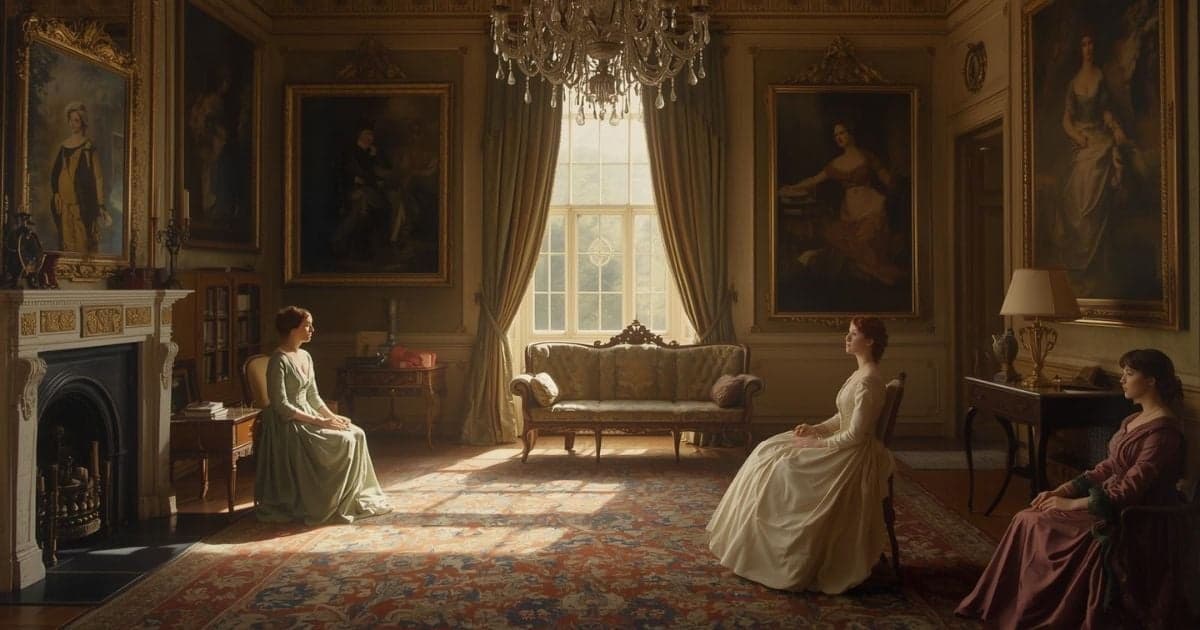
The Sister Who Carries the Room
Sense and Sensibility is often retold as a contest between two temperaments, with a double wedding to decide the winner. Austen writes a colder fact first. Norland is entailed to a child of four, a dying man asks his son to provide for the women, and by the time the funeral is over the promise has been talked down into a mood. The book's psychological core is what two sisters do with a feeling that has no legal standing. Elinor, at nineteen, becomes the counsellor her mother has not learned to be, and carries the room so the others can feel at full volume. Marianne treats that volume as the only honest proof. Money, charm, and a secret each test the theory. The ending houses both of them. It does not make the ledger just.
A Promise Becomes a Mood
The originating wound is not a quarrel between sisters. It is a house that will not count them as heirs. Henry Dashwood's son from an earlier marriage, John, inherits Norland. On the deathbed he is asked to do everything in his power for his stepmother and half-sisters. Alone, he settles on three thousand pounds. Fanny, his wife, spends an afternoon walking the sum down: half, then an annuity, then occasional presents of fish and game. The women are still in the house for a season. The security has already left. What looked like a father's care becomes a brother's comfort with himself.
That afternoon teaches the psyche of the book. A feeling is real in the moment it is spoken and optional the moment it costs. John is not a monster in his own account. He is a man who can be brought, by slow sentences, to hear generosity in doing almost nothing. The sisters will spend the novel inside that lesson. Elinor will try to make feeling governable, because ungoverned feeling has just lost them a home. Marianne will try to make feeling unmistakable, because a quiet promise has just proved that quiet can mean nothing.
Elinor as the Parentified Child
The narrator is plain about the arrangement. Elinor's understanding and coolness qualify her, though only nineteen, to be the counsellor of her mother, and to counteract the eagerness that would otherwise lead Mrs Dashwood into imprudence. Her feelings are strong. She knows how to govern them. That knowledge is one her mother has yet to learn, and one her sister has resolved never to be taught. Mrs Dashwood and Marianne encourage each other in grief, renew it, and refuse consolation. Elinor consults with her brother, receives Fanny, and tries to rouse her mother to the same forbearance. The adult work has moved to the eldest daughter.
Parentification is a later word for a child who regulates the parent so the household can continue. It fits this opening if it is kept as a description, not a diagnosis. Elinor's composure is not the absence of pain. It is the job. When her mother prefers Marianne's weather because it looks like love, Elinor learns that her own strong feeling will not be recognised unless she translates it into management. The cost arrives later, in secrets she cannot share and in a face her family reads as peace. A parentified child is often praised for the very skill that keeps her from being helped.
Volume Treated as Proof
Marianne's rule is a theory of honesty. Edward reads Cowper with a calm she calls indifference, and she tells her mother she could not love a man whose taste did not coincide with hers in every point. Mrs Dashwood answers that Marianne is not yet seventeen, and that it is too early to despair of such a man. The answer misses the function of the rule. After a promise that shrank because nobody made a scene, Marianne has decided that a feeling which can be moderated might be a feeling that can be withdrawn. Volume is how she keeps love from becoming fish and game.
Willoughby arrives as the proof the theory was waiting for. He carries her home from a sprained ankle on the downs, shares her books, and makes disagreement last only as long as her eyes can win. Idealisation is the defence: if the match is total, the object cannot be hiding a calculation. She sleeps badly after a parting and treats the insomnia as evidence. The same structure will not let her believe the cold letter. She would rather suspect the whole world of black art than suspect a heart she has already decided she knows. Idealisation protects her from a second loss of the kind Norland was. It also stops her collecting the other evidence, which is already in the room.
The Hand That Is Not the Voice
The novel's formal cruelty is that a handwriting can be a disguise. In London, Willoughby returns Marianne's letters, a lock of her hair, and a note cold enough to sound like someone else. She insists the cruelty cannot be his. At Cleveland, while she may still die, he tells Elinor the truth of the paper. Sophia, the woman he is marrying for money, opened Marianne's letter, and he copied her sentences because a rupture would have cost him the fortune. He had the credit of the hand and the shame of the words. The object Marianne idealised did not even author the sentence that ended her.
That split is how the book thinks about knowledge. Elinor has already been living in it. From the walk where Lucy produces Edward's miniature, Elinor knows a fact the cottage does not, and she must speak, look, and hope in a language that will not betray the confidence. The narration stays near her, so the reader carries the secret with the sister who cannot use it. Marianne's openness and Elinor's silence are not only character. They are two positions toward a truth that arrives in the wrong hand: one woman believes the feeling and misreads the paper, the other reads the paper and is forbidden to correct the feeling.
The Secret Binds the Wrong Person
Lucy Steele has been engaged to Edward for four years. She chooses Elinor, on the walk from the Park to the cottage, as the person who will keep it. The miniature is the proof. The request is the weapon. A confidence of this kind is not intimacy. It is a claim on the listener's future speech. Lucy has studied the room. She binds the one woman whose hope the secret destroys, and then she can watch that woman perform ignorance for the family, for Edward, and for herself.
Edward's psychology is the other half of the same bind. He is awkward, kind, and already owned by a promise he lacks the courage to break or to name. He lets Barton build a future on his reticence. The engagement is a younger man's fear of poverty and of his mother, hardened into a fact he then treats as honour. Honour, in his case, is the story that makes silence look like virtue. Elinor pays for that story in months of private knowledge. The person with the least right to the secret is the person required to hold it, because holding it is how Lucy stays safe and how Edward stays unconfronted.
The Bow Across the Room
The defence breaks where other people can price it. At a London party Marianne sees Willoughby and crosses to him as if the old warmth were still a fact. He bows. Sophia is beside him. There is no corridor in which Marianne can revise the story before the room has seen her face go white. Ungoverned feeling, which she has treated as moral clarity, becomes a spectacle. Strangers receive information her sister has been spending months refusing to display.
Willoughby later asks to be pitied for that evening: Marianne on one side, calling him by his name, and Sophia jealous on the other. The confession is accurate about his discomfort and useless as an acquittal. He had already left Eliza Williams, Colonel Brandon's ward, when Mrs Smith offered to forgive him if he married the girl. He refused. Poverty frightened him more than the loss of Marianne, and Miss Grey's fifty thousand pounds settled the fear. The bow is not a sudden change of heart. It is the moment a calculation, which had been private, becomes a public posture. Marianne experiences it as the death of a person. It is the first time she sees the person who was already there.
Cleveland, Then the Scissors
Marianne's walks in the wet grass at Cleveland are the theory with nowhere left to go. Feeling had been her method of proof. When the proof fails, the method continues in the body, and the fever nearly finishes what the letter began. Elinor, again, does the adult work: she watches, she manages the household of alarm, and she receives Willoughby's confession in the next room while her sister may still die. The man who wants to be understood chooses the sister who can govern a face. Marianne, the one who loved him, is spared the speech and also denied it. Elinor leaves the interview with a pity she did not ask to carry, and with no power to hand it to the person it concerns.
The other break is quieter, and it is hers. After Lucy marries Robert, Edward comes to Barton. Elinor, forcing herself to enquire after Mrs Edward Ferrars, hears that he means Mrs Robert Ferrars. He walks to the window, takes up a pair of scissors, and spoils them and their sheath while he says that his brother has married Lucy. Elinor runs from the room and cries with a joy she thinks will not stop. The composure that has organised the novel fails, and the failure is relief. For once the feeling is allowed to be hers, in private, after the fact, when the secret no longer requires her service.
Marianne as the Reward of All
The ending gives both sisters a house and then tells the truth about how the second house is staffed. Edward and Elinor, grateful for Colonel Brandon's living at Delaford, feel his sorrows and their own obligations. Marianne, by general consent, is to be the reward of all. The narrator asks what she could do against that confederacy, against her knowledge of his goodness, and against a fondness that reaches her late. She marries at nineteen the man she had thought too old, the man of the flannel waistcoat. The sentence that records this is a joke and an audit. She was born, it says, to discover the falsehood of her own opinions, and to give her hand where she had once expected an irresistible passion.
This houses the danger and keeps the method. Marianne is no longer on the cliff. She is also the payment for a constancy the novel has admired, and for the living that makes her sister's marriage possible. Elinor's joy is real, and so is the year in which her face was public property. Willoughby keeps the wife, the money, and a regret he was allowed to narrate. Lucy is received as a favourite. Delaford lets judgment and feeling share a roof. It does not repeal the afternoon when a promise became a mood.
Why It Resonates Now
The anxiety the book keeps returning to is economic, and it is intimate. A household can praise a feeling and withdraw the support that would make the feeling livable. People still watch a large promise revised, politely, into almost nothing, and call the revision reasonable once the speaker is comfortable. They still meet a composed daughter or friend and treat the composure as evidence that nothing is wrong, because someone has to keep the room workable while others feel at full volume. The praise is often sincere. It is also how the work stays unpaid.
The other recognition is the proof problem. A culture that distrusts reserve will treat intensity as a character reference: the shared taste, the rescue, the lock of hair, the distress at parting. Austen does not deny that Willoughby felt something. She shows that a feeling can be real for weeks and still lose to fifty thousand pounds, and that the sentence which ends it may be copied from the person who holds the money. Reputation, in this psychology, is not a separate vanity. It is the room in which a private calculation puts on a bow. Readers who have been asked to keep a confidence that injured them will recognise Lucy's walk. The secret protects the people who already have a story, and it charges the listener with the silence.
Limits of This Reading
Parentification, idealisation, and the entrusted secret are later vocabularies. Austen writes prudence, sensibility, honour, and a confidence. Elinor is not a case file, and Marianne's fever belongs to a literary convention of the feeling body as well as to a defence that has run out of tools. The entail was law. In 1811 a daughter's security depended on a brother's mood and a husband's name. The novel was revised from an earlier draft called Elinor and Marianne. This reading stays with the finished book. It does not treat the page as a confession about Austen's family.
Other accounts should stay in view. The book is a comedy of money and marriage, and the flannel waistcoat is a joke about romantic maxims as well as a portrait of a second attachment. Brandon's history with the first Eliza, and Willoughby's abandonment of the second, can be read as a social novel about seduction and reputation, not only as the hidden content of Marianne's idealisation. Calling Elinor's silence a form of care can slide into praising the very arrangement the plot makes costly. The framework names the cost. It does not make her composure a mistake she ought to have skipped, in a world that punished the woman who could not govern a face.
Across the Shelf
Pride and Prejudice opens on the same kind of loss: an estate that will not go to the daughters, and a neighbourhood ready to turn a man with money into a plot. Elizabeth's defence is mobility. She turns ranking into wit before the ranking can finish her. Elinor's defence is containment, and Marianne's is volume. Read together, the two novels show Austen studying women who must become readers of their own desire while the property system is still reading them as futures to be settled. Elizabeth gets a letter that revises a man in private, on a walk. Marianne gets a letter in the beloved's hand that was written by his wife. One heroine is allowed to change her mind where no one is watching. The other learns what she feels in a room that has already seen her cross it.