
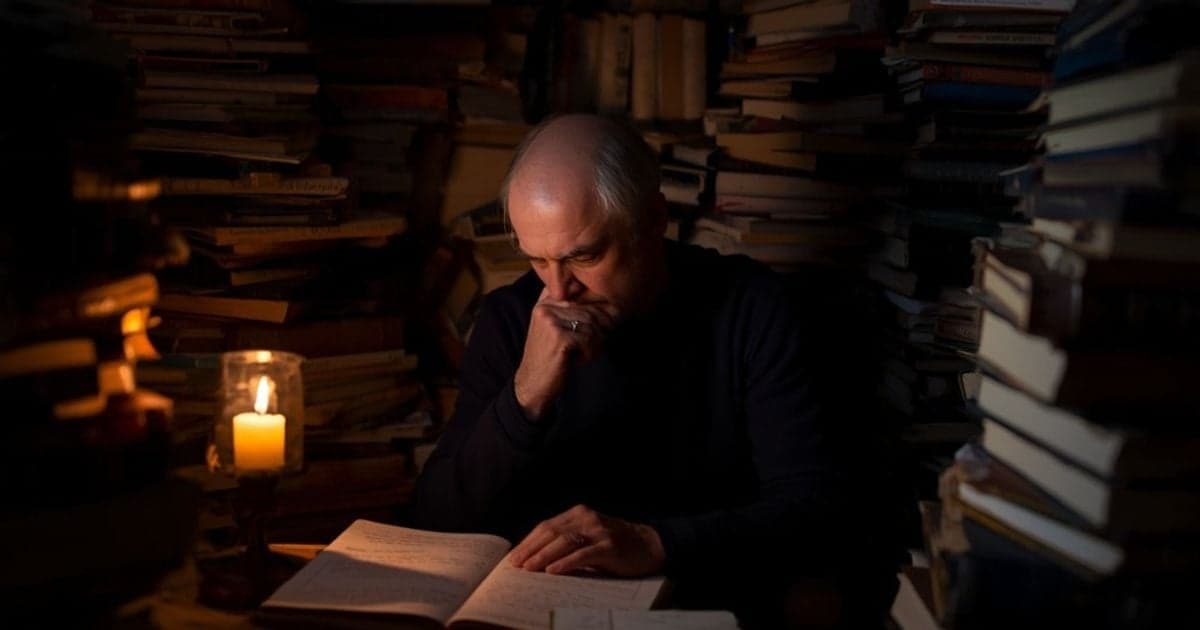
The Underground Man's cleverness is not a gift he is trying to use. It is a caste. Direct people act because they are limited. He cannot become anything because he sees too much. The sentence sounds like despair. Listen again: it is a ranking. Fools become. The intelligent remain uncompromised by results. Dostoevsky understood how a certain mind turns its stall into an aristocracy, and then has to keep proving the aristocracy in rooms that never asked for a philosopher.
Part I builds the rank in private. He is ashamed of being cleverer than the people around him, which is still a way of staying cleverer. Romantic costumes keep the lead role indoors. Part II takes the rank to a dinner it paid to attend. Zverkov, Simonov, the officers: they are not a seminar. They are a table. He arrives determined to be finer than the table, which means he cannot sit at it. The evening humiliates him, and the humiliation is immediately converted into evidence. Of course they did not understand. Understanding was never what he came for. He came to remain above the people who can still toast, laugh, and leave together.
The skill is catching pride when it is wearing self-attack. A man who calls himself a mouse may still be calling you a bull, and not as a compliment. If your intelligence has started to make finished work look vulgar, you are not seeing clearly. You are protecting a hierarchy that cannot survive being ordinary in a room. Stay home and the superiority remains a thought. Walk in and it will demand a scene. Either way the other people are not your students. They are living. The question is whether you can bear to live with them without a rank.
The Central Lesson
Intellectual pride in this book does not look like boasting. It looks like a man who cannot become anything because becoming is what fools do. Consciousness is worn as rank. The mouse is miserable and still will not trade awareness for a result. Then he buys his way into a dinner so the rank can be tested, and when the table does not submit, humiliation becomes more proof that he was never one of them. Seeing more is not the same as ranking higher. If your intelligence requires other people's action to look simple, you are not trapped by thought. You are protecting a hierarchy that cannot survive an ordinary chair. Sit down. Let the toast proceed without a theory. Fools, in his language, are simply people who were willing to become.
Prestige deep dive
A Psychological Reading of Notes from Underground
Notes from Underground shows a man who can name the kind act and still perform the cruel one, because the clarity protects a self that would collapse if it became ordinary.
Read the full psychological readingApplying This to Your Life
Hear the Insult Inside the Self-Attack
If you cannot become anything because only fools become, you have already ranked the people who ship, speak, or show up. Reverse the sentence: what would it cost you to be one of them for an afternoon? If the cost is status, the despair was a costume for pride.
Do Not Enter a Room Only to Remain Above It
The dinner he forces is a test of rank, not of friendship. Before you spend a night proving you are finer than the table, ask whether you can sit as a guest. If the answer is no, staying home is cleaner than a scene that will only confirm the hierarchy you brought with you.
Let a Result Edit the Private Story
Private grandeur never has to survive witnesses. Pick one small public act whose outcome you do not control: a meeting, a draft other people can mark, a toast you do not dominate. If you need the room to fail in order for you to remain special, you are not seeking understanding. You are seeking a caste.
Other lessons in this book
More life-skill deep dives from the same classic.
Reading Performed Vulnerability
Tell a real confession from the performance of honesty: the opening lies, the toothache moans, the masks when Liza knocks.
5 chapters·Explore AnalysisHolding a Grievance as Identity
Follow the eighteen-month sword feud, the rehearsed bump, and the sledge through wet snow until a slight is a self.
6 chapters·Explore AnalysisRecognizing Self-Sabotage Patterns
Sit with Liza after the speech: she believes him, then he rages, offers money, and drives her out.
5 chapters·Explore AnalysisBreaking the Analysis Paralysis Loop
Watch consciousness become a disease, the mouse lose to the bull, and insight turn into a reason not to move.
5 chapters·Explore AnalysisUnderstanding Free Will vs. Rational Self-Interest
Hear why twice two makes four can feel like an insult, and why people smash a crystal palace to stay free.
5 chapters·Explore Analysis
Continue exploring
The same lessons in other books
See how other books teach the same life skills.

The Essays of Montaigne
Choosing Real FriendshipHear essay 27 answer La Boétie: because it was he, because it was I.
The Idiot
Maintaining Goodness Without NaivetySit with Myshkin on the train in chapter 1: honesty with no angle, and a city that can only call it idiocy.
Jude the Obscure
When Desire Becomes a TrapTrack the pig, the dimple, the false pregnancy, and the second marriage arranged over gin.
Where the lesson lives in the book
Intelligence Worn as Rank
He treats heightened consciousness as a station ordinary people do not hold. The active man is limited. The intelligent man cannot become anything seriously, and it is only the fool who becomes anything. The insult hidden in the self-attack is that everyone who finishes a job is simple. Shame at himself becomes contempt for anyone who can still choose.
Key Insight:
Intellectual pride often sounds like humility. Listen for the moment the speaker's shame turns into a ranking system. If action is the work of fools, inaction has been promoted to an aristocracy.
“An intelligent man cannot become anything seriously, and it is only the fool who becomes anything.”
Misery with Extra Awareness
The mouse's consciousness is offered as a kind of breeding. The bull is stupid enough to act. The underground is wretched, and still the narrator would rather be wretched with extra awareness than simple with a result. Complexity is not a finding here. It is a status symbol he will not trade for a wall that actually stops a charge.
Key Insight:
Pride can choose the more painful identity if that identity keeps you above the people who finished the work. Watch for the bargain: I suffer more, therefore I see more, therefore I rank higher. The suffering is real. The ranking is the scam.
The Hero No One Is Allowed to Edit
Romantic roles let him feel exceptional in private. The loftiness is not a plan to be tested. It is a hierarchy that never has to survive another person's eyes. He remains the lead in a story whose only reader is himself, which is the safest form of superiority.
Key Insight:
A self you only inhabit in fantasy is still a class system. You stay above the room by never entering it. Private grandeur is not innocence. It is rank without the inconvenience of witnesses.
Forcing the Test He Cannot Afford
He invites himself to a farewell dinner for Zverkov, an officer he barely knows. The point is not friendship. The point is not being left out of a room where he can prove he is finer than Simonov and the rest. He spends what he does not have. He rehearses all night. Staying home would confirm that the superiority was only a thought.
Key Insight:
Intellectual pride will walk into a room that does not want it, because absence would be an admission. The dinner is a test he cannot afford to skip and cannot afford to pass. Passing would mean becoming one of them. Failing will prove he was above them all along.
Superiority That Cannot Survive Being Seen
They drink past him. His speeches land as scenes. The duel is a joke. The man who has been cleverer than everyone surrounding him is now a clerk making a mess at a table that did not need him. Pride does not argue its way out. It sits in the wreck and converts humiliation into more evidence that the others were never worthy.
Key Insight:
When superiority meets a room, it either becomes ordinary participation or it declares the room invalid. The Underground Man chooses the second. That choice feels like dignity. It is only the hierarchy protecting itself after contact.