
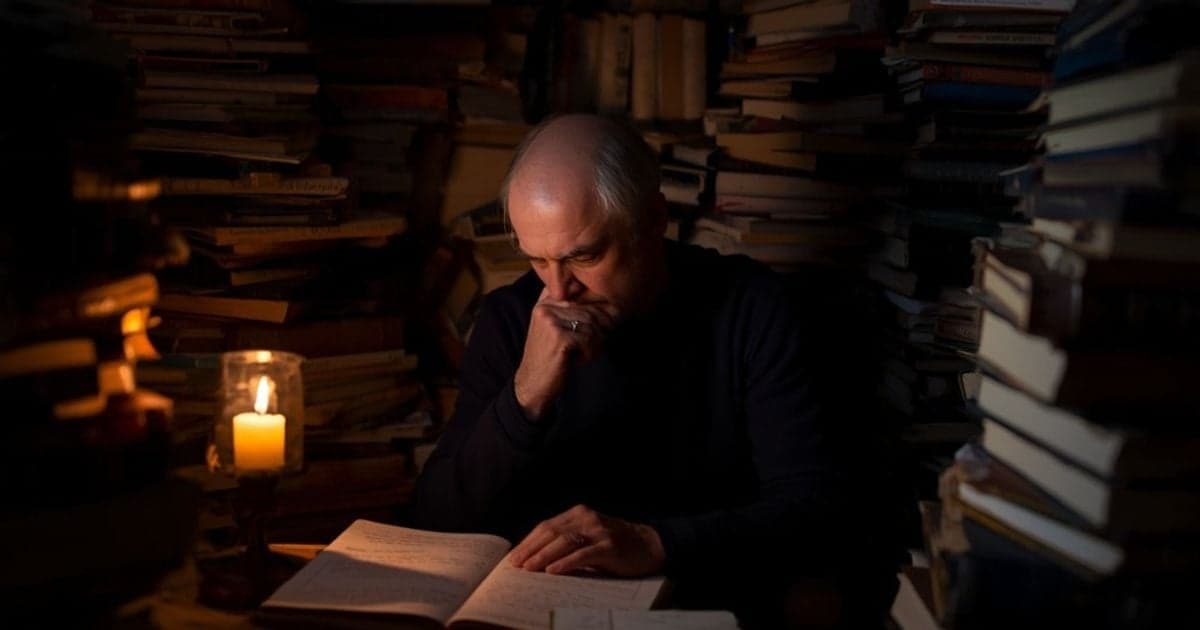
The Underground Man is not waiting for better information. He already has more of it than the bull who puts his head down and goes. What he lacks is a moment when thinking stops being the job. Dostoevsky's joke, if it is a joke, is that the man who sees every motive most clearly is the one least able to spend a motive on an act. Consciousness is offered as rank. It functions as a stall. The mouse is not preparing a better answer. The mouse is employed by the insult.
Part I is the workshop of that employment. He tries to become an insect and cannot. He envies laziness because laziness would at least be a calling: a belly, a chin, a nose people could point to as something real. Instead he has commentary. Direct people look stupid from the burrow, which is convenient, because their results would otherwise be an accusation. Romantic roles fill the evenings. They do not fill a Tuesday. By the time he admits that writing the notes is another pose, the loop has already learned to wear honesty as its uniform.
The skill is not thinking less. It is catching the hour when analysis stops being information and starts being the activity that replaces the act. The dinner is still unattended. Liza has not yet knocked. The liver can wait. What cannot wait, if you want a life instead of a notebook, is the smallest move that would count as leaving the chair. Dostoevsky will not let you keep the flattering story that one more honest sentence about yourself is always the next right step. Sometimes the next right step is smaller, and more embarrassing, than another distinction.
The Central Lesson
Analysis becomes a prison when it is promoted from a tool to a career. The Underground Man sees every side, envies the bull, and still cannot begin or finish. Each new distinction feels like progress because it is the only labor the burrow recognizes. Confession is the last stall: a man can diagnose the loop and treat the diagnosis as the day's work. The escape is not a finer theory of yourself. It is a smaller, ruder act that would still be true if nobody heard the explanation. If the next thought is always required before the next move, you are not preparing. You are employed by the delay. Leave the chair. The notebook can wait.
Prestige deep dive
A Psychological Reading of Notes from Underground
Notes from Underground shows a man who can name the kind act and still perform the cruel one, because the clarity protects a self that would collapse if it became ordinary.
Read the full psychological readingApplying This to Your Life
Set a Decision Time, Not Another Distinction
If the next thought is always required before you move, you are already in the burrow. Name the smallest act that would count as leaving it. Do that act before you refine the theory of why you have not. Depth that never spends itself is still a stall.
Do Not Treat Ordinary Action as the Work of Fools
The mouse's worst luxury is calling the bull stupid. If your self-awareness has started to make decisive people look simple, check whether you are protecting a delay. Results are not a character flaw in other people. They are what your commentary has not yet risked.
Stop Congratulating the Confession
Naming the loop is not exiting it. If you can narrate your paralysis more fluently than you can send the message, make the appointment, or leave the room, the notebook has become the life. Write less. Move once. Then see whether the analysis still needs to be that long.
Other lessons in this book
More life-skill deep dives from the same classic.
Reading Performed Vulnerability
Tell a real confession from the performance of honesty: the opening lies, the toothache moans, the masks when Liza knocks.
5 chapters·Explore AnalysisSeeing Through Intellectual Pride
Catch consciousness worn as rank, the dinner he forces his way into, and superiority that cannot survive being seen.
5 chapters·Explore AnalysisHolding a Grievance as Identity
Follow the eighteen-month sword feud, the rehearsed bump, and the sledge through wet snow until a slight is a self.
6 chapters·Explore AnalysisRecognizing Self-Sabotage Patterns
Sit with Liza after the speech: she believes him, then he rages, offers money, and drives her out.
5 chapters·Explore AnalysisUnderstanding Free Will vs. Rational Self-Interest
Hear why twice two makes four can feel like an insult, and why people smash a crystal palace to stay free.
5 chapters·Explore Analysis
Continue exploring
The same lessons in other books
See how other books teach the same life skills.

The Essays of Montaigne
Choosing Real FriendshipHear essay 27 answer La Boétie: because it was he, because it was I.
The Idiot
Maintaining Goodness Without NaivetySit with Myshkin on the train in chapter 1: honesty with no angle, and a city that can only call it idiocy.
Jude the Obscure
When Desire Becomes a TrapTrack the pig, the dimple, the false pregnancy, and the second marriage arranged over gin.
Where the lesson lives in the book
Consciousness as a Career
He names too much consciousness an illness, then treats the diagnosis as work. Ordinary people act. He sees every motive and its opposite, and therefore cannot become an insect, a clerk with a character, or even a vice he could inhabit. Intelligence is not a tool in this room. It is the occupation that keeps the tool in the drawer.
Key Insight:
Insight that never leaves the chair is not wisdom. It is a delay you have learned to call depth. If seeing every side is the whole day's labor, you have already refused to pick one.
“To be too conscious is an illness—a real thorough-going illness.”
The Mouse and the Bull
The direct man charges like a bull. The mouse of heightened consciousness collects the injury, rehearses it for forty years, and adds ignominious details the original insult never contained. The underground is not a hiding place that will be left. It is the office where rehearsal has replaced the blow.
Key Insight:
A grievance you keep polishing is still a substitute for a decision. The mouse is not weaker because it understands more. It is weaker because understanding has become the only activity that counts as living.
“For forty years together it will remember its injury down to the smallest, most ignominious details, and every time will add, of itself, details still more ignominious.”
Neither Beginning nor Finishing
He wants a career, a defined failure, even laziness as a vocation with a belly and a ruby nose people could point to. Every attempt dissolves into commentary. He considers himself intelligent only because he has been able neither to begin nor to finish anything. The next distinction arrives on time. The first real act does not.
Key Insight:
The loop is not a shortage of information. Each new refinement feels like progress while the furniture stays where it was. If the next thought is always required before the next act, you are already underground.
“Perhaps I consider myself an intelligent man, only because all my life I have been able neither to begin nor to finish anything.”
The Costume That Never Goes Outside
Romantic literature lent him lofty roles: the hero, the lover, the man of feeling. He could inhabit them in private and then despise himself for needing the costume. The dream is not preparation. It is identity without the risk of being edited by another pair of eyes.
Key Insight:
A self you only inhabit in fantasy is still a way of not choosing. Loftiness that never takes a step looks intentional. It is only the story that makes an unfinished life feel like a stance.
“Oh, if I had done nothing simply from laziness! Heavens, how I should have respected myself, then.”
Confession as the Last Stall
Part I closes with the narrator admitting he will not stop, that writing this down is another performance, and that he is about to prove the philosophy in a story from his youth. Consciousness has not delivered him. It has given him a genre. Naming the loop is the loop's most respectable form.
Key Insight:
The last move of paralysis is to make the confession itself the substitute for change. A man can tell you exactly why he does not move and still treat the telling as the day's accomplishment. Part II will spend the same mind on a dinner and a girl.