
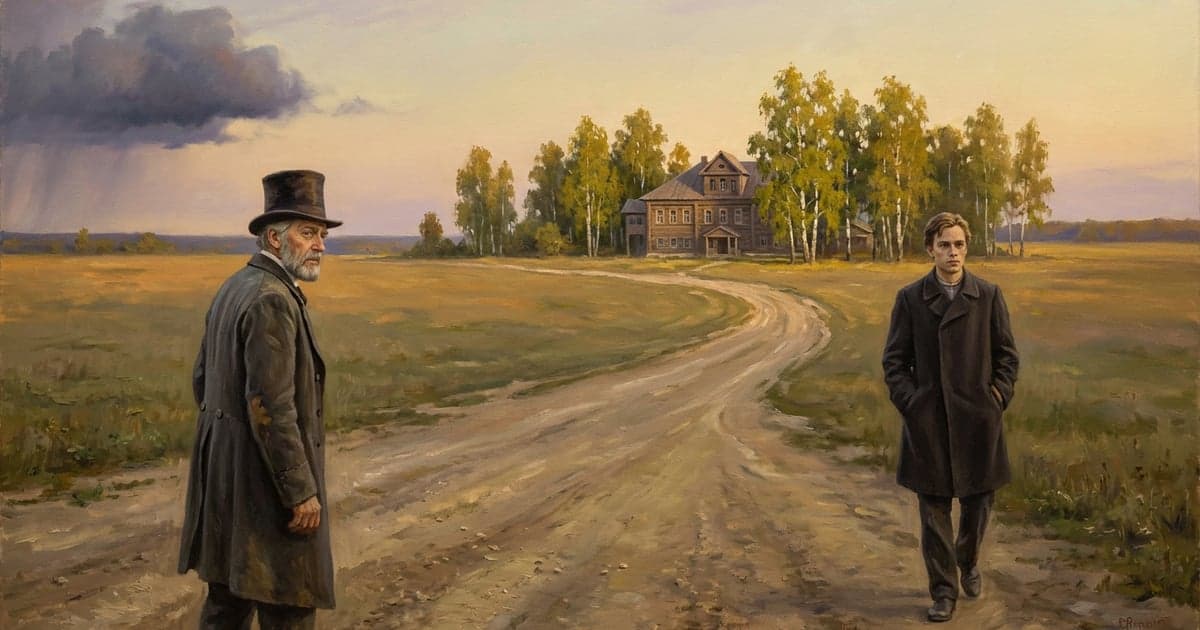
Bazarov is not a cartoon of arrogance. He is a man with a method that actually works on the materials it was built for. Pretension, inherited piety, the fog of good manners: these yield to a knife and a question. Turgenev respects that. He will not let you skip the part where the young doctor is the most honest person in the room.
The pressure arrives as a person, then as a body. Anna will not take a category. Love will not stop because it has been correctly named. A lancet infected on a peasant corpse will not negotiate with a theory of meaning. At each step the framework offers a translation, and the translation does not change the fact. That is the difference between a map and a life. Maps are allowed to omit weather. Bodies are not.
The book is not an argument for abandoning rigor. It is an argument for noticing when rigor has become a hide. Work after the boudoir is still work. It is also flight. Death faced without flinching is still courage. It is also the moment he asks for a woman his system had no instrument for. The parents at the grave are the last data point. If your certainty cannot include them, it is not finished. It is only sharp.
The Central Lesson
A sharp framework can be true in its native habitat and still fail as a life. Bazarov's science cuts what it was built to cut. It cannot make a face sit still in a category, cannot talk a feeling out of a body, and cannot console a death it has already explained. Turgenev does not ask you to become vague. He asks you to stop treating explanation as a cure. Keep the instrument. Admit the rooms it cannot enter. The people you reach for when the theory runs out are not a contradiction of your mind. They are the rest of the evidence.
Applying This to Your Life
Keep the Tool Where It Fits
Do not throw out a method that still cuts fog. Use it on hypocrisy, sloppy claims, and your own favorite stories. Bazarov is useful until he pretends the tool is a world.
Notice the Person Who Will Not Categorize
Name one relationship that keeps failing your type. Instead of forcing a label, write what the person actually does. The mismatch is information. It is where the framework is thin.
Ask for Presence When Proof Runs Out
When you are in a room your theory cannot furnish, grief, illness, a refusal you respect, stop translating and ask for a person. That request is not a collapse of mind. It is the mind refusing to lie about its edge.
Other lessons in this book
More life-skill deep dives from the same classic.
When Love Refuses Your Terms
Stay for the morning after the confession, when Anna will not leave her régime for a man who calls love a disease.
6 chapters·Explore AnalysisThe Armor We Build Against Feeling
See Pavel's cuffs, Anna's rails, and Bazarov's sneer as the same closed door.
6 chapters·Explore AnalysisNavigating the Generation Gap
Watch Nikolai wait at the posting-house, then hear that his song has been sung, and stay in the room anyway.
7 chapters·Explore AnalysisOutgrowing Your Teacher
Sit under the ash tree with Arkady and Katya, and watch a borrowed voice finally go quiet.
6 chapters·Explore AnalysisDisagreeing Without Contempt
Follow the breakfast fight to the duel, and notice the one talk that is not a score.
6 chapters·Explore Analysis
Continue exploring
The same lessons in other books
See how other books teach the same life skills.
Hamlet
Distinguishing Truth from DeceptionTest a ghost, a play within a play, and a story that only Horatio will carry out.Hamlet
Paralysis in Decision-MakingWatch the ghost's charge, the play that proves the king, and the prayer Hamlet will not interrupt.
King Lear
Recognizing Flattery vs LoyaltyWatch the love test, Kent's exile, and the Fool's crab line show a speech that buys land and a silence that tells the truth.
Where the lesson lives in the book
The Method in Its Native Habitat
Bazarov is first to wake. He likes to open frogs and observe what their insides are doing. With peasant boys he is patient, curious, and free of the house's manners. The philosophy looks like honesty here. It cuts pretense. Turgenev lets it work before he starts to press it.
Key Insight:
Every framework is most persuasive where its tools fit. Bazarov's rigor is genuinely powerful against hypocrisy and inherited fog. The question is not whether he is intelligent. It is whether a single instrument can measure every room a life will enter.
“You see, I like to open them, and then to observe what their insides are doing.”
A Person Who Will Not Categorize
At Nikolskoe the manor matches a church of yellow walls and white columns. Anna is not vain in the way Bazarov had budgeted for, not weak, not a type. He talks more than he means to. The certainty does not crack in an argument. It slips because someone will not sit still inside a label.
Key Insight:
The first sign that a worldview is under pressure is rarely a better theory. It is a person who will not behave. Notice who in your life regularly fails to fit the story you tell about them. That is where the story is thin.
“Now let us see to what category of mortals to assign this young person.”
A Correct Name That Cures Nothing
Days at her house run on rails. Bazarov can name what is happening to him: chemistry, animal response, rot. The naming is accurate enough and useless. He cannot make the feeling stop by classifying it. The gap between the map and the weather becomes a private torment he will not admit.
Key Insight:
Intellectualization is the most respectable way to avoid an experience. Understanding a feeling in technical terms is not the same as living it. A diagnosis that cannot change the condition is not wisdom. It is a stall.
“Somehow it reminds one of running on a pair of rails.”
Refusal from Someone Who Understands
Anna is pale at breakfast and calls him to the boudoir over a textbook. He tells her the truth in a form that sounds like a challenge. She is frightened, not flattered. She knows exactly who he is and still says no. The old escape, that rejecters simply fail to understand, is gone.
Key Insight:
Certainty that has never been tested by a peer is brittle. You can dismiss people who do not get you. You cannot dismiss a clear-eyed no. A framework that has no move for respected refusal will treat love as an insult and then call the insult analysis.
“Somehow her face looked pale, and it was not long before she returned to her boudoir.”
Work as a Faster Horse
He announces he is leaving. The house absorbs the crisis as if it were a scheduling error. He throws himself at specimens with a fury that looks like discipline. Turgenev lets you see the flight inside the rigor. The tools are the same. The use has changed.
Key Insight:
A healthy method becomes armor when you use it to avoid the part of life it cannot explain. The test is not whether the work is real. It is whether you are engaging the world or hiding in the one room where your instruments still win.
“I am not her hireling.”
The Lancet the Theory Cannot Argue With
He cuts himself on a peasant autopsy and reads the wound correctly. He tells his father without drama. Courage here is real. So is the limit. The philosophy that denied the significance of death cannot console a man who is dying. He asks for Anna anyway.
Key Insight:
Clarity is excellent at cutting illusion. It is a poor substitute for presence when you need something that is not a proof. Calling for a person you cannot theoretically justify is not a betrayal of the mind. It is the mind meeting its edge.
“I am going to spend with you six whole weeks. But I desire to work, and therefore must not be disturbed.”
What the System Had No Use For
The white winter proceeds. Tables are laid. Marriages hold. The parents he found most inconvenient keep coming to the grave. The novel does not recant science. It simply ends on a love that has no philosophical content and cannot be reasoned out of the ground.
Key Insight:
Turgenev's last claim is not that certainty was wrong. It is that it was unfinished. A worldview that cannot account for the old couple at the cemetery can still be sharp. It is not sufficient. Completeness is a different test from brilliance.
“At three o'clock precisely the company gathers around the board.”