
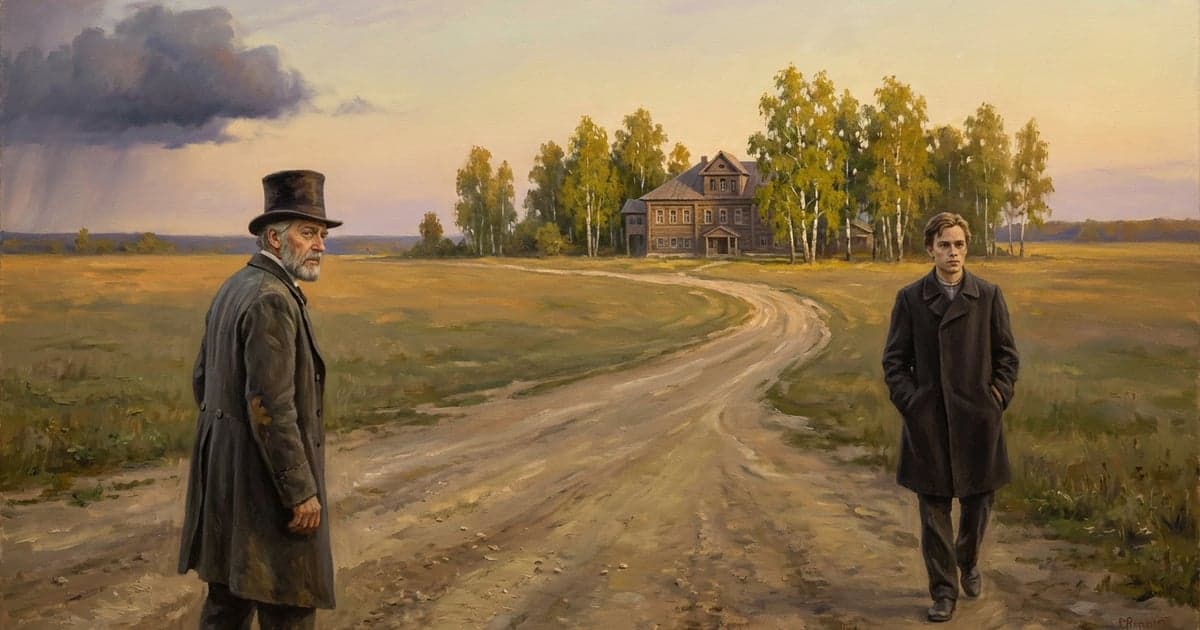
Bazarov and Pavel are not opposites. Both are sharp. Both have fused a worldview to a self. Neither can imagine being seriously mistaken in public. That is why their talk cannot produce anything. Each uses the other as a mirror that must not be allowed to show a crack. The real argument between an old order and a new one never happens, because neither representative ever actually listens.
Turgenev then gives you the cheap copy, so you will not confuse noise with thought. Kukshina's progress is a bell-handle. Sitnikov's emancipation is name-dropping. At the ball, rank replaces replies. Contempt has several speeds: the breakfast insult, the salon performance, the smile that will not even grant you an opponent. All of them end the same way. Nobody has to risk being changed.
The duel is not a surprise. It is the last honest form of a contest that was never about Germans or art. Nikolai's uncertain reading, and the late talk in the temple, are the small proofs that another method exists. They are late and fragile. The book seems to believe that honest disagreement is possible, and that the conditions for it are almost never present while anyone still needs to win.
The Central Lesson
Contempt is not a sharper form of disagreement. It is the end of disagreement. Once you have decided the other person is not a serious interlocutor, every later sentence is only a score. Turgenev follows that logic from a breakfast table to a copse with pistols, and he also shows the rare alternative: a man willing to be uncertain, and a talk that becomes honest only after nobody needs a victory. If you want argument to do any work, grant the other side the dignity of opposition while the stakes are still live. Waiting for the ruins is not wisdom. It is what is left when pride has already spent the summer.
Applying This to Your Life
Ask the Openness Test
Before the next charged conversation, ask whether you would actually revise a claim if the other person produced a better one. If the answer is no, say so to yourself. You are preparing a performance, not a hearing.
Answer the Strongest Version
Take one person whose views you have been treating as beneath you. State their position in a form they would recognize as intelligent. Then answer that. Contempt prefers the easy copy. Inquiry has to pay for the real one.
Stop the Escalation Early
If you notice the talk turning into who is allowed to matter, name that turn out loud and pause. Pavel and Bazarov never did. The pistols were already implied in the first cup of tea.
Other lessons in this book
More life-skill deep dives from the same classic.
When Love Refuses Your Terms
Stay for the morning after the confession, when Anna will not leave her régime for a man who calls love a disease.
6 chapters·Explore AnalysisThe Armor We Build Against Feeling
See Pavel's cuffs, Anna's rails, and Bazarov's sneer as the same closed door.
6 chapters·Explore AnalysisNavigating the Generation Gap
Watch Nikolai wait at the posting-house, then hear that his song has been sung, and stay in the room anyway.
7 chapters·Explore AnalysisOutgrowing Your Teacher
Sit under the ash tree with Arkady and Katya, and watch a borrowed voice finally go quiet.
6 chapters·Explore AnalysisWhen Your Certainties Aren't Enough
Name the night in Anna's boudoir when science has no instrument for what Bazarov wants.
7 chapters·Explore Analysis
Continue exploring
The same lessons in other books
See how other books teach the same life skills.

Hamlet
Distinguishing Truth from DeceptionTest a ghost, a play within a play, and a story that only Horatio will carry out.Hamlet
Paralysis in Decision-MakingWatch the ghost's charge, the play that proves the king, and the prayer Hamlet will not interrupt.
King Lear
Recognizing Flattery vs LoyaltyWatch the love test, Kent's exile, and the Fool's crab line show a speech that buys land and a silence that tells the truth.
Where the lesson lives in the book
The Table That Wanted a Winner
Bazarov sits down to tea and the room divides. Pavel wants to expose a plebeian. Bazarov wants to strip an English coat. The subjects are real enough. The method is not inquiry. Each man is using the other as a surface on which to prove he cannot be moved.
Key Insight:
The diagnostic question is simple. Is either party actually willing to be wrong? If not, you are not watching a debate. You are watching a status contest that has borrowed the language of reason.
“You think highly of the Germans?”
The Brother Who Will Hold a Position Lightly
While the two combatants harden, Nikolai reads what Arkady recommends and remains uncertain. He does not abandon his life. He also does not treat uncertainty as humiliation. The effort is awkward, sometimes comic, and it is the only intellectual humility in the house.
Key Insight:
Openness is not conversion. Nikolai keeps his values and still asks whether he is missing something. That move is rarer than brilliance. It is also the only one that can still change a mind after breakfast has already become a war.
“He is not sufficiently practical.”
Disagreement as a Cracked Bell-Handle
Kukshina's villa advertises progress with a crooked visiting-card and a lady companion. Sitnikov performs emancipation. Bazarov is bored. The room is full of dissent and empty of cost. Turgenev parks a parody next to the real fight so you can tell them apart.
Key Insight:
Contrarianism that costs nothing is costume. Genuine disagreement requires you to engage a position you dislike, test your own, and risk discovering you were partly mistaken. A salon that disagrees with everything has skipped the work and kept the pose.
“These two phenomena, the bell-handle and the lady companion, constituted clear evidence of the progressiveness of the hostess's views.”
The Contempt That Will Not Even Argue
At the governor's ball, Matvei Ilyitch smiles as if bestowing a favour. Hierarchy replaces conversation. Young men with ideas are not opponents. They are furniture. Pavel at least grants Bazarov the dignity of hostility. Power often will not.
Key Insight:
Refusing to argue can be a higher form of contempt than shouting. It says you do not merit opposition. If someone will only condescend, they are not being polite. They are closing the court before the case is heard.
“With Matvei's suavity of demeanour nothing could be compared save his pomposity.”
When the Topic Has Already Been Forgotten
Pavel knocks with an ivory-headed cane and asks for five minutes. The duel is, from the theoretical standpoint, a sheer absurdity. Both men know it. They proceed. The breakfast subjects are gone. What remains is honour, a kiss in a garden, and weeks of untreated scorn.
Key Insight:
A duel is what you get when argument has been a status contest from the first cup of tea. Once that pattern is set, the only escalation left is to stop pretending it was about ideas. Two intelligent men who might have learned from each other choose performance until the pistols come out.
“From the theoretical standpoint, the duel is a sheer absurdity.”
Honesty After the Stakes Are Gone
In a brick Greek temple with a noseless Goddess of Silence, Bazarov and Anna speak clearly at last. Nearby, Arkady finds a language with Katya that does not need a winner. The one conversation that is not a score arrives when it can no longer change the summer.
Key Insight:
People often become fair only after they have stopped needing anything. That is not a coincidence. Openness without agenda is hardest when the outcome still matters. Turgenev's irony is that we most need that talk in the breakfast room, and we usually get it in the ruins.
“Only one of these, the statue of the Goddess of Silence, with a finger to her lips, had actually been delivered.”