
The Republic
The Republic
A Brief Description
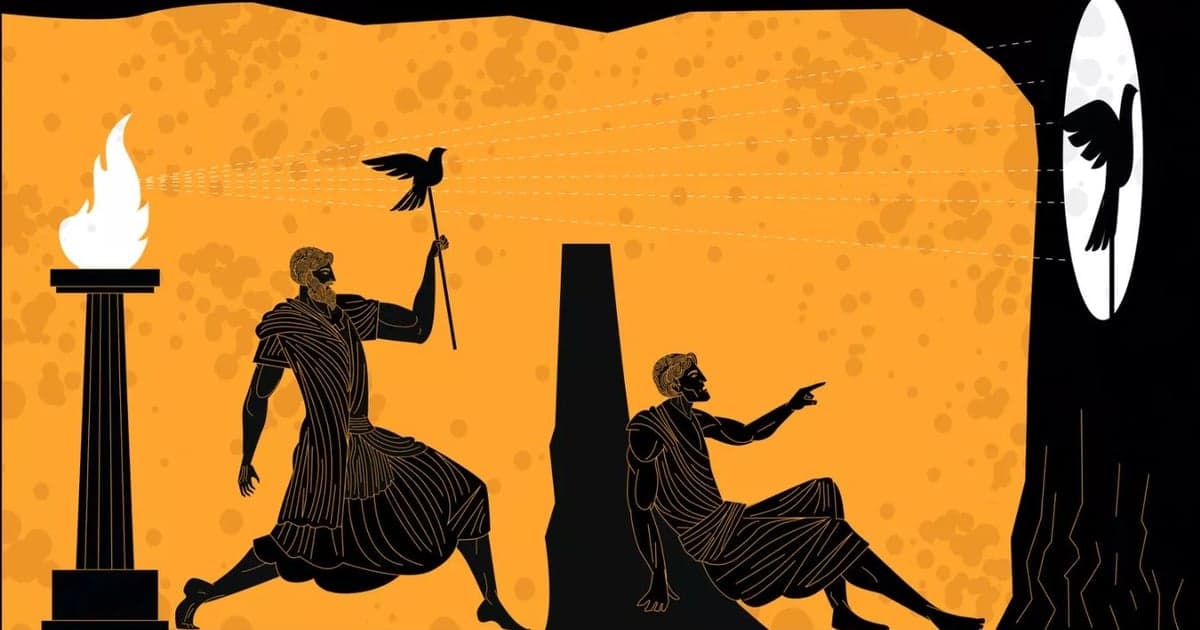
The Republic follows Socrates through a night-long conversation that begins with a simple question: what is justice? It spirals into an ambitious exploration of reality itself. Plato constructs an imaginary city from the ground up, examining what makes a society good, who should lead it, and whether truth can be taught or only discovered. Along the way he introduces ideas that still dominate Western thought: the Allegory of the Cave, where prisoners chained since birth mistake shadows for reality; the theory of Forms, which suggests everything we see is merely an imperfect copy of eternal templates; and the controversial claim that philosophers should be kings.
This is not dry academic philosophy. It is Socrates at his most provocative, relentlessly questioning his companions until their confident answers collapse. He builds his ideal city brick by brick, assigns each class its role, designs an education system that shapes souls rather than minds, and then watches it decay through five stages of corruption, each worse than the last. Tyranny, he argues, does not arrive by conquest. It grows from within, fed by the very freedoms that made the city feel good.
The Republic speaks to anyone who has wondered whether society could be better, questioned whether truth is objective or constructed, or felt the gap between how things are and how they should be. Plato forces uncomfortable questions: Can you handle the truth if it destroys your comfortable illusions? Should the wise govern the ignorant? Is your entire worldview built on shadows?
Written over 2,300 years ago, it remains startlingly relevant because the questions it raises about justice, knowledge, and the good life have never been answered, only endlessly reconsidered by each generation that inherits them. Wide Reads follows all ten books with Sophia, a public policy professor who imagines ideal systems while living in a flawed one, as the modern thread.
Essential Life Skills Deep Dive
Explore chapter-by-chapter breakdowns of the essential skills taught in this classic work.
Why Be Good When You Could Get Away With It
The Ring of Gyges challenge — Glaucon's demand that Socrates prove justice is worth choosing for its own sake, and Plato's psychological answer through the portrait of the tyrant.
The Cave
What you think is real may not be — the Allegory of the Cave, the Ship of State, and the cost of turning around and looking at the fire instead of the shadows.
What Makes a Leader Worth Following
Why the people best suited to power are those who don't want it — the philosopher-king argument, the Ship of State, and why genuine competence loses to charisma in democratic conditions.
How Good People Become Bad Systems
Five stages of political degeneration — aristocracy to timocracy to oligarchy to democracy to tyranny — each driven by people pursuing real values beyond their proper limits.
Table of Contents
The Festival and the First Question
The Republic begins at a festival for Bendis in the Piraeus, where Socrates and Glaucon are persuade...
The Challenge of Justice
Thrasymachus is silenced, but Glaucon refuses to let the argument rest. He sorts goods into three ki...
The Noble Lie and the Education of Guardians
Socrates turns from defending justice in the abstract to designing the education that would produce ...
The Soul's Three Parts
Adeimantus interrupts with a practical objection: Socrates' guardians live like ascetic soldiers, wi...
The Great Wave of Equality
Having outlined classes and education, Socrates provokes his friends with a first wave of paradox: w...
The Ship of Fools
Socrates must explain what philosophers are and why cities reject them. A philosopher loves learning...
The Cave and the Light
Socrates continues by asking who should learn philosophy and when. The young should not be thrown in...
The Decline of States and Souls
Adeimantus asks how the ideal city could fall, and Socrates answers that even good constitutions dec...
The Tyrant's Prison
Socrates argues that the tyrannical soul is the most unjust and therefore the least happy, reversing...
The Cave's Exit and Soul's Journey
The final book returns to poetry, pleasure, and immortality. Socrates renews his attack on tragic an...
About Plato
Published -375
Plato (428–348 BC) was born into an Athens that had just lost a generation-long war and watched its civic life turn brutal. He came from one of the city's most distinguished families, was groomed for politics, and might have taken his place among the powerful—until he saw something that changed the course of Western thought. In 399 BC, his teacher Socrates was tried on charges of impiety and corrupting the youth, convicted by a jury of his fellow citizens, and sentenced to drink hemlock. Plato was about thirty. He left public life, founded the Academy—the Western world's first sustained institution of higher learning—and spent the next fifty years writing.
What he produced was unlike anything before it: philosophy cast as conversation, not lecture. In his dialogues, Socrates walks through the streets, argues in private houses, catches his companions in contradictions, and refuses to let comfortable answers stand unexamined. Plato gives you the scene—the personalities, the stakes, the moment when someone's certainty cracks. You are not reading conclusions handed down from a podium. You are watching a mind think in real time.
The Republic is his most ambitious dialogue: a single night-long conversation that begins with a simple question about justice and expands into an entire city, a theory of the soul, the Allegory of the Cave, and a warning about how free societies decay into tyranny. It asks whether you would still choose to be good if you could get away with anything—and whether the people who want power most are the ones who should hold it.
Why Plato Matters Today
Plato speaks to the moment when the institutions you trusted stop making sense: the election that rewards performance over judgment, the workplace where the loudest voice wins, the comfortable belief you inherited and never examined. His answer is not cynicism. It is questioning. What is justice, really? Who should lead? What do you call knowledge when you have only ever seen shadows on a wall?
What makes him indispensable is that he never wrote philosophy as a finished system handed down from above. He wrote scenes. Socrates in a house in Piraeus, pressed by friends who want a clear answer and cannot get one. The Republic is not a blueprint for utopia. It is a stress test for every assumption you carry about fairness, education, power, and the good life. The Cave is not ancient metaphor. It is the feed, the algorithm, the consensus you mistake for reality because everyone around you mistakes it too.
Political philosophy is often reduced to slogans about freedom or order. Plato is the correction. He shows how good cities decay step by step, how the soul mirrors the state, and why the person who craves power is the last one you should give it to. Augustine, Machiavelli, and every modern debate about who deserves to govern still circle back to him. If you have ever wondered whether you would still do the right thing when no one was watching, Plato is the teacher who makes that question impossible to dodge.
More by Plato in Our Library
Wide Reads is different.
not a sparknotes, nor a cliffnotes
Two ways in
Read & listen to the summary
Walk with the characters. Hear the story told completely — chapter by chapter, with audio. Feel what they feel. The meaning arrives because you experienced it, not because someone listed bullet points. Every chapter has a summary that speaks.
Start with this.
Read the original text
The manuscript. The actual words the author wrote. Every book on Wide Reads includes the original text alongside the summary — so you can read Austen as Austen wrote her, Dostoevsky as he wrote his. Use the summary as a guide, then step into the source.
Then step into the source.
Either way, the door opens inward.
As you enter the realm — each chapter goes deeper
— and most of all, Why does this matter?
Get the Full Book
Purchase the complete book to access all chapters and support classic literature
Available in paperback, hardcover, and e-book formats
You Might Also Like


Free to read • No account required