
Das Kapital
Das Kapital
A Brief Description
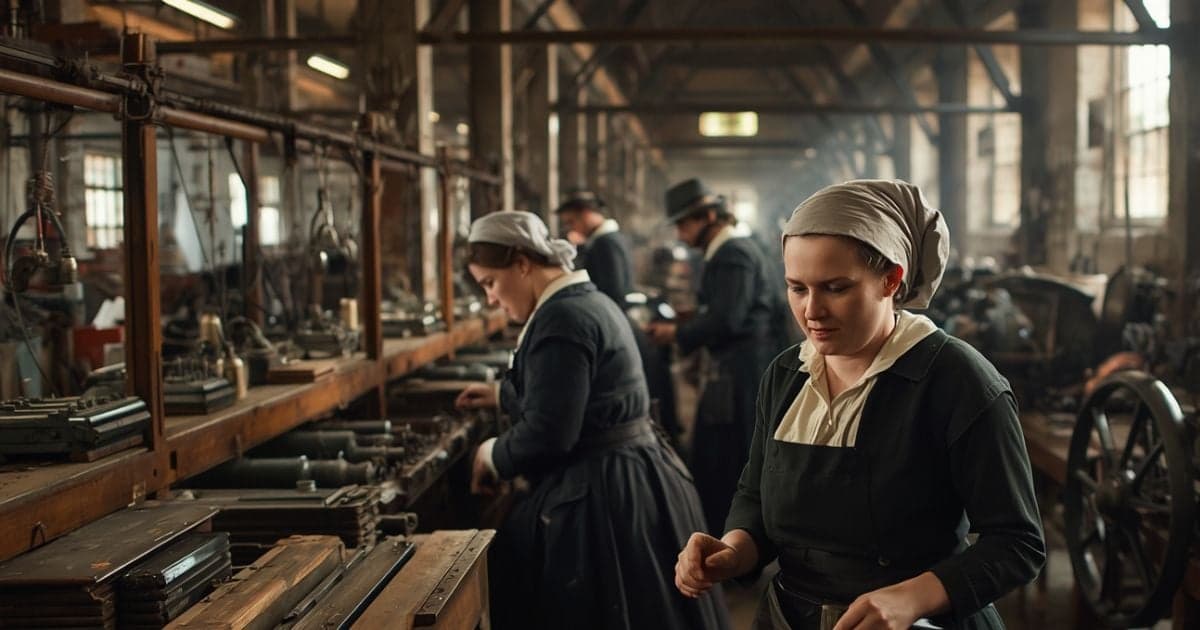
Das Kapital is Karl Marx's sweeping scientific dissection of capitalist production, exposing the hidden mechanics by which wealth is generated and inequality is reproduced. Marx begins with the humble commodity, a coat or a loaf of bread, and peels back layer after layer to reveal the labor time crystallized within it, the surplus value extracted from workers, and the relentless drive for accumulation that transforms money into capital. Volume 1 charts capitalism's inner logic from the factory floor through machinery, the working day, and primitive accumulation, showing how a system built on "free" exchange conceals a structured form of exploitation and carries within it the seeds of its own transformation.
Marx's central discovery is surplus value: the gap between what a worker's labor produces and what that worker is actually paid. Everything else, profit, rent, interest, and capital accumulation itself, flows from this gap. When you buy something in a store, you see a price. What Das Kapital teaches you to see is the invisible architecture behind that price: the hours of human effort absorbed into the object, the wage relationship that makes extraction possible, and the competition between capitalists that compels them to squeeze workers harder regardless of personal ethics or intention.
The book is not a call to individual villain-hunting. Marx argues that the problem is structural: even kind-hearted employers are forced by market competition to treat workers as costs to be minimized. The factory owner who pays generously goes bankrupt; the one who doesn't, survives. Das Kapital maps the logic of a system that produces outcomes no one necessarily chose.
Volume 1 moves through the working day, the factory, the rise of machinery, and the history of "primitive accumulation," the violent dispossession of peasants from common land that created the modern working class. Each chapter adds another layer to the portrait of how capitalism reproduces itself, not just economically but socially, legally, and ideologically.
Read carefully, Das Kapital becomes a set of analytical tools for understanding the world you actually live in. You'll see why wage negotiations feel one-sided, why productivity gains rarely raise your pay, why austerity always seems to fall on workers rather than owners, and why these outcomes keep recurring regardless of who is in charge. This is not abstract theory. It is a precise account of a system still operating today.
Life-Skill Deep Dives
Theme-by-theme chapter breakdowns of the essential skills in this classic work.
Seeing Labor Behind Commodities
5 chapters revealing the human work hidden inside every price tag, from the commodity to the wage illusion.
Understanding Surplus Value
6 chapters on where profit really comes from: the unpaid portion of the working day Marx calls surplus value.
Recognizing Alienation
5 chapters on division of labor, machinery, and why work can feel hollowing even when the paycheck arrives.
Analyzing Class Interests
5 chapters on structural conflict between workers and owners, from the working day to colonial dispossession.
Table of Contents
The Hidden Life of Things We Buy
Marx opens with the commodity, the cell-form of capitalist wealth. Every useful thing has a use-valu...
How Things Become Money
Commodities cannot walk to market on their own. They need owners who recognise one another as privat...
Money's Three Faces
With money in hand, Marx tracks how commodities actually circulate. Money first serves as a measure ...
The Money-Making Machine Revealed
Marx turns from circulation in general to capital in particular. Merchants and usurers already live ...
The Profit Puzzle
Marx now confronts the apparent contradiction head on. If equivalents exchange for equivalents, wher...
The Labor Deal: Why Workers Always Lose
The puzzle of Chapter 5 resolves here. The money-owner must discover a commodity whose use-value is ...
How Bosses Turn Work Into Profit
Marx crosses the threshold from market to workshop. The purchaser of labour-power consumes it by set...
The Two Faces of Labor
Marx now sorts the ingredients of production by how they behave in value terms. Means of production ...
The Rate of Surplus-Value
Marx turns to measurement. Surplus-value must be compared to variable capital alone, not to total ca...
The Battle for the Working Day
Measurement is not enough; the length of the working day is fought over in courts, factories, and st...
The Math of Exploitation
Marx steps back to arithmetic after the battle over hours. Holding the value of labour-power constan...
Working Smarter, Not Harder: The Productivity Trap
Marx opens Part IV by asking a precise question: if the working day is fixed at twelve hours, with t...
The Power of Working Together
Capitalist production begins when one employer puts many workers on the same task under one roof. At...
Division of Labor and Manufacture
Manufacture, dominant from the mid-sixteenth to late eighteenth century, is cooperation organized th...
Machinery and Modern Industry
Machinery completes the revolution manufacture began. Marx starts from the machine as an organized s...
About Karl Marx
Published 1867
Karl Marx (1818-1883) was born in Trier, Prussia, to a Jewish family that converted to Lutheranism under social pressure. He studied philosophy at Bonn and Berlin, earning his doctorate with a thesis on ancient Greek atomism, and quickly established himself as one of the sharpest minds of his generation. He was expelled from three countries, Germany, France, and Belgium, for his radical journalism and political organizing before settling permanently in London, where he spent the rest of his life in grinding poverty, supported largely by his friend and collaborator Friedrich Engels.
Das Kapital was the labor of decades. Marx spent years in the British Museum reading room, working through political economy, factory inspection reports, and parliamentary testimony to build an account of capitalism that was both philosophically rigorous and empirically grounded. Volume 1 was published in 1867; Marx died before finishing Volumes 2 and 3, which Engels edited from his manuscripts and published posthumously.
The book transformed history. It gave the labor movement an intellectual framework, shaped the revolutions of the twentieth century, and established the discipline of critical political economy. It has also been misread, selectively quoted, and weaponized by regimes Marx would have opposed. What the actual text rewards is something simpler: a careful, unsentimental look at how a specific economic system works, and who it works for.
Why This Author Matters Today
Reading Karl Marx is an act of self-discovery — one that tends to be more unsettling, and more rewarding, than you expect. Their work doesn't offer easy answers. It offers something rarer: the right questions. Questions about what we owe each other, what we owe ourselves, and what kind of person we are quietly becoming through the choices we make every day.
What makes Karl Marx indispensable isn't just their insight into human nature — it's their honesty about its contradictions. They understood that people are capable of extraordinary courage and ordinary cowardice, often in the same breath. That we can hold convictions firmly and abandon them the moment they cost us something. That the gap between who we think we are and who we actually are is where most of life's real drama lives.
In an age of noise, distraction, and the constant pressure to perform certainty we don't feel,Karl Marx is a corrective. Their pages slow you down and ask you to look more carefully — at the world, yes, but especially at yourself. Few writers have done more to show us that thinking well is not an academic exercise but a survival skill, and that the examined life is not a luxury but the only honest way to live.
Wide Reads is different.
not a sparknotes, nor a cliffnotes
Two ways in
Read & listen to the summary
Walk with the characters. Hear the story told completely — chapter by chapter, with audio. Feel what they feel. The meaning arrives because you experienced it, not because someone listed bullet points. Every chapter has a summary that speaks.
Start with this.
Read the original text
The manuscript. The actual words the author wrote. Every book on Wide Reads includes the original text alongside the summary — so you can read Austen as Austen wrote her, Dostoevsky as he wrote his. Use the summary as a guide, then step into the source.
Then step into the source.
Either way, the door opens inward.
As you enter the realm — each chapter goes deeper
— and most of all, Why does this matter?
Get the Full Book
Purchase the complete book to access all chapters and support classic literature
Available in paperback, hardcover, and e-book formats
You Might Also Like



Free to read • No account required