Wide Reads
Literature MattersLife IndexEducators
Sign in
Where to Begin
War and Peace - Dinner Table Power Dynamics

Leo Tolstoy

War and Peace

Dinner Table Power Dynamics

Home›Books›War and Peace›Chapter 27
Previous
27 of 361
Next

Summary

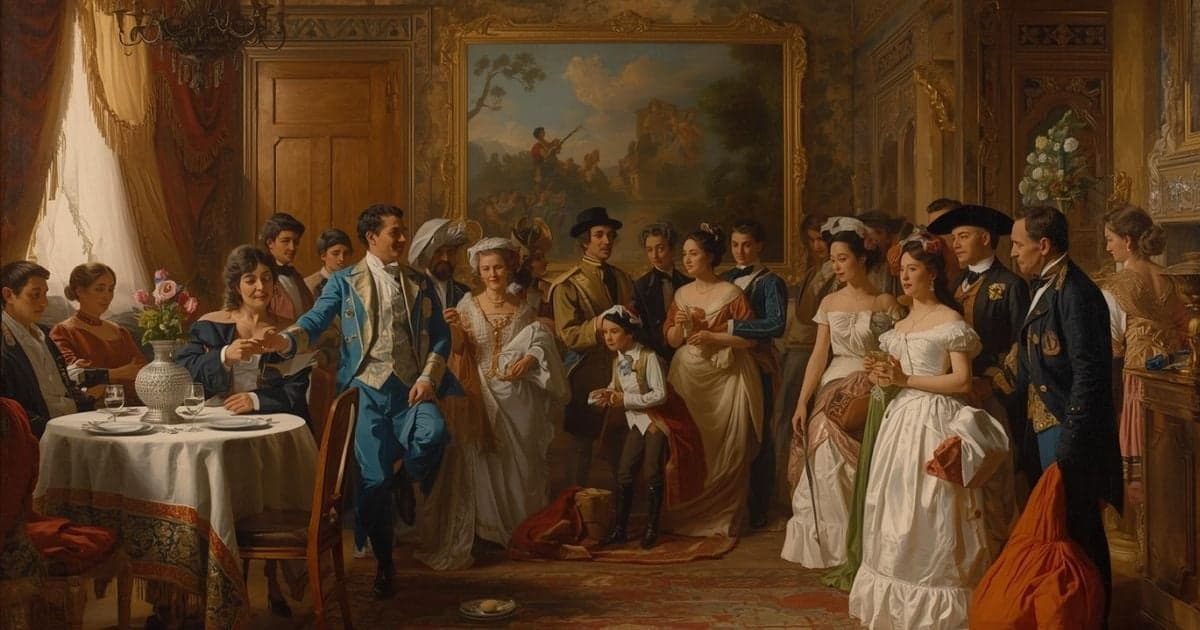
The old Prince Bolkonski holds court at his formal dinner table, and every interaction reveals the careful choreography of power. He's invited his architect Michael Ivanovich to dine with the family—not out of kindness, but to prove his theory that 'all men are equal' while simultaneously demonstrating his absolute control over who gets honored at his table. Prince Andrew sees through his father's contradictions, quietly mocking the family's genealogical pretensions while his sister Mary remains reverently blind to their father's flaws. The pregnant young princess tries to charm the intimidating patriarch with gossip and small talk, but he dismisses her efforts with cold calculation. The real drama unfolds in the political debate about Napoleon Bonaparte. The old prince, despite living in rural isolation, displays sharp knowledge of European military affairs, using the conversation to belittle modern generals and politicians while elevating the heroes of his youth. Andrew defends Bonaparte's tactical genius, creating a generational clash that reveals deeper tensions about change, tradition, and respect. Throughout the meal, servants hover attentively, the little princess sits in frightened silence, and every word carries weight beyond its surface meaning. This dinner isn't just about food—it's a masterclass in how authority figures use social settings to reinforce their dominance, test loyalties, and maintain the delicate balance of family hierarchy. The scene exposes how even intimate family gatherings can become battlegrounds where respect, fear, and love intersect in complex ways.

Coming Up in Chapter 28

After the tense dinner, private conversations reveal what family members really think when the patriarch isn't listening. The little princess finally speaks her mind about her formidable father-in-law.

Share it with friends

Previous ChapterNext Chapter
GO ADS FREE — JOIN US
Original text
complete·1,561 words
A

t the appointed hour the prince, powdered and shaven, entered the dining room where his daughter-in-law, Princess Mary, and Mademoiselle Bourienne were already awaiting him together with his architect, who by a strange caprice of his employer’s was admitted to table though the position of that insignificant individual was such as could certainly not have caused him to expect that honor. The prince, who generally kept very strictly to social distinctions and rarely admitted even important government officials to his table, had unexpectedly selected Michael Ivánovich (who always went into a corner to blow his nose on his checked handkerchief) to illustrate the theory that all men are equals, and had more than once impressed on his daughter that Michael Ivánovich was “not a whit worse than you or I.” At dinner the prince usually spoke to the taciturn Michael Ivánovich more often than to anyone else.

1 / 10

Master this chapter. Complete your experience

Purchase the complete book to access all chapters and support classic literature

Read Free on GutenbergBuy at Powell'sBuy on Amazon

As an Amazon Associate, we earn a small commission from qualifying purchases at no additional cost to you.

Available in paperback, hardcover, and e-book formats

GO ADS FREE — JOIN US

Why This Matters

Connect literature to life

Skill: Reading Power Dynamics

This chapter teaches how to recognize when authority figures use noble principles as cover for maintaining control.

Practice This Today

This week, notice when someone in authority preaches equality or fairness—then watch what they actually do and who they actually listen to.

GO ADS FREE — JOIN US

Now let's explore the literary elements.

Key Quotes & Analysis

"Michael Ivanovich was not a whit worse than you or I"

— Prince Bolkonski

Context: The prince's favorite theory about equality while simultaneously showing his power to elevate or dismiss people

Reveals the prince's hypocrisy - he claims to believe in equality while making it clear that dining with him is a special honor he grants. It's performative equality that actually reinforces hierarchy.

In Today's Words:

This guy's just as good as anyone else here - but aren't I generous for letting him sit at my table?

"Buonaparte was born with a silver spoon in his mouth. He has got splendid soldiers."

— Prince Bolkonski

Context: Dismissing Napoleon's military genius during the political debate

Shows how the old prince diminishes modern achievements by attributing them to luck rather than skill. He can't accept that the new generation might be genuinely superior.

In Today's Words:

That Napoleon guy just got lucky with good timing and decent troops.

"The genealogical tree of the Princes Bolkonski"

— Narrator

Context: Andrew looking at the family tree displayed prominently in the dining room

The physical display of family history shows how aristocrats used ancestry to justify their current power. It's literally putting their superiority on the wall for everyone to see.

In Today's Words:

Look at this fancy family tree showing how important we've always been.

Thematic Threads

Power

In This Chapter

The old prince uses dinner as a stage to demonstrate his absolute control over family dynamics and social hierarchy

Development

Building from earlier chapters showing various forms of social power

In Your Life:

You might see this when supervisors use team meetings to assert dominance rather than solve problems

Class

In This Chapter

The prince's treatment of his architect reveals how class boundaries are maintained through calculated gestures of inclusion

Development

Continues the theme of rigid social stratification from previous chapters

In Your Life:

You might experience this when wealthy patients treat you kindly but still expect subservience

Family Loyalty

In This Chapter

Mary reveres her father despite his cruelty while Andrew sees through the manipulation but stays silent

Development

Deepens the exploration of conflicted family bonds introduced earlier

In Your Life:

You might recognize this in family members who defend toxic relatives because 'that's just how they are'

Generational Conflict

In This Chapter

The political debate between father and son reveals deeper tensions about change versus tradition

Development

First major exploration of how different generations view progress and authority

In Your Life:

You might see this in workplace conflicts between older and younger staff about new procedures

Social Performance

In This Chapter

Every interaction at dinner is carefully choreographed theater designed to reinforce existing power structures

Development

Continues the theme of aristocratic social rituals as performance

In Your Life:

You might notice this in how people behave differently in formal workplace settings versus casual interactions

GO ADS FREE — JOIN US

You now have the context. Time to form your own thoughts.

Discussion Questions

  1. 1

    What contradictions do you notice between what the old prince says he believes and how he actually treats people at dinner?

    analysis • surface
  2. 2

    Why does the old prince invite his architect to dine with the family, and what does this reveal about how he uses 'kindness' as a tool?

    analysis • medium
  3. 3

    Where have you seen someone claim noble principles while exercising total control over a situation?

    application • medium
  4. 4

    How would you handle being in Prince Andrew's position - seeing through your father's manipulation but still needing to maintain the relationship?

    application • deep
  5. 5

    What does this dinner scene teach us about why people in authority often preach equality while demanding special treatment?

    reflection • deep

Critical Thinking Exercise

10 minutes

Map the Authority Figure

Think of someone in your life who holds authority over you - a boss, parent, teacher, or supervisor. Write down three things they say they believe in, then write down three ways they actually behave. Look for the gaps between their stated values and their actions. This isn't about judging them, but about understanding the pattern so you can navigate it more effectively.

Consider:

  • •Focus on patterns of behavior, not isolated incidents
  • •Consider that they might genuinely believe their own contradictions
  • •Think about how understanding this pattern could help you respond differently

Journaling Prompt

Write about a time when you recognized someone's contradictions between their words and actions. How did this realization change how you interacted with them? What would you do differently now?

Coming Up Next...

Chapter 28: The Weight of Farewell

After the tense dinner, private conversations reveal what family members really think when the patriarch isn't listening. The little princess finally speaks her mind about her formidable father-in-law.

Continue to Chapter 28
Previous
Family Rituals and War Plans
Contents
Next
The Weight of Farewell

Continue Exploring

War and Peace Study GuideTeaching ResourcesEssential Life IndexBrowse by ThemeAll Books
Power & CorruptionLove & RelationshipsIdentity & Self-Discovery

You Might Also Like

Anna Karenina cover

Anna Karenina

Leo Tolstoy

Also by Leo Tolstoy

The Idiot cover

The Idiot

Fyodor Dostoevsky

Explores love & romance

Moby-Dick cover

Moby-Dick

Herman Melville

Explores mortality & legacy

Dracula cover

Dracula

Bram Stoker

Explores love & romance

Browse all 47+ books

Share This Chapter

Know someone who'd enjoy this? Spread the wisdom!

TwitterFacebookLinkedInEmail

Read ad-free with Prestige

Get rid of ads, unlock study guides and downloads, and support free access for everyone.

Subscribe to PrestigeCreate free account
Intelligence Amplifier
Intelligence Amplifier™Powering Wide Reads

Exploring human-AI collaboration through books, essays, and philosophical dialogues. Classic literature transformed into navigational maps for modern life.

2025 Books

→ The Amplified Human Spirit→ The Alarming Rise of Stupidity Amplified→ San Francisco: The AI Capital of the World
Visit intelligenceamplifier.org
hello@widereads.com

WideReads Originals

→ You Are Not Lost→ The Last Chapter First→ The Lit of Love→ Wealth and Poverty→ 10 Paradoxes in the Classics · coming soon
Arvintech
arvintechAmplify your Mind
Visit at arvintech.com

Navigate

  • Home
  • Library
  • Essential Life Index
  • How It Works
  • Subscribe
  • Account
  • About
  • Contact
  • Authors
  • Suggest a Book
  • Landings

Made For You

  • Students
  • Educators
  • Families
  • Readers
  • Literary Analysis
  • Finding Purpose
  • Letting Go
  • Recovering from a Breakup
  • Corruption
  • Gaslighting in the Classics

Newsletter

Weekly insights from the classics. Amplify Your Mind.

Legal

  • Privacy Policy
  • Terms of Service
  • Cookie Policy
  • Accessibility

Why Public Domain?

We focus on public domain classics because these timeless works belong to everyone. No paywalls, no restrictions—just wisdom that has stood the test of centuries, freely accessible to all readers.

Public domain books have shaped humanity's understanding of love, justice, ambition, and the human condition. By amplifying these works, we help preserve and share literature that truly belongs to the world.

A Pilgrimage

Powell's City of Books

Portland, Oregon

If you ever find yourself in Portland, walk to the corner of Burnside and 10th. The building takes up an entire city block. Inside is over a million books, new and used on the same shelf, organized by color-coded rooms with names like the Rose Room and the Pearl Room. You can lose an afternoon. You can lose a weekend. You will find a book you have been looking for your whole life, and three you did not know existed.

It is a pilgrimage. We cannot find a bookstore like it anywhere on earth. If you read the classics, and you ever get the chance, go. It belongs on every reader's bucket list.

Visit powells.com

We are not in any way affiliated with Powell's. We are just a very big fan.

© 2026 Wide Reads™. All Rights Reserved.

Intelligence Amplifier™ and Wide Reads™ are proprietary trademarks of Arvin Lioanag.

Copyright Protection: All original content, analyses, discussion questions, pedagogical frameworks, and methodology are protected by U.S. and international copyright law. Unauthorized reproduction, distribution, web scraping, or use for AI training is strictly prohibited. See our Copyright Notice for details.

Disclaimer: The information provided on this website is for general informational and educational purposes only and does not constitute professional, legal, financial, or technical advice. While we strive to ensure accuracy and relevance, we make no warranties regarding completeness, reliability, or suitability. Any reliance on such information is at your own risk. We are not liable for any losses or damages arising from use of this site. By using this site, you agree to these terms.