Wide Reads
Literature MattersLife IndexEducators
Sign in
Where to Begin
War and Peace - Family Rituals and War Plans

Leo Tolstoy

War and Peace

Family Rituals and War Plans

Home›Books›War and Peace›Chapter 26
Previous
26 of 361
Next

Summary

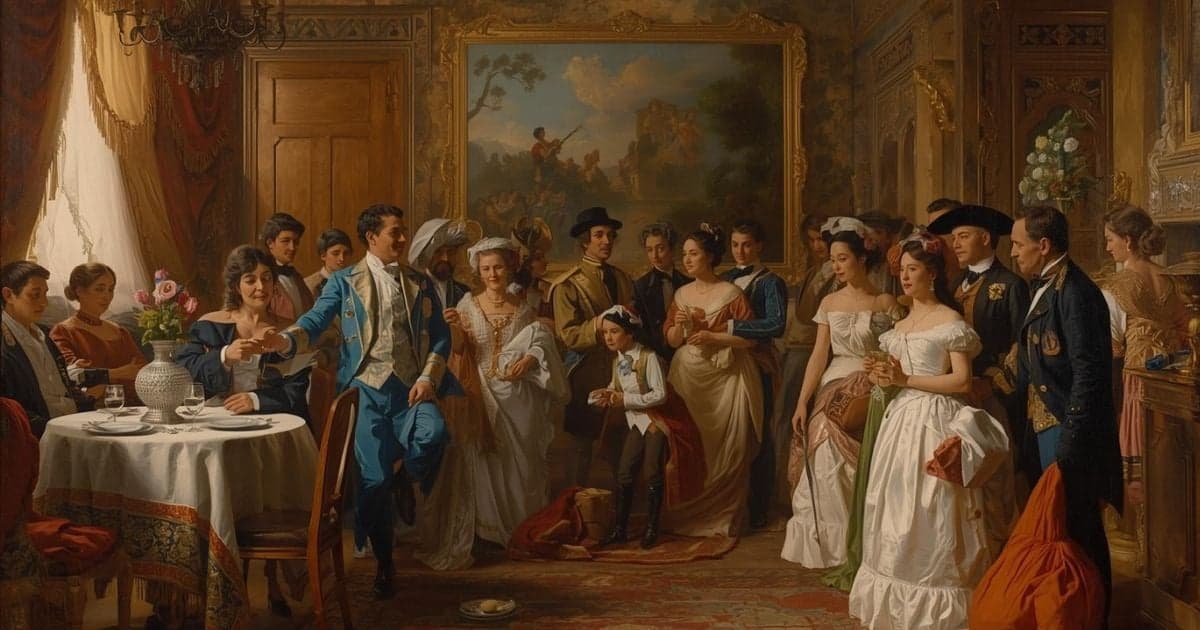
Prince Andrew returns home with his pregnant wife Lise to visit his father and sister Princess Mary before departing for war. The chapter reveals the rigid structure of the old prince's household, where even his son's arrival cannot disrupt the established daily routine. The contrast between personalities becomes immediately apparent: Lise is bubbly and talkative, Princess Mary is gentle and emotional, while Andrew appears uncomfortable with displays of affection. The reunion between the two women is tearfully joyful, but Andrew finds their emotional outpouring awkward and unnatural. Meanwhile, his father maintains his eccentric habits—precise schedules, mathematical lessons, and dismissive attitudes toward modern military strategy. When Andrew finally meets with his father, the old prince shows both affection and stubborn opinions, insisting on hearing war plans while simultaneously mocking them. The old man's interruptions during Andrew's military briefing reveal his scattered attention and preoccupation with domestic details, even as his son prepares for battle. This chapter establishes the family dynamics that will influence Andrew's emotional development throughout the novel, showing how different generations and personalities cope with love, duty, and impending separation. The structured household routines provide comfort and continuity, even as war threatens to disrupt everything.

Coming Up in Chapter 27

The family dinner brings together all these contrasting personalities under one roof, where the old prince's sharp tongue and strong opinions will create tension as Andrew's departure for war looms closer.

Share it with friends

Previous ChapterNext Chapter
GO ADS FREE — JOIN US
Original text
complete·1,951 words
T

he gray-haired valet was sitting drowsily listening to the snoring of the prince, who was in his large study. From the far side of the house through the closed doors came the sound of difficult passages—twenty times repeated—of a sonata by Dussek.

Just then a closed carriage and another with a hood drove up to the porch. Prince Andrew got out of the carriage, helped his little wife to alight, and let her pass into the house before him. Old Tíkhon, wearing a wig, put his head out of the door of the antechamber, reported in a whisper that the prince was sleeping, and hastily closed the door. Tíkhon knew that neither the son’s arrival nor any other unusual event must be allowed to disturb the appointed order of the day. Prince Andrew apparently knew this as well as Tíkhon; he looked at his watch as if to ascertain whether his father’s habits had changed since he was at home last, and, having assured himself that they had not, he turned to his wife.

“He will get up in twenty minutes. Let us go across to Mary’s room,” he said.

1 / 12

Master this chapter. Complete your experience

Purchase the complete book to access all chapters and support classic literature

Read Free on GutenbergBuy at Powell'sBuy on Amazon

As an Amazon Associate, we earn a small commission from qualifying purchases at no additional cost to you.

Available in paperback, hardcover, and e-book formats

GO ADS FREE — JOIN US

Why This Matters

Connect literature to life

Skill: Reading Fear Disguised as Control

This chapter teaches how to recognize when someone's rigid behavior stems from fear rather than genuine authority.

Practice This Today

This week, notice when someone insists on following procedures during emotional moments—they might be using rules to avoid vulnerability.

GO ADS FREE — JOIN US

Now let's explore the literary elements.

Key Quotes & Analysis

"He will get up in twenty minutes. Let us go across to Mary's room."

— Prince Andrew

Context: Andrew tells his wife they must wait because his father is napping on schedule

Shows how completely the father's routine dominates the household. Even Andrew's return from a long absence and departure for war cannot disrupt the established order.

In Today's Words:

Dad's still sleeping and we can't wake him up, so we'll have to wait.

"Why, this is a palace!"

— Lise

Context: The little princess comments on the house as they enter

Demonstrates her attempt to be the perfect guest, complimenting her host even though this is her family home. It shows her social training and desire to please.

In Today's Words:

Wow, this place is amazing! (Even though I've been here before and feel obligated to say something nice)

"Tíkhon knew that neither the son's arrival nor any other unusual event must be allowed to disturb the appointed order of the day."

— Narrator

Context: Explaining why the servant won't wake the sleeping prince

Reveals how completely routine has taken over this household. Even major life events like a son's final visit before war cannot interrupt the schedule.

In Today's Words:

The routine was more important than anything else happening in their lives.

Thematic Threads

Control

In This Chapter

The old prince maintains absolute control over household routines, even when his son returns from war

Development

Introduced here

In Your Life:

You might recognize this when you insist on your usual routine during family visits instead of being present for rare time together.

Emotional Distance

In This Chapter

Andrew feels uncomfortable with his wife and sister's tearful reunion, finding their emotions 'awkward and unnatural'

Development

Introduced here

In Your Life:

You might see this when you feel awkward around coworkers who express genuine emotion or vulnerability.

Generational Conflict

In This Chapter

Father dismisses son's military knowledge while demanding to hear war plans, showing both love and stubborn opinions

Development

Introduced here

In Your Life:

You might experience this when older family members simultaneously worry about your choices while dismissing your expertise.

Social Expectations

In This Chapter

Each family member performs their expected role—bubbly wife, gentle sister, dutiful son—even during emotional reunion

Development

Introduced here

In Your Life:

You might notice this when you automatically slip into expected family roles during visits, even when they don't fit who you are now.

Duty vs. Connection

In This Chapter

Andrew fulfills his duty to visit family before war, but struggles to genuinely connect with their emotions

Development

Introduced here

In Your Life:

You might see this when you check all the boxes of being a good family member without actually being emotionally present.

GO ADS FREE — JOIN US

You now have the context. Time to form your own thoughts.

Discussion Questions

  1. 1

    Why does the old prince refuse to change his daily routine even when his son returns from war?

    analysis • surface
  2. 2

    What does Andrew's discomfort with emotional displays reveal about how he's learned to cope with feelings?

    analysis • medium
  3. 3

    Where have you seen people use rigid routines or rules to avoid dealing with difficult emotions or situations?

    application • medium
  4. 4

    How would you balance maintaining helpful structure while staying emotionally available to people you care about?

    application • deep
  5. 5

    What does this family's struggle with connection teach us about the difference between being organized and being present?

    reflection • deep

Critical Thinking Exercise

10 minutes

Audit Your Own Armor

Think about your own daily routines and habits. Make two lists: structures that help you connect with others (family dinner time, regular check-ins with friends) and structures that might be protecting you from difficult emotions or conversations (always being busy, strict schedules that prevent spontaneous connection). Be honest about which category each routine really falls into.

Consider:

  • •Notice when you feel most resistant to changing a routine - that resistance often signals emotional protection
  • •Consider whether your structures serve the people in your life or just make you feel more in control
  • •Think about times when flexibility led to better outcomes than sticking to the plan

Journaling Prompt

Write about a time when your need for routine or control prevented you from being fully present for someone who needed you. What were you really protecting yourself from?

GO ADS FREE — JOIN US

Coming Up Next...

Chapter 27: Dinner Table Power Dynamics

The family dinner brings together all these contrasting personalities under one roof, where the old prince's sharp tongue and strong opinions will create tension as Andrew's departure for war looms closer.

Continue to Chapter 27
Previous
The Clockwork Prince and His Daughter
Contents
Next
Dinner Table Power Dynamics

Continue Exploring

War and Peace Study GuideTeaching ResourcesEssential Life IndexBrowse by ThemeAll Books
Power & CorruptionLove & RelationshipsIdentity & Self-Discovery

You Might Also Like

Anna Karenina cover

Anna Karenina

Leo Tolstoy

Also by Leo Tolstoy

The Idiot cover

The Idiot

Fyodor Dostoevsky

Explores love & romance

Moby-Dick cover

Moby-Dick

Herman Melville

Explores mortality & legacy

Dracula cover

Dracula

Bram Stoker

Explores love & romance

Browse all 47+ books

Share This Chapter

Know someone who'd enjoy this? Spread the wisdom!

TwitterFacebookLinkedInEmail

Read ad-free with Prestige

Get rid of ads, unlock study guides and downloads, and support free access for everyone.

Subscribe to PrestigeCreate free account
Intelligence Amplifier
Intelligence Amplifier™Powering Wide Reads

Exploring human-AI collaboration through books, essays, and philosophical dialogues. Classic literature transformed into navigational maps for modern life.

2025 Books

→ The Amplified Human Spirit→ The Alarming Rise of Stupidity Amplified→ San Francisco: The AI Capital of the World
Visit intelligenceamplifier.org
hello@widereads.com

WideReads Originals

→ You Are Not Lost→ The Last Chapter First→ The Lit of Love→ Wealth and Poverty→ 10 Paradoxes in the Classics · coming soon
Arvintech
arvintechAmplify your Mind
Visit at arvintech.com

Navigate

  • Home
  • Library
  • Essential Life Index
  • How It Works
  • Subscribe
  • Account
  • About
  • Contact
  • Authors
  • Suggest a Book
  • Landings

Made For You

  • Students
  • Educators
  • Families
  • Readers
  • Literary Analysis
  • Finding Purpose
  • Letting Go
  • Recovering from a Breakup
  • Corruption
  • Gaslighting in the Classics

Newsletter

Weekly insights from the classics. Amplify Your Mind.

Legal

  • Privacy Policy
  • Terms of Service
  • Cookie Policy
  • Accessibility

Why Public Domain?

We focus on public domain classics because these timeless works belong to everyone. No paywalls, no restrictions—just wisdom that has stood the test of centuries, freely accessible to all readers.

Public domain books have shaped humanity's understanding of love, justice, ambition, and the human condition. By amplifying these works, we help preserve and share literature that truly belongs to the world.

A Pilgrimage

Powell's City of Books

Portland, Oregon

If you ever find yourself in Portland, walk to the corner of Burnside and 10th. The building takes up an entire city block. Inside is over a million books, new and used on the same shelf, organized by color-coded rooms with names like the Rose Room and the Pearl Room. You can lose an afternoon. You can lose a weekend. You will find a book you have been looking for your whole life, and three you did not know existed.

It is a pilgrimage. We cannot find a bookstore like it anywhere on earth. If you read the classics, and you ever get the chance, go. It belongs on every reader's bucket list.

Visit powells.com

We are not in any way affiliated with Powell's. We are just a very big fan.

© 2026 Wide Reads™. All Rights Reserved.

Intelligence Amplifier™ and Wide Reads™ are proprietary trademarks of Arvin Lioanag.

Copyright Protection: All original content, analyses, discussion questions, pedagogical frameworks, and methodology are protected by U.S. and international copyright law. Unauthorized reproduction, distribution, web scraping, or use for AI training is strictly prohibited. See our Copyright Notice for details.

Disclaimer: The information provided on this website is for general informational and educational purposes only and does not constitute professional, legal, financial, or technical advice. While we strive to ensure accuracy and relevance, we make no warranties regarding completeness, reliability, or suitability. Any reliance on such information is at your own risk. We are not liable for any losses or damages arising from use of this site. By using this site, you agree to these terms.