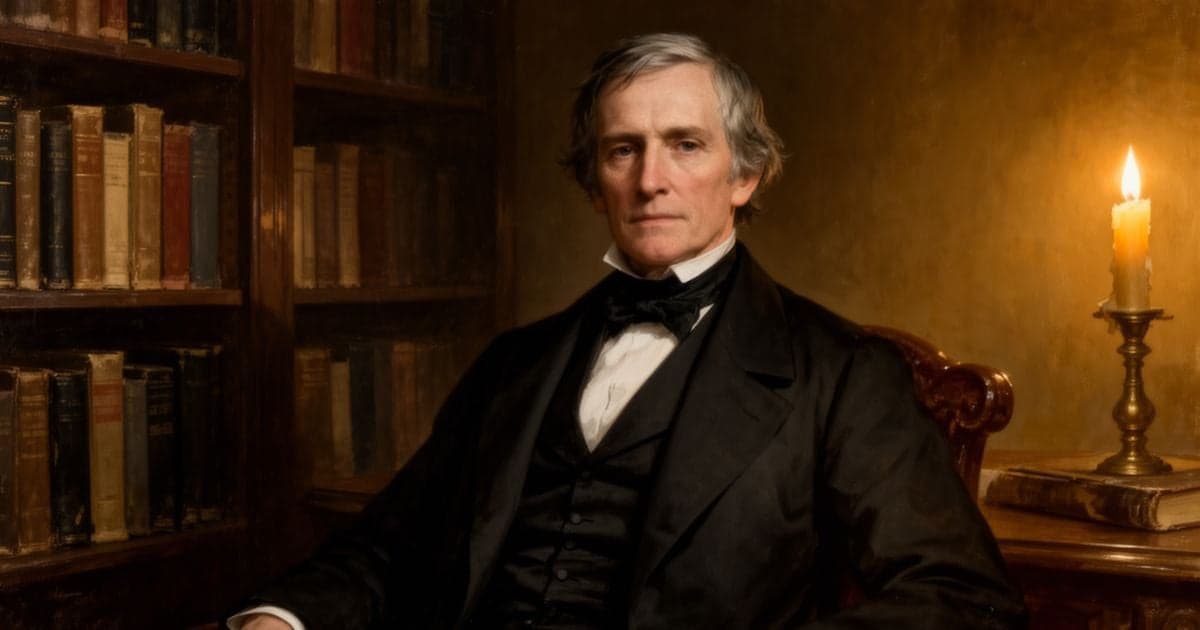
Free study guide · no paywall
WaldenStudy Guide
by Henry David Thoreau (1854)

Prestige · $2.99/month
Chapter audio, theme analysis, and downloads
Free study guide · no paywall
by Henry David Thoreau (1854)
A two-year ledger argument for deliberate living, mapped across 17 chapters and six lessons.

Start here
17 chapter summaries · 5 key figures · discussion questions · quotes · free
Henry David Thoreau borrows an axe, builds a cabin on Emerson's Walden Pond woodlot for twenty-eight dollars and twelve and a half cents, and stays two years, two months, and two days beginning on the Fourth of July, 1845. Economy opens with the house cost and the claim that the mass of men lead lives of quiet desperation. He hoes beans, visits Concord, meets John Field at Baker Farm, sounds the pond through ice, and leaves when the audit is done, refusing to turn the cabin into a brand.
What readers search for
Thoreau builds a cabin for twenty-eight dollars and twelve and a half cents on Emerson's woodlot and stays two years, two months, and two days starting July 4, 1845. The book is not a nature diary. It is a ledger argument: most of what people call necessity is a choice they never audited, and most of what they sell their hours for is the thing that keeps them from feeling alive. He went to the woods to live deliberately and front only the essential facts of life.
Deliberate LivingBecause he wished to live deliberately, not because he hated society or wanted a permanent hermitage. Economy opens with the house cost and the claim that the mass of men lead lives of quiet desperation. Where I Lived, and What I Lived For names the experiment: simplify, bathe in the pond as morning rite, and see whether the hours you sell match what you actually need. He leaves when the audit is done, which is part of the point.
Deliberate LivingThoreau's opening claim in Economy: most people sell most of a waking life for a farm, a coat, or a reputation they never chose, then call the bargain necessity. The Concord neighbor lives it; John Field at Baker Farm works himself poorer chasing tea and meat Thoreau has already dropped. Quiet desperation is not loud misery. It is the routine that never gets audited because everyone around you is running the same ledger.
Reading Hidden SystemsTwo years, two months, and two days, beginning on the Fourth of July, 1845. He publishes nine years later with accounts of Economy, the bean-field, Baker Farm, the pond in winter, and a Conclusion that refuses to turn the cabin into a brand. The ending matters: he leaves as deliberately as he entered. The woods were a tool for asking what you need, not an identity to perform forever.
Voluntary SimplicityAudit the life you are already living before you chase a bigger one. Thoreau sorts necessities from comforts from luxuries, watches railroad sleepers laid under the rails, sounds the pond through ice to find its deepest point, and treats that geometry as a method for finding depth in a person. The message is not "move to a forest." It is: name what costs you your hours, then decide whether the price is yours.
Simplifying What You Actually NeedFast track
These six chapters carry the argument end to end: the ledger, the bean field, John Field at Baker Farm, the wildness question, the pond sounded through ice, and the different drummer at the close.
Full coverage
The same surfaces readers expect from a traditional study guide — plot, characters, themes, quotes, and homework help — grouped across 4 parts, with audio and the source text on every chapter. Free, no paywall.
Plot overview
Summary, context, and why the book still matters
17 chapter summaries
Every chapter with audio narration
5 key figures
Who drives the plot and what each one does
6 lessons
Themes traced to scenes, not generic labels
15+ important quotes
Verified lines with chapter links and analysis
Discussion questions
Five per chapter, with suggested answers for class and essays
Original text
Author's words beside every summary
This is not a nature diary or a back-to-the-woods manifesto. Wide Reads walks Walden as an audit: Thoreau goes into the woods to run the numbers on what a life actually costs, and the six lessons map what he finds there — from voluntary simplicity to the different drummer at the end. Use the part-by-part path below to keep your bearings, and open individual chapters for summaries, quotes, and audio.
For plot and theme questions about Walden, see Common Questions on the book page.
How to use this guide
Economy (Chapter 1) opens with the house cost — twenty-eight dollars and twelve and a half cents — and the claim that the mass of men lead lives of quiet desperation. Get the numbers before the philosophy, or the argument lands abstract.
Chapters 7–11 test the experiment against Concord: the bean field, the village, the ponds, Baker Farm. This is where John Field appears and Thoreau watches a man work himself poorer chasing the table he has already dropped.
Chapters 12–16 move through house-warming into winter and spring. Chapter 15 sounds the ice and finds the deepest point at the crossing of the longest and widest axes. Chapter 17 closes the experiment by leaving it deliberately.
Plot & context
He writes twenty-eight dollars and twelve and a half cents in a column and calls it a house. Boards, nails, a chimney, two windows. Henry David Thoreau borrowed an axe, walked onto Emerson's woodlot at Walden Pond, and built the cabin he would occupy for two years, two months, and two days, beginning on the Fourth of July, 1845. The book he published nine years later is not a nature diary. It is a ledger argument. Most of what people treat as necessity is a choice they never audited, and most of what they sell their hours for is the thing that keeps them from feeling alive. He went to the woods, he says, because he wished to live deliberately, to front only the essential facts of life, and not, when he came to die, discover that he had not lived.
Thoreau is the surveyor who keeps the accounts: lumber, seed, the going rate for a day's labor, then the hours those numbers buy back. The Concord neighbor is the addressee who lives what Thoreau names quiet desperation, selling most of a waking life for a farm, a coat, or a reputation he did not choose. John Field, the Irishman at Baker Farm, is the example who works himself poorer chasing tea, coffee, and meat that Thoreau has already dropped. The railroad sleeper is the Irish or Yankee man laid under the rails so someone else can ride. The news-reader at the Mill-dam is the opponent who thinks Spain and a fire-bell are more urgent than the day in front of him. The ice-cutters who harvest Walden for Calcutta are the market walking onto the pond and leaving. The pressure among them is not who loves woods. It is who gets to name what a life costs, and who pays without looking at the bill.
Economy opens with the house cost and the claim that the mass of men lead lives of quiet desperation. Where I Lived, and What I Lived For names the experiment: live deliberately, simplify, bathe in the pond as if morning were a rite, and treat the railroad as something that rides on men rather than the other way around. The Bean-Field turns hoeing into chosen work, two and a half acres of beans that pay in more than money. The Village sends him into Concord for gossip and the woods he gets lost in on the way home. Baker Farm is the hinge. He meets John Field and watches a man trade his days for a table Thoreau has already proven he can do without. Brute Neighbors watches an ant war with the attention of a military historian. The Pond in Winter is a plumb line. He sounds the ice, finds the deepest point at the crossing of the longest and widest axes, and treats that geometry as a method for finding depth in a person. Conclusion refuses to stay. He leaves the woods as deliberately as he entered, and says that if a man does not keep pace with his companions, perhaps he hears a different drummer.
Thoreau reports an experiment he can measure. Borrowed land, laundry done in town, dinners in Concord: the margins show the freedom the experiment required. Educated, unmarried, without dependents. He treats that freedom as a method, not a costume. The ending is earned because he leaves. The woods were a tool. The last pages refuse both the man who never tries the audit and the man who would turn the cabin into a brand. What remains is a habit of asking what you actually need, what you actually want, and whether the hours match.
Read the full summary on the book page →
The pressure Thoreau names — selling hours for things you never chose — is more legible now than in 1854. The cabin is not the point. The audit is. People still arrive at this book when a busy schedule has outrun any clear reason for the busyness, or when comfort has become the thing that costs the most. This guide keeps the ledger tied to the specific rooms, objects, and chapters where Thoreau runs the numbers.
Henry David Thoreau (1817-1862) was born in Concord, Massachusetts, graduated from Harvard in 1837, and spent most of his life within a few miles of his birthplace. He worked as a schoolteacher, pencil-maker in his family's factory, and surveyor, occupations that left enough time for the long daily walks he considered essential to his thinking. Emerson owned the Walden Pond woodlot where Thoreau ran his famous two-year experiment, and their friendship anchored the Transcendentalist circle. Where Emerson's prose is oratorical and expansive, Thoreau's is precise and dry. He kept detailed journals for over twenty years, measuring rainfall, recording ice-out dates, and cataloging wildflowers with the exactness of a naturalist. His essay "Resistance to Civil Government," now known as "Civil Disobedience," followed his 1846 arrest for refusing a poll tax that supported slavery and the Mexican-American War. The essay influenced Tolstoy, Gandhi, and the American civil rights movement. He died of tuberculosis at forty-four with only two books published in his lifetime. Walden and the posthumous journals confirmed what readers still find in him: a disciplined mind that turned a borrowed axe and a ledger into a method for living deliberately.
Themes with proof
Six pressures repeat across the seventeen chapters: live deliberately instead of inheriting pace; simplify what you actually need through necessities, comforts, and luxuries; treat attention as practice from sunrise to the ant war; read hidden systems in railroad sleepers and ice bound for Calcutta; choose voluntary simplicity before overflow costs you; and follow your own direction when the herd's drummer is not yours. Each spoke ties named chapters to the pattern.
Deep dives
Character guide
Who drives the plot, what each one wants, and why they matter to the argument of the book.
Surveyor, pencil-maker, and the book's auditor — the man who borrowed an axe, kept the books, and left when the experiment was done.
Owner of the Walden Pond woodlot and Thoreau's neighbor — the patron whose land makes the experiment possible.
The Irishman at Baker Farm who works himself poorer chasing tea and meat that Thoreau has already dropped — the hinge figure of Part II.
The French-Canadian woodcutter — instinctive, largely unread, and in some ways freer than any educated Concord villager.
The unnamed addressee throughout: the person living the life of quiet desperation, selling most of a waking life for a farm or a reputation they did not choose.
Memorable lines
Verified passages with chapter links — the lines teachers and essays keep returning to.
“I went to the woods because I wished to live deliberately, to front only the essential facts of life, and see if I could not learn what it had to teach, and not, when I came to die, discover that I had not lived.”
“To be awake is to be alive.”
“How many a man has dated a new era in his life from the reading of a book.”
“Most men are satisfied if they read or hear read, and perchance have been convicted by the wisdom of one good book, the Bible, and for the rest of their lives vegetate and dissipate their faculties in what is called easy reading.”
“I did not read books the first summer; I hoed beans.”
“I grew in those seasons like corn in the night, and they were far better than any work of the hands would have been.”
“I have never felt lonesome, or in the least oppressed by a sense of solitude, but once, and that was a few weeks after I came to the woods, when, for an hour, I doubted if the near neighborhood of man was not essential to a serene and healthy life.”
“I find it wholesome to be alone the greater part of the time. To be in company, even with the best, is soon wearisome and dissipating.”
“I had three chairs in my house; one for solitude, two for friendship, three for society.”
“Individuals, like nations, must have suitable broad and natural boundaries, even a considerable neutral ground, between them.”
“I cherish them, I hoe them, early and late I have an eye to them; and this is my day’s work.”
“I was determined to know beans.”
“As I walked in the woods to see the birds and squirrels, so I walked in the village to see the men and boys; instead of the wind among the pines I heard the carts rattle.”
“Not till we are lost, in other words not till we have lost the world, do we begin to find ourselves, and realize where we are and the infinite extent of our relations.”
“The fruits do not yield their true flavor to the purchaser of them, nor to him who raises them for the market.”
Class & essay prep
Sample prompts drawn from the chapter guides — each with suggested answers for seminars and written work.
In the opening pages Thoreau describes walking every farm within twelve miles purely in imagination and 'purchasing' each one without money. What does this practice reveal about the relationship between wanting something and actually having it?
From Chapter 1Thoreau claims that 'the mass of men lead lives of quiet desperation.' What specific conditions in Concord society does he identify as causing this desperation, and which of those conditions does his Walden experiment directly address?
From Chapter 1Thoreau distinguishes between 'reading' books and truly reading them. What specific conditions does he say are necessary for reading to become the serious practice he values?
From Chapter 2Thoreau argues that Concord residents support newspapers, gossip, and light entertainment but would not pay to bring a genuine lecturer or scholar to town. What does this observation reveal about the difference between what people say they value and what they actually seek?
From Chapter 2In this chapter Thoreau sits in his doorway for hours doing nothing, then describes it as the most productive use of his time. What does he mean by productivity here, and how does it differ from the usual definition?
From Chapter 3Thoreau describes the train's arrival as both an intrusion and a kind of spectacle. What does his ambivalent response to the railroad reveal about his attitude toward industrial progress?
From Chapter 3Thoreau claims he has never felt lonely at Walden except once, briefly. What explanation does he give for why solitude is not equivalent to loneliness, and what does he say loneliness actually requires?
From Chapter 4Thoreau writes that 'we are for the most part more lonely when we go abroad among men than when we stay in our chambers.' What specific experience does he describe in this chapter that supports this claim?
From Chapter 4Thoreau describes his three chairs as representing solitude, friendship, and society. What does this image reveal about how he thinks conversation functions at different scales?
From Chapter 5When guests filled his cabin, Thoreau moved the real conversations to the pine woods behind the house. What does this action suggest about the relationship between physical space and the depth of what people are willing to say?
From Chapter 5Thoreau plants beans not to sell them but to 'know beans', as an inquiry rather than an enterprise. What does this distinction reveal about his understanding of the purpose of work?
From Chapter 6While hoeing his rows, Thoreau hears distant military music and drums and feels the contrast sharply. What does this moment reveal about the different claims that society and the individual make on a person's day?
From Chapter 6Thoreau describes walking into the village as entering a system he can observe from outside. What specific behaviors does he notice that he says villagers cannot see in themselves?
From Chapter 7Thoreau is briefly arrested and jailed during this chapter for refusing to pay his poll tax. How does he describe his experience of the jail, and what does his reaction suggest about where he locates the real prison?
From Chapter 7Thoreau calls Walden Pond 'earth's eye' and spends considerable time describing its color, clarity, and depths. What argument is he making about the kind of attention a natural feature like a pond deserves?
From Chapter 8Chapter by chapter
Grouped by 4 sections — the same structure as the book hub.
Chapters 1–6 · The experiment — economy, reading, sounds, solitude
Thoreau's opening argument is not about the woods but about what ownership actually means, and the question provides the philosophical ground for ever...
Thoreau makes a bold case for reading as the ultimate form of self-improvement, arguing that most people never learn to truly read at all. He distingu...
Thoreau opens by stepping back from the argument for books he just made, insisting that even the most select reading is only a dialect when measured a...
Thoreau explores the difference between being alone and being lonely, revealing how solitude can be deeply nourishing rather than isolating. He descri...
Authentic connection, Thoreau argues in this chapter, is less a matter of proximity than of the space that proximity allows or forecloses. His famous ...
Thoreau spends an entire summer tending a bean field near Walden Pond, hoeing seven miles of rows by hand while neighbors question his methods and tim...
Chapters 7–11 · The argument tested — bean field, village, Baker Farm
Thoreau describes his regular trips from his cabin to Concord village, treating these excursions like a naturalist studying human behavior. He observe...
What this chapter accomplishes, across its nine thousand words, is the complete transformation of a physical place into a philosophical argument. Wald...
Thoreau takes us on two journeys that reveal everything about how we choose to live. First, he wanders through forests, visiting trees like old friend...
Chapters 12–16 · Winter, depth, and spring
House-Warming charts the transition from autumn abundance to winter settlement, and in doing so makes the central argument that what we build with our...
Former Inhabitants and Winter Visitors uses deep winter solitude as a lens to bring two things simultaneously into focus: the erased communities that ...
Thoreau discovers that winter isolation doesn't mean loneliness, it means becoming aware of an entire world of animal neighbors he never noticed befor...
Using this guide
How to use Wide Reads for class, essays, and revision — and how this guide compares to traditional study sites.
Traditional study guides summarise what happens in Walden. This guide gives you that coverage: all 17 chapters, five key figures, and discussion questions with suggested answers, chapter by chapter. Wide Reads adds Deliberate Living and Reading Hidden Systems traced through named scenes like Economy, Baker Farm, and the pond in winter. Summaries include audio; the original text sits beside every chapter. Free, no paywall.
Walden is rated intermediate difficulty. Our chapter-by-chapter analysis breaks down complex passages, explains historical context, and highlights key themes to make the text more accessible. Each chapter includes summaries, character analysis, and discussion questions to deepen your understanding.
Yes — use this reading guide alongside Walden, not instead of it. Wide Reads exists to show you why the book still matters: lessons, chapter summaries with audio, and life skills you can carry into real life. That context can sharpen essays on themes, characters, and quotes. Always read Henry David Thoreau's original text, though. We are the guide at the trailhead; the classic is still the point.
Chapter 1 opens with the balance sheet of a borrowed axe and a cabin Thoreau built himself. Each chapter adds summaries, quotes, audio, and the Lesson thread that turns Thoreau's two-year experiment into a method for anyone still asking what their hours are worth.
Plot, characters, and themes — plus audio, source text, and patterns you can use after class
Two ways in
Chapter by chapter, with audio. The meaning arrives because you experienced it — not because someone listed bullet points.
Start with this.
The actual words the author wrote, alongside every summary. Use the guide, then step into the source.
Then step into the source.
Either way, the door opens inward.
— and most of all, Why does this matter?
Guides, life skills, and the full library.More ways to read Walden: guides, life skills, and the wider library.

Weekly insights from the classics. Amplify Your Mind.
We focus on public domain classics because these timeless works belong to everyone. No paywalls, no restrictions—just wisdom that has stood the test of centuries, freely accessible to all readers.
Public domain books have shaped humanity's understanding of love, justice, ambition, and the human condition. By amplifying these works, we help preserve and share literature that truly belongs to the world.
© 2026 Wide Reads™. All Rights Reserved.
Intelligence Amplifier™ and Wide Reads™ are proprietary trademarks of Arvin Lioanag.
Copyright Protection: All original content, analyses, discussion questions, pedagogical frameworks, and methodology are protected by U.S. and international copyright law. Unauthorized reproduction, distribution, web scraping, or use for AI training is strictly prohibited. See our Copyright Notice for details.
Disclaimer: The information provided on this website is for general informational and educational purposes only and does not constitute professional, legal, financial, or technical advice. While we strive to ensure accuracy and relevance, we make no warranties regarding completeness, reliability, or suitability. Any reliance on such information is at your own risk. We are not liable for any losses or damages arising from use of this site. By using this site, you agree to these terms.
It is never too late to give up our prejudices.
Higher Laws uses a single primal impulse to open a sustained inquiry into what it means to live at a higher register. Coming home through the woods wi...
Walden Pond in winter becomes both laboratory and philosophical text. Thoreau opens by chopping through ice to fetch morning water, finding beneath th...