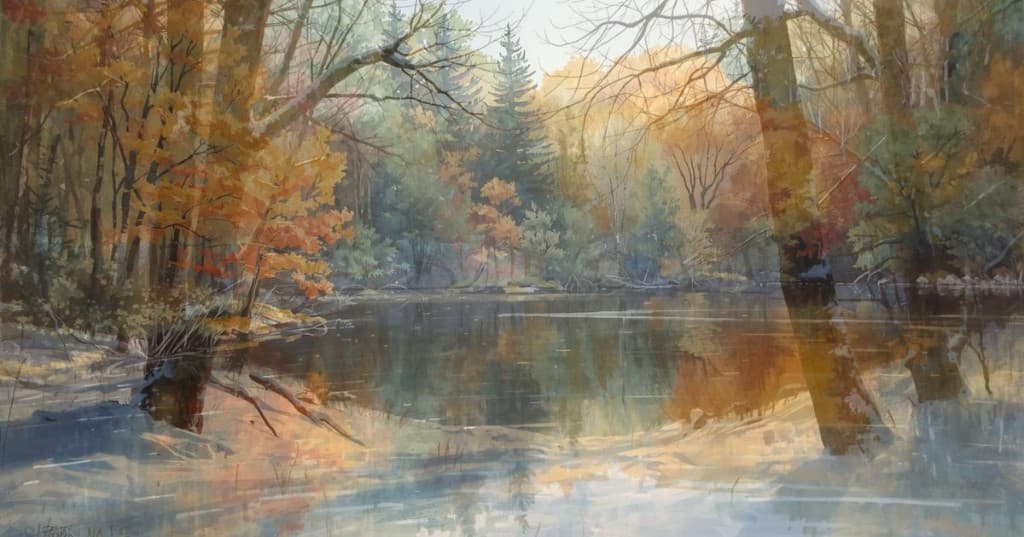
What this chapter accomplishes, across its nine thousand words, is the complete transformation of a physical place into a philosophical argument. Walden Pond is not backdrop or setting; it is the chapter's protagonist, its measure of value, and its standard against which every human claim is tested and found wanting. Thoreau's argument moves in six phases, from intimate encounter to historical meditation to moral indictment, and the pond holds each phase steady.
The chapter opens not at the water's edge but in retreat from human company. After a surfeit of village gossip, Thoreau forages for huckleberries on Fair Haven Hill, and his opening observation crystallizes what the entire chapter will demonstrate: a huckleberry purchased in a market is not a huckleberry. The essential thing, the flavor, the living quality, is "rubbed off in the market cart." You have to be where the thing is, doing what the encounter requires, to receive what it has to offer. He then moves to the pond itself, joining an old deaf fisherman in wordless companionship, fishing together across hours without exchanging speech, the silence "of unbroken harmony, far more pleasing to remember than if it had been carried on by speech." Later, fishing alone at midnight by moonlight, surrounded by perch and dimpling water, he feels his line stretching forty feet into depth while his thoughts wander to "vast and cosmogonal themes," and the sudden jerk of a fish links him back to the immediate world. He writes: "I caught two fishes as it were with one hook." The pond is always doing two things at once.
The second movement is a naturalist's survey of Walden's physical properties, rendered with a precision that reads less like inventory than portraiture. The water is blue at a distance and green up close, because it "lies between the earth and the heavens" and partakes of both. It is so transparent that swimmers appear as alabaster statues; you can see the bottom at twenty-five feet. Thoreau catalogs the fish species, records water temperatures in March, and retrieves a lost axe from twenty-five feet of depth using a birch pole and a slip-noose. This precision is not pedantry; it is the kind of attention that comes from love. He is learning the pond as he learned his beans, by dwelling long enough that its particularities become knowledge rather than impression.
The third movement extends the pond backward in time. Walden has been here before recorded history, possibly already present "on that spring morning when Adam and Eve were driven out of Eden." Indigenous hunters wore a path around its shore that is still faintly visible after snowfall, a "clear undulating white line" tracing the oldest human relationship with this water. The pond rises and falls on a cycle no one has fully mapped, and when it floods it kills the encroaching trees that have grown along its margin. "The shore is shorn," Thoreau writes, and the pond asserts title to its own edge. It manages itself. An Indian legend holds that a hill once stood here and sank when the people committed great wrongs, and the pond formed in its place; Thoreau notes only that the fable does not conflict with the facts.
The fourth movement is the chapter's philosophical summit. Thoreau watches the pond's surface in every season and condition and draws from it a theory of reflection, literal and moral. In September, Walden is "a perfect forest mirror, set round with stones as precious to my eye as if fewer or rarer." The water receives every disturbance and smooths it away; "not a fish can leap or an insect fall on the pond but it is thus reported in circling dimples." Most crucially: "A lake is the landscape's most beautiful and expressive feature. It is earth's eye; looking into which the beholder measures the depth of his own nature." The pond does not judge. It reflects what is actually there, and Thoreau finds himself measured by it, found both wanting and wanting more.
The fifth movement introduces time's wound. Thoreau recalls paddling as a boy through thick groves of pine and oak that formed bowers over the coves, the water surrounded by old-growth forest. Now the woodcutters have stripped the shore. "How can you expect the birds to sing when their groves are cut down?" The railroad, "that devilish Iron Horse," has muddied the Boiling Spring and browsed off the woods, introducing a thousand men into the landscape's belly. His lament is not sentiment; it is a precise accounting of what has been lost. The pond itself remains unchanged ("all the change is in me"), but its setting has been degraded, and the degradation is ongoing.
The sixth movement delivers the moral verdict. Thoreau turns to Flint's Pond, larger, shallower, less pure, and delivers his most sustained indictment: it is named for a farmer who never loved it, who would have drained it for the mud at its bottom, who "goes to market for his god as it is." A place named by a man who could not see it should be renamed after the fish and wild fowl that actually inhabit it. Then the chapter closes with its most compressed argument. White Pond and Walden are "Lakes of Light," great crystals on the surface of the earth. If they were small enough to carry, they would be hauled away like jewels. Because they are large and liquid and free, we disregard them and "run after the diamond of Kohinoor." The pond's final lesson is about what we systematically cannot value: what is too pure to have a market price, what must be attended to rather than purchased, what offers itself completely to anyone willing to look. "Talk of heaven! ye disgrace earth."