Wide Reads
Literature MattersLife IndexEducators
Sign in
Where to Begin
Walden - Finding Your True Depth

Henry David Thoreau

Walden

Finding Your True Depth

Home›Books›Walden›Chapter 15
Previous
15 of 17
Next

Summary

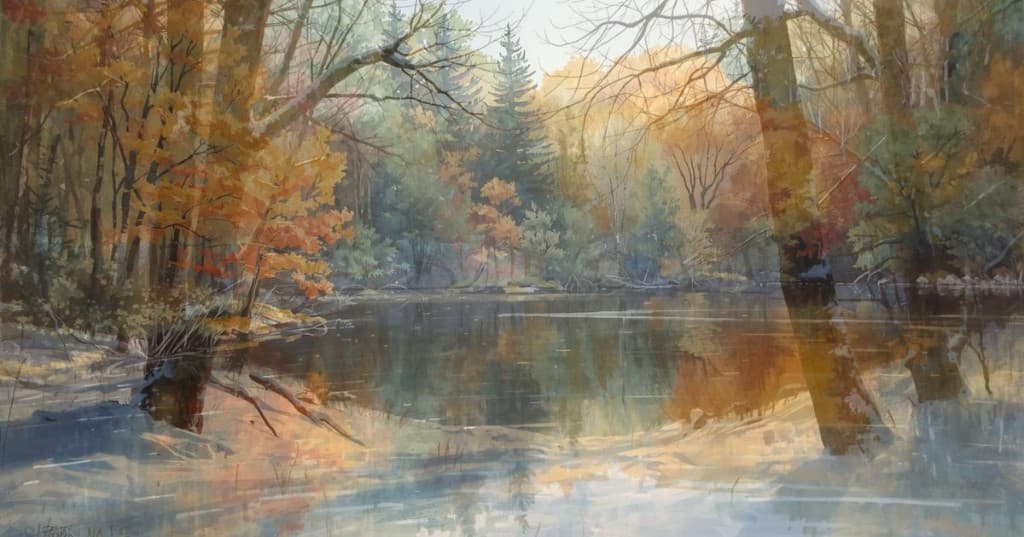
Thoreau spends winter studying Walden Pond with the precision of a scientist and the wonder of a poet. He cuts through ice to reach water, marveling at the hidden world beneath—fish swimming in their 'quiet parlor' while teams of horses travel overhead. Local fishermen intrigue him; these practical men know nature intimately without books or formal education, living closer to natural rhythms than scholars ever could. When rumors claim the pond is bottomless, Thoreau methodically maps it, discovering it's 107 feet deep—remarkable but measurable. His careful surveying reveals a profound pattern: the pond's deepest point lies exactly where its longest and widest measurements intersect. This isn't coincidence but natural law. He realizes this same principle applies to human character—our true depth lies where the longest and broadest lines of our daily behavior cross. The chapter culminates with ice harvesters arriving like an army, cutting the pond's frozen surface into blocks bound for distant cities. Thoreau sees his local water traveling to Charleston, Calcutta, mingling with sacred rivers. This connection between his simple pond and the wider world captures his central insight: careful attention to what's immediately around us reveals universal truths. The winter pond becomes a mirror for understanding how depth, whether in water or character, can only be discovered through patient, honest examination.

Coming Up in Chapter 16

As winter gives way to spring, Thoreau witnesses the dramatic awakening of the natural world around his cabin. The changing season brings profound revelations about renewal, growth, and the eternal cycles that govern both nature and human life.

Share it with friends

Previous ChapterNext Chapter
GO ADS FREE — JOIN US
Original text
complete·5,209 words
T

he Pond in Winter

After a still winter night I awoke with the impression that some question had been put to me, which I had been endeavoring in vain to answer in my sleep, as what—how—when—where? But there was dawning Nature, in whom all creatures live, looking in at my broad windows with serene and satisfied face, and no question on her lips. I awoke to an answered question, to Nature and daylight. The snow lying deep on the earth dotted with young pines, and the very slope of the hill on which my house is placed, seemed to say, Forward! Nature puts no question and answers none which we mortals ask. She has long ago taken her resolution. “O Prince, our eyes contemplate with admiration and transmit to the soul the wonderful and varied spectacle of this universe. The night veils without doubt a part of this glorious creation; but day comes to reveal to us this great work, which extends from earth even into the plains of the ether.”

1 / 24

Master this chapter. Complete your experience

Purchase the complete book to access all chapters and support classic literature

Read Free on GutenbergBuy at Powell'sBuy on Amazon

As an Amazon Associate, we earn a small commission from qualifying purchases at no additional cost to you.

Available in paperback, hardcover, and e-book formats

GO ADS FREE — JOIN US

Why This Matters

Connect literature to life

Skill: Distinguishing Surface Drama from Actual Depth

This chapter teaches how to see past rumors and assumptions to identify where real competence and value actually lie.

Practice This Today

This week, notice when people complain about 'unfair' decisions at work—then observe quietly to see if the person who got ahead might have depth that wasn't immediately visible.

GO ADS FREE — JOIN US

Now let's explore the literary elements.

Key Quotes & Analysis

"The greatest depth was exactly one hundred and seven feet; and this is a remarkable coincidence, since it is the exact average depth of all ponds in this vicinity."

— Narrator

Context: After methodically surveying the pond to disprove claims it was bottomless

This reveals Thoreau's commitment to facts over folklore, and his discovery that even unique places follow natural patterns. His scientific approach yields both practical knowledge and philosophical insight.

In Today's Words:

When I actually measured it carefully, the pond turned out to be deep but not magical - and it followed the same patterns as other ponds around here.

"What I have observed of the pond is no less true in ethics. It is the law of average. Such a rule of the two diameters not only guides us toward the sun in the system and the heart in man, but draws lines through the length and breadth of the aggregate of a man's particular daily behaviors and waves of life."

— Narrator

Context: Connecting his pond measurements to human character

Thoreau sees the pond's deepest point as a metaphor for finding our own depth where our longest and broadest life patterns intersect. This transforms a simple measurement into profound self-knowledge.

In Today's Words:

The same rule that showed me the pond's deepest spot applies to people - you find someone's true depth where their main behaviors and life patterns cross.

"The pond was my well ready dug. For four months in the year its water is as cold as it is pure at all times; and I think that it is then as good as any, if not the best, in the town."

— Narrator

Context: Describing his relationship with the pond as his water source

This shows Thoreau's practical dependence on the pond while suggesting that direct access to pure sources - whether water or truth - is superior to processed alternatives.

In Today's Words:

This pond was like having my own private well - clean, cold water that was better than anything else in town.

Thematic Threads

Class

In This Chapter

Local fishermen possess deeper knowledge than educated scholars because they combine sustained practice with broad natural observation

Development

Evolved from earlier chapters - Thoreau increasingly values practical wisdom over formal education

In Your Life:

The coworker without a degree who truly understands the job might know more than the supervisor with credentials.

Identity

In This Chapter

Thoreau defines himself as both scientist and poet, refusing to choose between systematic measurement and wonder

Development

Developed from earlier chapters - his identity integration becomes more sophisticated

In Your Life:

You don't have to pick just one role—the nurse who's also an artist brings both skills to patient care.

Social Expectations

In This Chapter

Society expects either scholarly detachment or practical engagement, but Thoreau combines both approaches

Development

Continued from earlier chapters - his rejection of either/or thinking

In Your Life:

People might expect you to be either 'book smart' or 'street smart,' but real wisdom combines both.

Personal Growth

In This Chapter

Growth comes through patient, methodical attention to immediate surroundings rather than seeking exotic experiences

Development

Central theme deepening - local attention yields universal insights

In Your Life:

Understanding your current situation deeply teaches you more than constantly seeking new experiences.

Human Relationships

In This Chapter

The ice harvesters connect his local pond to distant cities, showing how intimate knowledge creates global connections

Development

New development - individual depth creates wider community

In Your Life:

When you truly understand your own community, you better understand how all communities work.

GO ADS FREE — JOIN US

You now have the context. Time to form your own thoughts.

Discussion Questions

  1. 1

    Why does Thoreau bother measuring the pond when everyone says it's bottomless?

    analysis • surface
  2. 2

    What does Thoreau discover about where the pond's deepest point is located, and why is this significant?

    analysis • medium
  3. 3

    Think about someone you know who has real expertise in their field. Where do you see their 'longest effort' intersecting with their 'broadest knowledge'?

    application • medium
  4. 4

    How would you apply Thoreau's measurement approach to understanding a complex situation in your own life—whether at work, in relationships, or in your community?

    application • deep
  5. 5

    What does this chapter suggest about the difference between reputation and actual depth of character?

    reflection • deep

Critical Thinking Exercise

10 minutes

Map Your Own Intersection Point

Think about an area where you want to develop real expertise or depth. Draw two lines: one representing your longest sustained effort (what you've consistently worked on over time) and another representing your broadest knowledge (the wide range of things you understand). Where do these lines cross? That's your potential depth point—the place where you could develop genuine mastery.

Consider:

  • •Don't confuse busy work with sustained effort—look for what you've consistently returned to over months or years
  • •Broad knowledge doesn't mean knowing everything—it means understanding how different pieces connect
  • •Your intersection point might be different from what others expect or what looks impressive on paper

Journaling Prompt

Write about a time when you misjudged someone's depth based on surface appearances. What did you miss, and how did you eventually discover their real expertise or character?

GO ADS FREE — JOIN US

Coming Up Next...

Chapter 16: The Art of Paying Attention to Change

As winter gives way to spring, Thoreau witnesses the dramatic awakening of the natural world around his cabin. The changing season brings profound revelations about renewal, growth, and the eternal cycles that govern both nature and human life.

Continue to Chapter 16
Previous
Winter's Wild Neighbors
Contents
Next
The Art of Paying Attention to Change

Continue Exploring

Walden Study GuideTeaching ResourcesEssential Life IndexBrowse by ThemeAll Books

You Might Also Like

Siddhartha cover

Siddhartha

Hermann Hesse

Explores nature & environment

Thus Spoke Zarathustra cover

Thus Spoke Zarathustra

Friedrich Nietzsche

Explores personal growth

Tao Te Ching cover

Tao Te Ching

Lao Tzu

Explores nature & environment

On Liberty cover

On Liberty

John Stuart Mill

Explores personal growth

Browse all 47+ books
GO ADS FREE — JOIN US

Share This Chapter

Know someone who'd enjoy this? Spread the wisdom!

TwitterFacebookLinkedInEmail

Read ad-free with Prestige

Get rid of ads, unlock study guides and downloads, and support free access for everyone.

Subscribe to PrestigeCreate free account
Intelligence Amplifier
Intelligence Amplifier™Powering Wide Reads

Exploring human-AI collaboration through books, essays, and philosophical dialogues. Classic literature transformed into navigational maps for modern life.

2025 Books

→ The Amplified Human Spirit→ The Alarming Rise of Stupidity Amplified→ San Francisco: The AI Capital of the World
Visit intelligenceamplifier.org
hello@widereads.com

WideReads Originals

→ You Are Not Lost→ The Last Chapter First→ The Lit of Love→ Wealth and Poverty→ 10 Paradoxes in the Classics · coming soon
Arvintech
arvintechAmplify your Mind
Visit at arvintech.com

Navigate

  • Home
  • Library
  • Essential Life Index
  • How It Works
  • Subscribe
  • Account
  • About
  • Contact
  • Authors
  • Suggest a Book
  • Landings

Made For You

  • Students
  • Educators
  • Families
  • Readers
  • Literary Analysis
  • Finding Purpose
  • Letting Go
  • Recovering from a Breakup
  • Corruption
  • Gaslighting in the Classics

Newsletter

Weekly insights from the classics. Amplify Your Mind.

Legal

  • Privacy Policy
  • Terms of Service
  • Cookie Policy
  • Accessibility

Why Public Domain?

We focus on public domain classics because these timeless works belong to everyone. No paywalls, no restrictions—just wisdom that has stood the test of centuries, freely accessible to all readers.

Public domain books have shaped humanity's understanding of love, justice, ambition, and the human condition. By amplifying these works, we help preserve and share literature that truly belongs to the world.

A Pilgrimage

Powell's City of Books

Portland, Oregon

If you ever find yourself in Portland, walk to the corner of Burnside and 10th. The building takes up an entire city block. Inside is over a million books, new and used on the same shelf, organized by color-coded rooms with names like the Rose Room and the Pearl Room. You can lose an afternoon. You can lose a weekend. You will find a book you have been looking for your whole life, and three you did not know existed.

It is a pilgrimage. We cannot find a bookstore like it anywhere on earth. If you read the classics, and you ever get the chance, go. It belongs on every reader's bucket list.

Visit powells.com

We are not in any way affiliated with Powell's. We are just a very big fan.

© 2026 Wide Reads™. All Rights Reserved.

Intelligence Amplifier™ and Wide Reads™ are proprietary trademarks of Arvin Lioanag.

Copyright Protection: All original content, analyses, discussion questions, pedagogical frameworks, and methodology are protected by U.S. and international copyright law. Unauthorized reproduction, distribution, web scraping, or use for AI training is strictly prohibited. See our Copyright Notice for details.

Disclaimer: The information provided on this website is for general informational and educational purposes only and does not constitute professional, legal, financial, or technical advice. While we strive to ensure accuracy and relevance, we make no warranties regarding completeness, reliability, or suitability. Any reliance on such information is at your own risk. We are not liable for any losses or damages arising from use of this site. By using this site, you agree to these terms.