Thoreau opens by stepping back from the argument for books he just made, insisting that even the most select reading is only a dialect when measured against the language all things speak without metaphor. His first summer at Walden, he barely read at all: he hoed beans, and on better mornings still, he sat motionless in his doorway from sunrise until the sun hit his west window, growing 'like corn in the night.' That image is the chapter's first major turn: stillness as cultivation, idleness as work the neighbors cannot see.
The second beat introduces the counterforce. The Fitchburg Railroad runs a hundred rods from the cabin, and Thoreau watches it daily with equal admiration and suspicion. He gives the locomotive mythological grandeur, a fire-breathing iron horse, a 'travelling demigod' who might take the sunset sky for his livery. But beneath the spectacle is a sharper observation: the railroad has constructed a kind of fate, an Atropos that never turns aside, imposing its timetable on every farm clock in the valley. Thoreau catalogs the freight with a naturalist's eye: lime, pine, salt fish, Spanish hides still curved to the shape of the cattle that wore them, each item carrying a history more legible than any book. Commerce is brave and serene, he grants, but what comes down when so many things go up? 'Up come the books, but down goes the wit that writes them.'
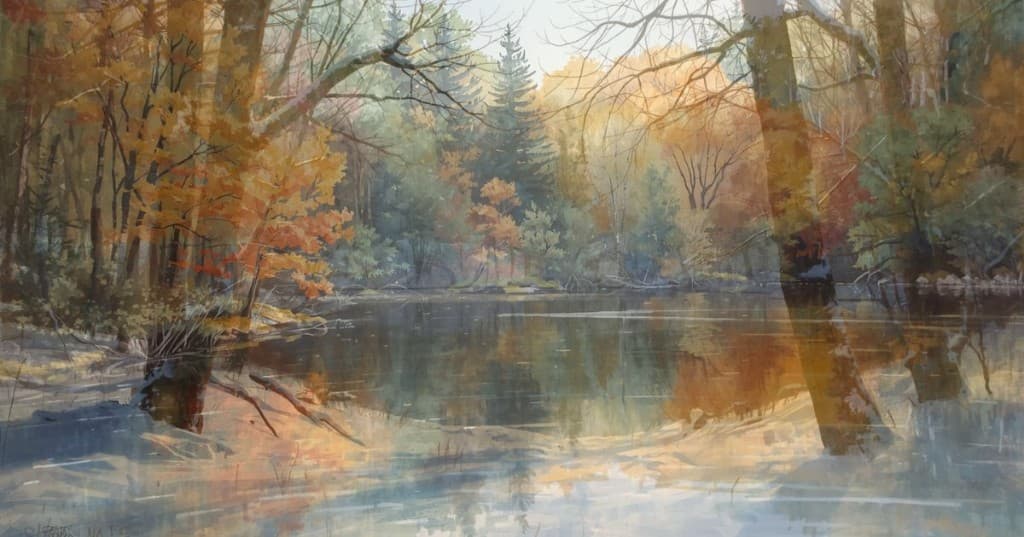
After the cars are gone, the chapter opens into an expanse of natural sound. Church bells, filtered through miles of woodland, arrive at the cabin transformed into something almost organic, the pine needles vibrating like harp strings. A cow's evening lowing might be a minstrel. Whippoorwills begin their vespers within five minutes of sunset, as regular as the trains they succeed. Screech owls fill the dark with what Thoreau calls the dark and tearful side of music, the doleful responses of spirits expiating old sins. Hooting owls suggest idiotic despair that, heard from a distance, resolves into genuine melody.
The chapter closes with the bullfrogs holding their Stygian ceremony around the pond, the patriarch bellowing from the shore long after the rest have gone under. Then Thoreau inverts the catalog: instead of what he hears, he lists what is absent from his life, no cockerel, no hens, no churn, no spinning wheel, no children crying, no rats in the wall. The absent sounds of domesticity become the positive space of his existence. Wild nature presses to his very sills: no front yard, no gate, 'no path to the civilized world.'
What the chapter demonstrates is that attention trained on one place long enough begins to discover its own form of order. The train is as punctual as sunrise, the owls as inevitable as night, the bullfrogs as ceremonial as any human institution. Nature is not quieter than society. It is more coherent, once you stay still long enough to hear it.
Coming Up in Chapter 4
Having explored the sounds that surround his cabin, Thoreau now turns inward to examine the profound experience of solitude. He'll reveal how being truly alone, without books, visitors, or distractions, can become a source of unexpected companionship and self-discovery..