
Lessons
Lessons from The Aeneid
Six lessons from this classic work, traced chapter by chapter.
0:00 / 0:00
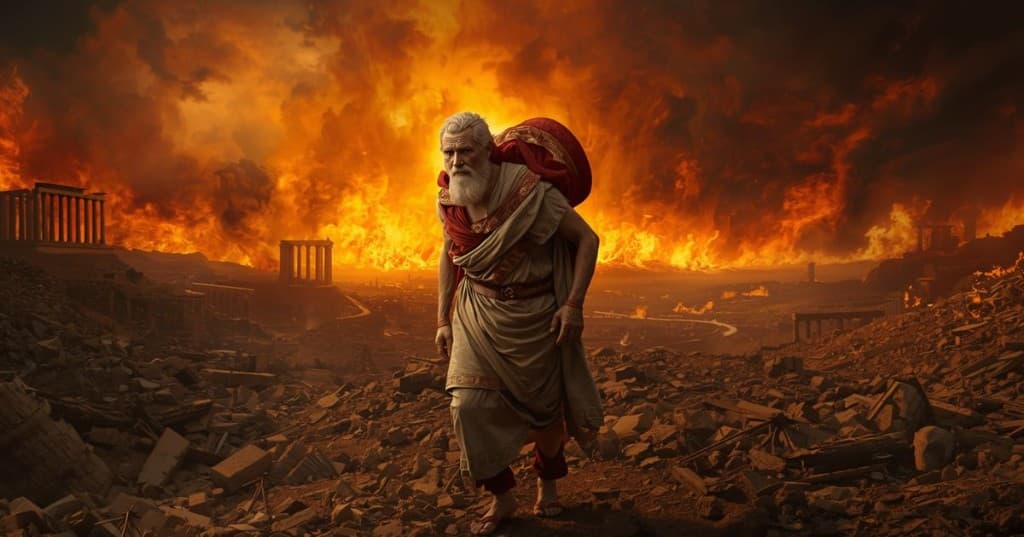
Juno sends a storm against the Trojan fleet. Aeneas, who already carried his father out of a city on fire, washes onto Dido's shore and is asked to tell how Troy fell. He tells it. The survivors who crawl onto her sand have already lost a city and years of false harbors. Virgil spent the last eleven years of his life on the poem and died in 19 BC asking that the unfinished manuscript be burned. Augustus refused. Fate keeps assigning the next departure, and each one costs a life that was already working. The man everyone will call the founder of Rome does what fate requires and still cannot call the ending a victory.
Continue the summary
Aeneas is pius: dutiful, grieving, often uncertain, and still moving. Dido is the queen who built Carthage from exile and offers him a kingdom already standing. Turnus is the Latin prince who will not yield the land or the bride the gods have already assigned. Anchises dies on the road and still waits in the underworld with a vision of Rome. Ascanius is the son the future is supposed to belong to. Around them Virgil places Juno, who will not forgive Troy; Venus, who keeps bargaining for her son; Mercury, who arrives with the order to sail; Camilla, who dies magnificent; Pallas, whose belt will decide the last second of the poem; and Latinus, who wanted peace and got a war.
The poem turns on a storm, a cave, an underworld, and a belt. Juno's storm drives the survivors onto the Carthaginian coast. Aeneas tells the wooden horse, the night the city burned, and the moment he put Anchises on his back. False harbors waste years. In Carthage, Dido and Aeneas take shelter in a cave. Mercury tells him Italy waits. He sails. She builds a pyre. The ships burn at Drepanum. In the underworld he meets Dido's silence and Anchises's parade of unborn Romans. Latinus offers alliance. Juno and Allecto unmake it. Evander gives Pallas. Camilla falls. Turnus wears the belt. Aeneas sees it and does not spare him.
Virgil wrote the poem for Augustus and asked that the unfinished manuscript be burned. Augustus refused. He never treats Carthage as a cute delay, or the Italian war as a necessary inconvenience the reader is meant to cheer. Mercy, when it arrives, arrives as a hesitation over Turnus that does not last. What remains is not a hymn to empire. It is a picture of how a promised land is paid for by people who will not live to see it.
Juno's storm is already the first bill. Duty When Destiny Demands Sacrifice is Mercury at Carthage, Anchises's parade of unborn Romans, and the duel that fulfills prophecy without feeling like triumph. The Cost of Building Something New is Troy on Aeneas's back, the ships burned at Drepanum, and Latium's first blood, paid by people who will not see the city. When Love Collides With Duty is Dido's hospitality, the cave, the secret departure, and the shade that will not speak. Leading People Past Exhaustion is the fleet through the storm, the mutiny at the games, Evander's alliance, and a truce Juno and Allecto unmake. Carrying Grief While You Lead is Troy retold on Dido's shore, her smoke on the horizon, the underworld, and Pallas's funeral. When Founding Demands Violence is Camilla on the ground, the belt Turnus wears, and the last second when Aeneas sees it and does not spare him.
The ships that burned at Drepanum never make Italy. Turnus is already on the ground, asking to be sent back to his father. Aeneas sees Pallas's belt and the hesitation does not last. Dido's pyre is still smoking behind the departing ships. Anchises is still on his son's back in the story told on her shore. Wide Reads pairs summaries, quotes, and audio with all twelve books, and the last line is still a soul fleeing in protest.
Why this matters
People still arrive when doing the right thing still feels like a betrayal, when a mission requires leaving people who are still working, or when a founding only happens because someone paid for it who will not live to see it finished. Virgil does not let Rome's origin look clean. Dido curses the man who leaves her, Turnus begs before he dies, and the poem ends on a soul fleeing in protest, not a triumph. This guide keeps Carthage, the underworld, and Latium tied to costs you can still name.
Prestige deep dive
A Psychological Reading of The Aeneid
The Aeneid is the psychology of obedience that can weep and still leave, and of the finished lives spent so a city that does not exist yet can be called necessary.
Read the full psychological readingTheme breakdowns
Explore the lessons
The Aeneid is Virgil's epic about a man who carries his father out of a burning city and never gets to call the ending a victory: Juno's storm strands him at Carthage, where Dido builds him a kingdom he sails away from, Mercury orders him to Italy, the ships burn at Drepanum, Anchises shows him a parade of unborn Romans in the underworld, Camilla dies magnificent, and Aeneas sees Pallas's belt on Turnus and does not spare him, so a poem written to flatter an emperor ends instead on a soul fleeing in protest.
Each card traces a pattern through named chapters — summaries, quotes, and key insights tied to the scenes that prove it. Start with the featured lessons, then open the deep dives below.
Deep dives
Chapter-by-chapter breakdowns
When Love Collides With Duty
Watch Dido offer a kingdom already built, then the cave, the secret departure, and the shade that will not speak.
Leading People Past Exhaustion
Hold the fleet through Juno's storm, the ship-burning mutiny, Evander's alliance, and a truce that will not hold.
Continue Exploring
Guides, life skills, and the full library.More ways to read The Aeneid: guides, life skills, and the wider library.