Free study guide · no paywall
The AeneidStudy Guide
by Virgil (-19)
A city on fire, a founder who never wanted the job, and a war he cannot call a victory, mapped across 12 books and six lessons.
Start here
Plot, characters & chapter jump
12 chapter summaries · 8 key figures · discussion questions · quotes · free
Plot summary
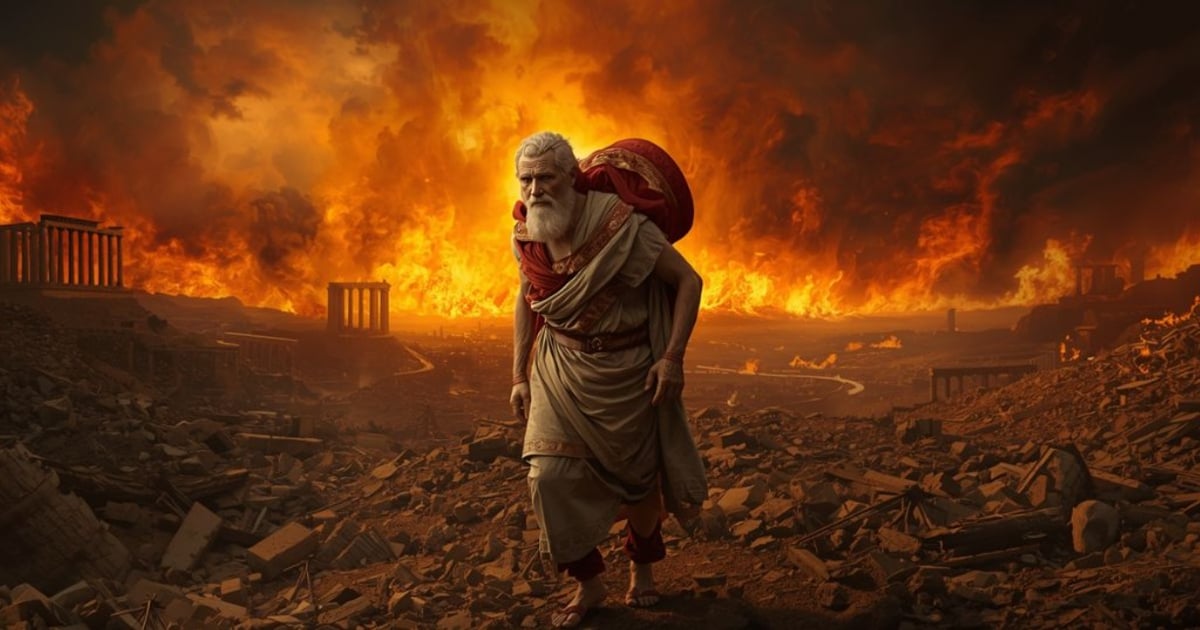
Aeneas carries his father out of burning Troy and spends the rest of Virgil's epic paying for a city that does not exist yet. Juno's storm strands him at Carthage, where Dido offers him a kingdom already built, then Mercury orders him to Italy. Anchises shows him Rome's unborn souls in the underworld; the war he fights to found Latium costs Camilla, Pallas, and finally Turnus, whom Aeneas kills on sight of Pallas's belt in the poem's last lines.
Jump to chapter
- Chapter 1Juno's storm strands the fleet
- Chapter 2Troy falls, Anchises on his back
- Chapter 4Dido's cave, Mercury's order
- Chapter 5The ships burn at Drepanum
- Chapter 6Anchises's parade of unborn Romans
- Chapter 9Camilla falls
- Chapter 10Pallas given to the cause, and killed
- Chapter 12Turnus's belt, the last line
What readers search for
Common questions about The Aeneid
What is The Aeneid about?
Virgil's epic follows Aeneas, who carries his father out of burning Troy and spends the rest of the poem paying for a city that does not exist yet. Juno's storm strands him at Dido's Carthage, Mercury orders him to Italy, and the war he fights there to found Rome costs Camilla, Pallas, and Turnus before the last line: a soul fleeing in protest, not a victory chant.
The Cost of Building Something NewWhy does Aeneas leave Dido in The Aeneid?
Dido offers him a kingdom already built at Carthage, and their cave becomes, in her telling, a marriage. Mercury arrives with a direct order: Italy waits, and the gods have already assigned the coast. Aeneas obeys, faces her fury and her curse, and later meets her silent shade in the underworld. Virgil does not let duty look clean. Aeneas's own eloquence arrives too late to matter.
When Love Collides With DutyWhy did Virgil want The Aeneid burned in The Aeneid?
He spent the last eleven years of his life on the poem and died at Brundisium in 19 BC with it still unfinished, asking that the manuscript be destroyed rather than published in that state. Augustus overruled him. The poem became Rome's national epic anyway, a school text, and Dante's guide through Hell, built on a request its own author did not want honored.
Duty When Destiny Demands SacrificeDoes Aeneas spare Turnus in The Aeneid?
No. Turnus is beaten to the ground and begs to be sent back to his father. Aeneas hesitates, an instant the poem lets you feel as real mercy considered, then sees Pallas's belt on Turnus's shoulder, the trophy taken from the young ally Turnus killed, and drives the sword home. The last lines follow Turnus's soul, not a Roman triumph.
When Founding Demands ViolenceWhat does Anchises show Aeneas in the underworld in The Aeneid?
Aeneas travels to the underworld and finds his father Anchises among the unborn, who shows him a parade of Roman souls still waiting to be born, including the future emperor Augustus. It is the poem's clearest sales pitch for empire, delivered as a father's pride to a grieving son who has already lost Troy, Dido, and Anchises himself. The vision does not undo the cost already paid to reach it.
Carrying Grief While You LeadFast track
Short on time? Start here
Eight scenes hold Virgil's argument together: the storm that strands the fleet, Troy falling on Aeneas's back, Dido's cave and Mercury's order, the ships burned at Drepanum, Anchises's underworld parade, Camilla's death, Pallas given to the cause, and the belt that ends the duel. Read these first if you need the plot spine before all twelve books.
Chapter 1
Juno's storm strands the fleet
Chapter 2
Troy falls, Anchises on his back
Chapter 4
Dido's cave, Mercury's order
Chapter 5
The ships burn at Drepanum
Chapter 6
Anchises's parade of unborn Romans
Chapter 9
Camilla falls
Chapter 10
Pallas given to the cause, and killed
Chapter 12
Turnus's belt, the last line
Full coverage
Everything in this study guide
The same surfaces readers expect from a traditional study guide — plot, characters, themes, quotes, and homework help — plus audio and the source text on every chapter. Free, no paywall.
Plot overview
Summary, context, and why the book still matters
12 chapter summaries
Every chapter with audio narration
8 key figures
Who drives the plot and what each one does
6 lessons
Themes traced to scenes, not generic labels
15+ important quotes
Verified lines with chapter links and analysis
Discussion questions
Five per chapter, with suggested answers for class and essays
Original text
Author's words beside every summary
This is not a plot cheat sheet. Wide Reads walks The Aeneid as Virgil's refusal to make Rome's founding cost invisible: a storm, a cave, an underworld, and a belt, each one a bill someone else pays. Use the book-by-book path below, follow the six lesson deep dives when a theme hooks you, and open individual chapters for summaries, quotes, and audio.
For plot and theme questions about The Aeneid, see Common Questions on the book page.
How to use this guide
How to Read This Book with Wide Reads
Start at the storm
Read Books 1–4 for Juno's storm, Dido's Carthage built from exile, and the cave the two of them name differently. You need the hospitality and the cost before Mercury's order can land.
Follow the underworld turn
Books 5–8 burn the ships at Drepanum and carry Aeneas through the underworld to Anchises's parade of unborn Romans. Books 9–12 run the Italian war: Camilla's death, Pallas given to Evander's cause, and the duel that ends on Turnus's belt.
Let the lessons carry you
When a book raises a question you cannot shake, whether duty's cost, grief carried in command, or founding built on violence, jump to the matching lesson page, then return to the book list.
Plot & context
Book Overview
Juno sends a storm against the Trojan fleet. Aeneas, who already carried his father out of a city on fire, washes onto Dido's shore and is asked to tell how Troy fell. He tells it. The survivors who crawl onto her sand have already lost a city and years of false harbors. Virgil spent the last eleven years of his life on the poem and died in 19 BC asking that the unfinished manuscript be burned. Augustus refused. Fate keeps assigning the next departure, and each one costs a life that was already working. The man everyone will call the founder of Rome does what fate requires and still cannot call the ending a victory.
Aeneas is pius: dutiful, grieving, often uncertain, and still moving. Dido is the queen who built Carthage from exile and offers him a kingdom already standing. Turnus is the Latin prince who will not yield the land or the bride the gods have already assigned. Anchises dies on the road and still waits in the underworld with a vision of Rome. Ascanius is the son the future is supposed to belong to. Around them Virgil places Juno, who will not forgive Troy; Venus, who keeps bargaining for her son; Mercury, who arrives with the order to sail; Camilla, who dies magnificent; Pallas, whose belt will decide the last second of the poem; and Latinus, who wanted peace and got a war.
The poem turns on a storm, a cave, an underworld, and a belt. Juno's storm drives the survivors onto the Carthaginian coast. Aeneas tells the wooden horse, the night the city burned, and the moment he put Anchises on his back. False harbors waste years. In Carthage, Dido and Aeneas take shelter in a cave. Mercury tells him Italy waits. He sails. She builds a pyre. The ships burn at Drepanum. In the underworld he meets Dido's silence and Anchises's parade of unborn Romans. Latinus offers alliance. Juno and Allecto unmake it. Evander gives Pallas. Camilla falls. Turnus wears the belt. Aeneas sees it and does not spare him.
Virgil wrote the poem for Augustus and asked that the unfinished manuscript be burned. Augustus refused. He never treats Carthage as a cute delay, or the Italian war as a necessary inconvenience the reader is meant to cheer. Mercy, when it arrives, arrives as a hesitation over Turnus that does not last. What remains is not a hymn to empire. It is a picture of how a promised land is paid for by people who will not live to see it.
Read the full summary on the book page →
Why this book now
People still arrive when doing the right thing still feels like a betrayal, when a mission requires leaving people who are still working, or when a founding only happens because someone paid for it who will not live to see it finished. Virgil does not let Rome's origin look clean. Dido curses the man who leaves her, Turnus begs before he dies, and the poem ends on a soul fleeing in protest, not a triumph. This guide keeps Carthage, the underworld, and Latium tied to costs you can still name.
About Virgil
Publius Vergilius Maro, known as Virgil (70-19 BC), was born near Mantua and trained in rhetoric and philosophy before the Eclogues and Georgics made him the poet Augustus trusted with a national origin. He spent the last eleven years of his life on The Aeneid. He worked slowly, dictating lines in the morning and revising them all day. He died at Brundisium with the poem unfinished and asked that the manuscript be burned. Augustus overruled him. The book became a school text, a political scripture, and Dante's guide through Hell and Purgatory. Readers of empire still hear flattery in it. The grief is louder: Aeneas weeps, Dido curses, Turnus begs, and the last line is a soul fleeing in protest. His gift was making destiny feel local: a storm, a cave, a funeral, a belt. The poem still finds readers who recognize the moment they were told to leave a life that was working, and the moment they finished the assigned task and could not call it a win.
Themes with proof
Lessons from The Aeneid
Six mechanisms Virgil tests once a survivor becomes a founder: duty that costs a life you cannot get back, a city built at the expense of people who will not see it finished, love that never agrees on its own definition, leadership that holds a fleet together with nothing left in reserve, grief carried without ever putting the command down, and a founding that demands violence no victory speech can fully justify. Each spoke ties named scenes to book proof.
Deep dives
Chapter-by-chapter breakdowns
When Love Collides With Duty
Watch Dido offer a kingdom already built, then the cave, the secret departure, and the shade that will not speak.
Relate at large, my godlike guest,
Leading People Past Exhaustion
Hold the fleet through Juno's storm, the ship-burning mutiny, Evander's alliance, and a truce that will not hold.
Endure, and conquer! Jove will soon dispose
Character guide
Key Figures
Who drives the plot, what each one wants, and why they matter to the argument of the book.
Aeneas
Trojan prince and pius founder: dutiful, grieving, often uncertain, who carries his father out of Troy and cannot call the war that founds Rome a victory.
Dido
Queen who built Carthage from exile and offers Aeneas a kingdom already standing; her curse follows him after he sails for Italy on Mercury's order.
Turnus
Latin prince who will not yield the bride and land the gods have assigned to Aeneas; dies begging, wearing Pallas's belt, in the poem's final lines.
Anchises
Aeneas's father, carried out of Troy and later met in the underworld, where he shows his son a parade of unborn Roman souls including Augustus.
Juno
Queen of the gods who never forgives Troy; sends the storm that strands the fleet at Carthage and later unleashes Allecto to unmake the Latin peace.
Camilla
Volscian warrior who fights for Turnus and dies magnificent in the Italian war, one of the costs the founding of Rome exacts before it is finished.
Pallas
Evander's son, given to Aeneas's cause and killed by Turnus; the belt Turnus takes as a trophy is what Aeneas sees before he ends the duel.
Ascanius
Aeneas's young son, the future Rome is supposed to belong to, present at Troy's fall and through the Italian war his father fights on his behalf.
Memorable lines
Key Quotes
Verified passages with chapter links — the lines teachers and essays keep returning to.
“Arms, and the man I sing, who, forc'd by fate,”
“Endure, and conquer! Jove will soon dispose”
“Trust not their presents, nor admit the horse.'”
“O goddess-born! escape, by timely flight,”
“O sacred hunger of pernicious gold!”
“A land there is, Hesperia call'd of old,”
“But anxious cares already seiz'd the queen:”
“But call'd it marriage, by that specious name”
“He knew the stormy souls of womankind, What secret springs their eager passions move, How capable of death for injur'd love.”
“By suff'ring well, our Fortune we subdue; Fly when she frowns, and, when she calls, pursue.”
“Smooth the descent, and easy is the way: But to return, and view the cheerful skies, In this the task and mighty labour lies.”
“The gates of hell are open night and day; Smooth the descent, and easy is the way:”
“Seek not, my seed, in Latian bands to yoke Our fair Lavinia, nor the gods provoke.”
“Hell shall the pow'r of Heav'n and Jove supply.”
“This is thy happy home, the clime where fate Ordains thee to restore the Trojan state.”
Class & essay prep
Discussion Questions
Sample prompts drawn from the chapter guides — each with suggested answers for seminars and written work.
Opening scene: Why does Virgil begin with Juno's rage before we meet Aeneas on the waves?
From Chapter 1Middle movement: How does Aeneas's speech to his men differ from what he feels inside?
From Chapter 1Opening scene: Why does Aeneas warn Dido that even Greeks wept to hear this tale?
From Chapter 2Middle movement: What makes Sinon's deception more effective than force alone?
From Chapter 2Opening scene: Why does Polydorus speak through bleeding plants instead of appearing outright?
From Chapter 3Middle movement: How does the Crete mistake happen despite a genuine oracle?
From Chapter 3Opening scene: Why does Dido confide in Anna before acting publicly?
From Chapter 4Middle movement: How do Juno and Venus shape the cave encounter?
From Chapter 4Why does Aeneas hold funeral games before confronting the ship-burning crisis?
From Chapter 5How does Iris manipulate the Trojan women, and what real need does she exploit?
From Chapter 5Why must Aeneas bury Misenus and find the golden bough before entering the underworld?
From Chapter 6What does Dido's silence teach that Aeneas' explanation cannot?
From Chapter 6How does the eaten trencher scene change the Trojans' status in Italy?
From Chapter 7Why does Juno summon Alecto instead of attacking the Trojans directly?
From Chapter 7Why does Tiber appear to Aeneas only after war preparations intensify?
From Chapter 8Chapter by chapter
All Chapters
Chapter-by-chapter summaries, quotes, and audio.
Ch. 1 · Storm-Tossed Heroes Find SanctuaryJuno's storm strands the fleet
Book 1 opens with Virgil's famous declaration: arms and the man, forced by fate and Juno's hatred, bearing long labors before Rome can rise. The Muse ...
Ch. 2 · The Fall of TroyTroy falls, Anchises on his back
Book 2 is Aeneas's painful answer to Dido's question. Before the court he warns that retelling Troy will reopen wounds even Greeks wept to hear, then ...
Ch. 3 · The Journey Through False Hopes
Book 3 continues the banquet narrative with years of wandering after Troy's fall. Near Ida the Trojans cut sacred timber, build a fleet, and sail with...
Ch. 4 · Love, Duty, and the Price of PassionDido's cave, Mercury's order
Book 4 turns from travelogue to tragedy of passion and duty. Dido confesses to Anna that Aeneas has reignited a love she swore never to repeat after S...
Ch. 5 · The Games and the Burning ShipsThe ships burn at Drepanum
Aeneas leaves Carthage and sails toward Italy, but a storm drives him to Sicily, where King Acestes welcomes the Trojans. The timing is painful and pr...
Ch. 6 · The Journey to the UnderworldAnchises's parade of unborn Romans
Aeneas lands at Cumae and climbs to Apollo's temple to consult the Sibyl, Deiphobe, who speaks for the god in terrifying bursts of prophecy. She warns...
Ch. 7 · When Diplomacy Fails and War Begins
Aeneas buries his nurse Caieta at the place that will bear her name, then sails past Circe's coast with Neptune's help and enters the Tiber mouth at d...
Ch. 8 · Divine Arms and Earthly Alliances
War preparations intensify on both sides. Turnus raids the countryside and sends Venulus to Diomedes, hoping Greek experience can stop Troy again. Aen...
Ch. 9 · The Night Raid and Its Tragic CostCamilla falls
While Aeneas is away seeking Tuscan allies, Turnus receives a divine nudge from Iris, who tells him the Trojan camp is undefended and urges an immedia...
Ch. 10 · Divine Intervention and Mortal ConsequencesPallas given to the cause, and killed
Jupiter summons the gods and orders them to stop taking sides in the Latin war. Venus pleads for the Trojans; Juno defends her interventions; the coun...
Ch. 11 · The Warrior Queen's Last Stand
Morning after the slaughter, Aeneas erects a trophy from Mezentius's armor on an oak trunk and tells his men that one enemy is gone while Turnus remai...
Ch. 12 · The Final Duel and PeaceTurnus's belt, the last line
The Latin army breaks, and Turnus feels public scorn pressing on his promise to fight. Humiliation sharpens rather than softens him. He demands single...
Using this guide
Study Guide FAQ
How to use Wide Reads for class, essays, and revision — and how this guide compares to traditional study sites.
Why Wide ReadsWhat makes this different from SparkNotes or CliffsNotes?
Traditional study guides summarise The Aeneid book by book. This guide gives you that coverage: all twelve books, eight key figures, and discussion questions with suggested answers. Wide Reads adds Duty When Destiny Demands Sacrifice and Carrying Grief While You Lead traced through named scenes like Anchises's underworld parade and the belt Turnus wears. Summaries include audio; the original text sits beside every chapter. Free, no paywall.
Is The Aeneid hard to read?
The Aeneid is rated intermediate difficulty. Our chapter-by-chapter analysis breaks down complex passages, explains historical context, and highlights key themes to make the text more accessible. Each chapter includes summaries, character analysis, and discussion questions to deepen your understanding.
Can I use this study guide for essays and homework?
Yes — use this reading guide alongside The Aeneid, not instead of it. Wide Reads exists to show you why the book still matters: lessons, chapter summaries with audio, and life skills you can carry into real life. That context can sharpen essays on themes, characters, and quotes. Always read Virgil's original text, though. We are the guide at the trailhead; the classic is still the point.
Begin in the storm
Book 1 opens with Juno's storm driving survivors who have already lost a city onto Dido's shore. Each chapter adds summaries, quotes, audio, and the life-skill thread that tracks what a founding costs the people who pay for it and never see it finished.
Wide Reads is different.
Plot, characters, and themes — plus audio, source text, and patterns you can use after class
Two ways in
Read & listen to the summary
Chapter by chapter, with audio. The meaning arrives because you experienced it — not because someone listed bullet points.
Start with this.
Read the original text
The actual words the author wrote, alongside every summary. Use the guide, then step into the source.
Then step into the source.
Either way, the door opens inward.
— and most of all, Why does this matter?
Continue Exploring
Guides, life skills, and the full library.More ways to read The Aeneid: guides, life skills, and the wider library.