
Grief That Still Has to Sail
The Aeneid is the psychology of obedience that can weep and still leave, and of the people whose finished lives are spent so a city that does not exist yet can be called necessary. Aeneas is pius. Duty does not cancel grief. It schedules it. He wishes he had died under Troy, then speaks a steadiness he does not feel. Dido has already built Carthage. Palinurus is drugged after proving he can stay awake. The last name spoken over the killing is Pallas. Pietas is the defence that lets feeling continue while the body does what the command requires. Virgil asked that the unfinished manuscript be burned. Augustus refused. The last line is a soul leaving the wound in protest.
The Death He Wanted Under the Walls
In Juno's storm, Orontes goes down where Aeneas can see him. The wish that follows is not for Italy. He wants the death he missed under Troy, among men whose ending was already complete. A finished grave would have closed the story. Exile keeps it open, and an open story needs a public voice. On the Libyan shore he feeds what is left of the crew and encourages them. The speech is real leadership. It is also laid over a preference for the death that would have excused him from the next departure.
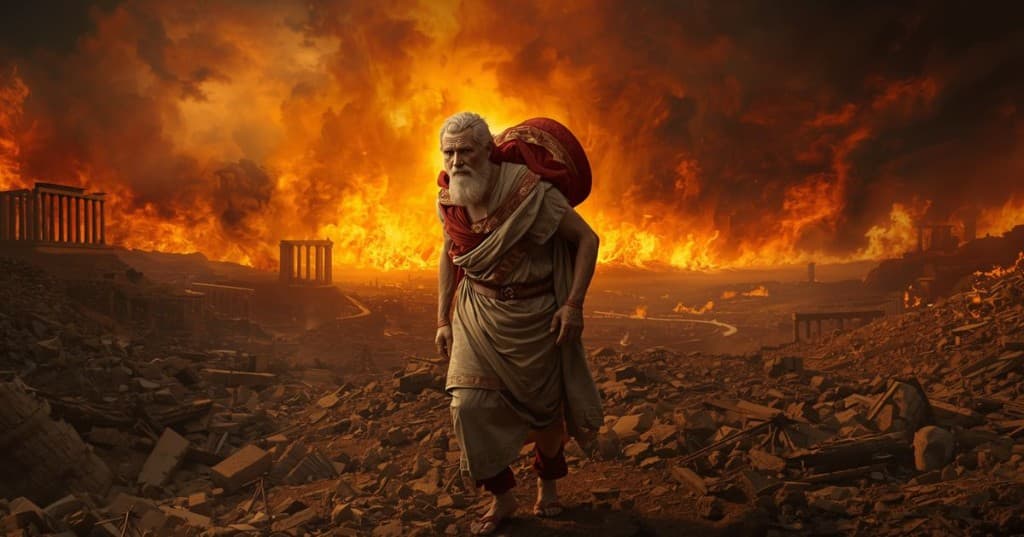
Troy's last night, told at Dido's table, shows the same preference in his father. Anchises will not leave the ruins. Flight looks like a second shame. He yields only when harmless fire crowns Ascanius and a star points toward Ida. The future has to appear on the child before the old man will consent to be carried. Pietas becomes a body then: a son with a father on his shoulders, Creusa lost in the smoke and returning only as a ghost who releases him. Love of the dead is converted, by omen and by command, into the strength required to abandon them.
A Troy You Can Walk Through
The years after the fire are a study in harbours that almost work. In Thrace the myrtle bleeds, and Polydorus accuses a host who killed a guest for gold. At Delos, Apollo's oracle is heard as Crete. They found a city, name it, and marry, until plague proves the reading wrong. Anchises remembers that Cassandra had said Italy and was ignored. Each settlement is a mind trying to stop. Visible walls feel like healing. They are also how a people attaches to the wrong shore, so that leaving will cost more the next time.
Andromache has solved the pain by copying it. At Buthrotum she walks a small Troy, a river given the old name. When Aeneas appears she collapses, because a living kinsman breaks the replica. The copy is a defence. If the city can be walked, the dead have an address. Aeneas cannot live in it. The grief which rebuilds the lost rooms is exactly what fate will not let the founder keep. He will soon meet a queen who did not copy Troy. She built a new city that already worked. He will leave that one too. At Drepanum, Anchises dies, and Aeneas tells Dido that this private loss, not the famine the prophets named, was the greatest of his labours.
The City That Was Already Built
Dido's wound is older than the guest. She fled a brother who murdered Sichaeus, and she raised Carthage from exile. She swore not to marry again. Anna hears the new love and translates it into policy: a husband, a stronger wall. The goddesses arrange the storm. In the cave, Dido calls the union a marriage. Aeneas does not. Two defences use one night. She is trying to make desire lawful so it does not break the vow. He is trying to let the harbour stay temporary so the command can still be obeyed.
Jupiter's order arrives as shame. Mercury finds a man lingering in a city that is not the assigned one, and the shame works because pietas already agrees that pleasure is a delay. Aeneas fits the fleet in secret. Secrecy is the tell. A man who trusted the leaving as pure duty could have said the duty in daylight. He meets her appeals to vows, to the welcome, to a kingdom already standing, with necessity. He weeps. The weeping is not a performance for the reader, and it does not change the sails. That is the defence in its clean form: the feeling stays complete, and the feeling is not allowed to steer.
She cannot hand Anna the plain word. The pyre is described as a spell, a rite that needs a sister's help. Anna helps because the story is magic, not a death. The sword is his. A queen who had already done the founding dies on a fire she had to misname in order to build. Later she will not take the explanation. She turns to Sichaeus. Duty can be true inside the founder's account and still have no claim on the person who paid.
One Life for the Many
On the anniversary of Anchises, Aeneas turns mourning into games. The ritual knits a wandering people, and it keeps grief inside a timetable. While the men compete, the women have reached the end of seven years. Iris arrives in an old Trojan's voice and tells them to burn the fleet and stop. The exhaustion is theirs. The mouth is a goddess who needs the voyage interrupted. Aeneas then founds Acesta for the weary and the frightened. A mission that cannot carry everyone's limit founds a second city and calls the division care.
The water still sets a price. Palinurus has already refused Sleep. The god returns and drugs the pilot whose virtue was staying awake, and Neptune's bargain is one life for the many. Alertness is not what fails. It is what gets chosen. Aeneas takes the helm and names the cost. Before the underworld gives the cape its name, the poem has already stated its theory of credit: a careful man can be spent, and the spending can be filed as the condition of everyone else's passage. In the world below, Palinurus will ask for burial and be offered a place-name instead. A map can be forced to remember what the fleet was not allowed to stop for.
A Parade That Includes a Funeral
The Sibyl does not soothe him. Italy will be worse than Troy. He says he is already used to suffering and asks only to see his father. The underworld is organised as consequence, not as a dream he directs. Dido stands among lovers, fresh from the wound, and will not look at him. The explanation he brought is refused by silence and by a turn toward Sichaeus. Pietas can be sincere and still not be forgiveness.
Anchises slips through his arms three times. Then he parades Romans who are not born yet, and stops on Marcellus, bright and already mourned. The vision is meant to turn exile into a national reason. It includes a funeral in the middle of the reason. Aeneas leaves by the ivory gate, the exit traditionally read as the gate of false dreams. The mandate to suffer for a city he will not see finished is handed to him in a place the poem marks as the doorway of what misleads. He does not argue. He sails.
The Gate He Could Not Hold
Latinus almost ends the story without a battle. He offers peace, land, and Lavinia. For a moment fate and hospitality are the same policy. Juno cannot sink this fleet, so she spends the arrival. Alecto infects Amata until a political refusal looks like sacred frenzy, sets a brand in Turnus until wounded status feels like a god's command, and turns the killing of a tame stag into a war. Turnus expected the bride and the throne. The expectation is not invented. The speed is. A real grievance is what a fury uses, because people defend a manufactured war more fiercely when some of the injury was already theirs.
Latinus knows the war is impious. He cannot hold the gates. Juno opens them. An old king who has told the truth and still loses the door is what authority looks like when the household splits faster than the office can speak. Lavinia does not get a mind on the page. She blushes and weeps, and she remains a term in other people's sentences. The silence is the limit Virgil leaves.
The Son Sent Ahead
Evander has a memory of Anchises, a poor feast, and a son. He gives the alliance and he gives Pallas. When he embraces Aeneas he is already crying for the boy. The gift and the funeral occupy one feeling. Piety between fathers makes the loan of a son feel like faith rather than a wager. Venus has a shield made. On it is a history Aeneas can admire and cannot yet read. He lifts a future he will help cause and will not live to inhabit. The founder carries pictures of a glory that does not include his comprehension.
Nisus and Euryalus take the night to reach Aeneas, for glory and for each other. Euryalus asks that his mother be cared for, then stops for armour that catches the moon. Nisus is clear of the lines and turns back. The errand dies with the friendship. Glory is the defence that lets a boy set his own price and feel proud of the number. Pallas dies in the same economy, and the belt comes off the body. Camilla later dies drawn by gold that shines. Evander receives his son and wants the killer's head. Love of the young becomes a reason the killing should continue.
The Belt Ends the Pause
Turnus demands the duel when public scorn is louder than Latinus's list of the dead. Aeneas offers terms that are not a conquest: shared law, a Trojan city beside the Latin one, no throne taken as plunder. The oath could have been the end. Juno will not allow an ending that looks like consent. Juturna breaks the truce in a borrowed captain's voice, as Iris burned the ships in a borrowed woman's voice. Peace, in this poem, is a structure a god can interrupt by sounding like one of the frightened. Altars become weapons. Amata, believing the champion lost, kills herself. The delay the leaders called honour has already multiplied the dead before the two men meet.
Turnus is on the ground. He asks Aeneas to remember that he too had a father, to pity Daunus, or at least to send the body home. Aeneas holds the stroke. The pause is real, because pietas has always been filial, and the plea is spoken in that language. Then the belt is in view. The name he speaks is Pallas, not Rome. Mercy was not fake. It was waiting for a trophy to tell it which feeling was allowed to finish. The poem stops on the rage and on the soul rushing through the wound, not on a wedding.
That ending is also a fact about the book as an object. Virgil died with the lines unfinished and asked for the manuscript to be burned. Augustus kept it. The culture received a founding. The last line kept a protest. Those are the same psychology at the scale of authorship: a completed assignment that the person who carried it did not want filed as a victory. Readers who need the last stroke to be gentle have to argue with the text, not with a mood. The hesitation happens. It does not last. The name that ends it is not the founder's.
Why It Resonates Now
People still meet the order to leave a life that is already working. It rarely arrives as Mercury. It arrives as a future described as necessary, and as a household that calls reluctance a failure of character. Aeneas is easy to file as the man who chose the mission. The poem keeps the other half. He weeps, he hides the ships, he hesitates, and he still leaves. The anxiety is the fear that if the harm counts, you failed the future, and that if it does not count, you can describe the cost and still not be steered by it.
The belt is the other recognition. A loss is stored as an object, a message, a picture. Later that object is what ends a mercy which had briefly become possible. Institutions do this when they found themselves on a necessary harm and then treat the memory of that harm as a debt the next harm is owed. Nothing in the poem teaches a cleaner way to obey. It shows why the clean story, the founder, the destiny, the offer of equal laws, can still have a boy on the shoulder of the man who is asking to be sent home to his father.
Limits of This Reading
This account can shrink a poem about empires into one defended conscience. Carthage and Rome are also a future war. Augustus wanted an origin that could stand beside Homer. Turnus is not only a man wearing a trophy. He is a prince who was promised a bride and a country, and who fights a stranger the oracles prefer. Juno is not only grief that will not retire. She is Carthage's patron. A reading that finds only pietas will understate the power that makes a private pause look like a luxury other people die inside. Latinus's failed peace is politics, not only a father's weakness.
If Juno, Venus, and Mercury move the storm, the cave, and the order to sail, obedience can be read as compulsion rather than defence. The poem also gives him secrecy, tears, and the pause over Turnus, which is why an inner life still belongs to him. Dido's silence is stronger evidence than his speech about the gods. The word defence is modern, and it fits only where feeling continues and the action does not follow it. The ivory gate should not be pressed into a claim that Anchises lied. Lavinia's mind is not written. Camilla is fuller than this essay's use of her. The text ends before the feast and on the protest. That limit binds every gentler account.