Wide Reads
Literature MattersLife IndexEducators
Sign in
Where to Begin

The Contradictions of Self-Awareness — Notes from Underground

Notes from Underground - The Contradictions of Self-Awareness

Fyodor Dostoevsky

Notes from Underground

The Contradictions of Self-Awareness

Home›Books›Notes from Underground›Chapter 11: The Contradictions of Self-Awareness
Previous
11 of 21
Next

Analysis by the Wide Reads editorial team·Reviewed against the source text·Updated September 1, 2024

Summary

The Contradictions of Self-Awareness

Notes from Underground by Fyodor Dostoevsky

0:000:00
Listen to Next Chapter

The last chapter of Part I opens with what sounds like a conclusion: the long and short of it is that conscious inertia is best. Hurrah for underground!, and then, three lines later: "Oh, but even now I am lying! I know myself that it is not underground that is better, but something different, quite different, for which I am thirsting, but which I cannot find! Damn underground!"

He goes further. It would be better if he believed anything of what he has just written. He swears there is not one word, not one, that he really believes. Or rather: he believes it, perhaps, but at the same time feels and suspects he is lying like a cobbler.

Then comes the chapter's most extraordinary passage. He imagines what the reader would say to him, and the imagined indictment is devastating. You thirst for life and try to settle its problems with a logical tangle. Your sallies are insolent and yet you are in continual alarm. You talk nonsense and are pleased with it. You say impudent things and immediately apologise. You declare you fear nothing while trying to ingratiate yourself. You gnash your teeth and try to be witty. Your witticisms are not witty, but you are satisfied with their literary value. You have no respect for your own suffering. You have sincerity but no modesty, out of the pettiest vanity you expose your sincerity to publicity and ignominy. You hide your last word through fear, having only cowardly impudence. You boast of consciousness, but your heart is darkened and corrupt, and you cannot have a full, genuine consciousness without a pure heart. "Lies, lies, lies!"

Then the turn: "Of course I have myself made up all the things you say. That, too, is from underground. I have been for forty years listening to you through a crack under the floor. I have invented them myself, there was nothing else I could invent."

He raises a question about who he is even writing for, confessions like these are never printed or given to others to read. But a fancy has occurred to him and he wants to realise it. He lays out a taxonomy: every man has reminiscences he'd tell friends, others he'd tell only himself, and others he fears to tell even himself. The more decent a man, the more of this last category he possesses. He wants to test whether one can be perfectly open even with oneself, not take fright at the whole truth.

On autobiography: Heine said a true autobiography is almost impossible, that man is bound to lie about himself, Rousseau certainly lied in his Confessions, even intentionally, out of vanity. He writes only for himself. The reader form is a convenience, nothing more. He will never have readers.

Why write rather than simply remember? Writing is more imposing. He can criticise himself, improve his style. And one memory in particular has been haunting him for days, like an annoying tune he cannot shake, and he believes writing it down might free him. Besides: he is bored, and never has anything to do. "Writing will be a sort of work. They say work makes man kind-hearted and honest. Well, here is a chance for me, anyway."

Snow is falling today, yellow and dingy. He thinks it is the wet snow that has reminded him of the incident he cannot shake off. And so let it be a story à propos of the falling snow. Part II begins.

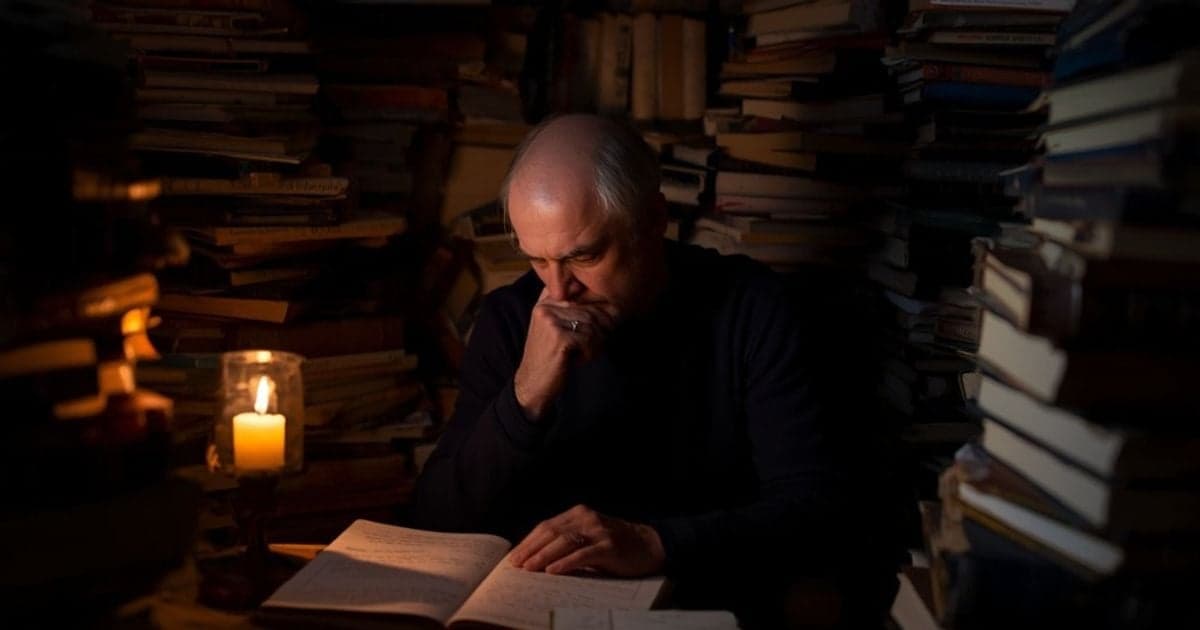
In this chapter: Terms Characters Key Quotes Themes Modern Story

Why This Matters

Connect literature to life

Skill: Recognizing Analysis Paralysis

The sharpest insights about yourself can be the last thing standing between you and a change you desperately need. The Underground Man begins Part I's final chapter by declaring conscious inertia the best path forward, then immediately catches himself lying, knowing the underground is not what he wants at all but unable to name what is. When you notice your most sophisticated thinking arriving precisely to prevent a decision, set a physical timer for five minutes and act before the next argument can form.

Coming Up in Chapter 12

The wet snow triggers a haunting memory from the Underground Man's past, launching into the story he's been avoiding. We're about to witness the specific incident that has been tormenting him - a tale that will reveal the real-world consequences of his underground philosophy.

Share it with friends

PreviousPrevious ChapterNextNext Chapter
Original text
1,429 wordscomplete

Chapter 11

The Contradictions of Self-Awareness

PART I — Underground Chapter XI The long and the short of it is, gentlemen, that it is better to do nothing! Better conscious inertia! And so hurrah for underground! Though I have said that I envy the normal man to the last drop of my bile, yet I should not care to be in his place such as he is now (though I shall not cease envying him). No, no; anyway the underground life is more advantageous. There, at any rate, one can ... Oh, but even now I am lying! I am lying because I know myself that…

Public-domain chapter text, formatted for reading.

Master this chapter. Complete your experience

Purchase the complete book to access all chapters and support classic literature

Buy at Powell's

Available in paperback, hardcover, and e-book formats

Now let's explore the literary elements.

Key Quotes & Analysis

"Oh, but even now I am lying! I am lying because I know myself that it is not underground that is better, but something different, quite different, for which I am thirsting, but which I cannot find! Damn underground!"

— Narrator

Context: Three lines after declaring conscious inertia the best outcome

The speed of the reversal is the point. He reaches his conclusion, states it, and immediately knows it is false. He is not searching for a better argument — he is thirsting for something he cannot name. This single outburst collapses all ten chapters of philosophical construction.

In Today's Words:

I keep catching myself mid-confession. Right now I am performing honesty for you, and I know it, and knowing it changes nothing about the performance. The watching and the doing are so entangled that I cannot separate them, which is, more or less, the entire problem this book has been trying to describe.

"There is not one thing, not one word of what I have written that I really believe. That is, I believe it, perhaps, but at the same time I feel and suspect that I am lying like a cobbler."

— Narrator

Context: Retracting Part I in its entirety

The qualification — 'I believe it, perhaps' — saves this from being simple nihilism. He is not saying it is all wrong. He is saying that his relationship to his own ideas is not belief. He performs conviction without possessing it. The cobbler image is deliberately undignified.

In Today's Words:

I have written fifty pages of confession and I do not believe a word of it. Not because it is false, but because the act of writing it has made it into something curated, performed, and therefore no longer quite real. The truth was present before I wrote it down. Writing it down turned it into evidence for a case I am building against myself.

"You boast of consciousness, but you are not sure of your ground, for though your mind works, yet your heart is darkened and corrupt, and you cannot have a full, genuine consciousness without a pure heart."

— Narrator (ventriloquizing the imagined reader)

Context: The climax of the devastating indictment he invents for himself

This is the underground man's own verdict on himself, spoken through an imagined voice. The accusation that consciousness without moral purity is fraudulent strikes at the centre of everything he has argued. He has claimed consciousness as his special dignity — and here accuses himself of having the wrong kind.

In Today's Words:

The more self-aware you are, the less certain you are of anything, including your own intentions. I can see myself from twelve angles simultaneously and none of them tells me what I actually want or who I actually am. Consciousness at this intensity does not produce clarity. It produces an infinite recession of doubt.

"Every decent man has a number of such things stored away in his mind. The more decent he is, the greater the number of such things in his mind."

— Narrator

Context: Introducing the taxonomy of secrets — things told to friends, to oneself, and things feared to tell even oneself

The inversion is characteristic: decency produces more concealment, not less. The better a person is, the more they accumulate that cannot be said. This is both a justification for his confessional project and a warning about its limits — even now, there will be things he cannot bring himself to write.

In Today's Words:

Every intelligent person keeps a private room of things they cannot say in public. Not because the things are shameful, exactly, but because the full picture is too complicated and contradictory to present without destroying the version of yourself that other people have agreed to believe in.

Thematic Threads

Self-Deception

In This Chapter

The Underground Man admits he lies while continuing to lie, showing how self-awareness doesn't guarantee honesty

Development

Evolved from earlier philosophical posturing to explicit acknowledgment of his own contradictions

In Your Life:

You might recognize this when you know you're making excuses but keep making them anyway.

Isolation

In This Chapter

He writes for an audience he claims doesn't exist, performing even in solitude

Development

Deepened from physical withdrawal to psychological disconnection from authentic self

In Your Life:

You might see this when you find yourself rehearsing conversations even when alone.

Performance

In This Chapter

Every thought and feeling becomes calculated, even his attempt at honesty is performed

Development

Introduced here as the logical endpoint of hyper-consciousness

In Your Life:

You might notice this when you can't tell the difference between what you actually feel and what you think you should feel.

Memory

In This Chapter

Specific memories haunt him like 'annoying tunes' that demand to be processed

Development

Introduced here as transition from abstract philosophy to concrete personal history

In Your Life:

You might experience this when certain memories keep surfacing until you deal with them directly.

Compulsion

In This Chapter

He feels driven to write his story despite knowing it might be another form of self-deception

Development

Evolved from intellectual choice to psychological necessity

In Your Life:

You might recognize this when you feel compelled to confess or explain yourself even when it won't help.

You now have the context. Time to form your own thoughts.

Discussion Questions

This is not a test. Five prompts guide you through the chapter, from how it opens to how it closes, so you notice context and rhythm rather than facts to memorize. Sit with each question in your own words. When you see "One way to read it," treat it as a starting point, not the only answer.

  1. 1

    The Underground Man opens by declaring conscious inertia the best path forward, then three lines later admits he is lying. What does this immediate self-correction tell us about his relationship with his own conclusions?

    ▶One way to read it

    He cannot commit to even a conclusion. The moment he states a position, a second voice undercuts it. This self-correction is not simple honesty; it is another loop of the same pattern that has paralyzed him throughout Part I.

    analysis • surface
  2. 2

    He includes Nekrasov's poem about a soldier and a fallen woman at the very end of Part I. What does this poem do to the chapter's closing, and why does it appear here?

    ▶One way to read it

    The poem anticipates Part II's central scenario before Liza appears. Ending Part I on a poem about a man who offers genuine rescue to a fallen woman is Dostoevsky's setup: the Underground Man is about to attempt exactly this, and fail in exactly the way his character predicts.

    analysis • medium
  3. 3

    He says that every decent man has stored away things he cannot speak of, and the more decent, the more of them. Have you ever produced something, a speech, a message, an argument, and felt afterward that it was real but also somehow not quite you?

    ▶One way to read it

    The Underground Man's predicament is the performed version of something most people recognize: the words were genuine at the moment of utterance but, seen from outside, became a kind of theater. The difference is that he sees the theater while he is still inside it.

    application • medium
  4. 4

    He knows that writing Part I has helped nothing but writes it anyway. What does this suggest about why people confess things that will not change their situation?

    ▶One way to read it

    The chapter implies that confession has its own logic apart from utility. Stating the truth, even to no one, even knowing it changes nothing, is still a form of action, the only one available to the Underground Man. That is why he cannot stop, even at the end of a section that has resolved nothing.

    application • deep
  5. 5

    Part I ends without resolution. What has the Underground Man actually accomplished by writing it?

    ▶One way to read it

    He has told the truth about himself in all its self-contradicting detail. Not the whole truth and not a useful truth, but the most accurate account of his experience he is capable of. Dostoevsky closes Part I suggesting this alone, the honest testimony of a wrecked consciousness, may be the Underground Man's only real achievement.

    reflection • deep

Critical Thinking Exercise

10 minutes

Track Your Analysis Loops

For the next day, notice when you catch yourself overthinking a decision or interaction. Write down three specific moments when analysis helped you versus three moments when it paralyzed you. Look for the pattern: when does thinking serve you, and when does it trap you?

Consider:

  • •Pay attention to the difference between useful planning and endless second-guessing
  • •Notice how overthinking affects your natural responses to people
  • •Observe whether your self-analysis makes you more or less confident in social situations

Journaling Prompt

Write about a recent situation where you overthought yourself into inaction. What would have happened if you'd trusted your first instinct instead?

Coming Up Next...

Chapter 12: The Underground Man at Twenty-Four

The wet snow triggers a haunting memory from the Underground Man's past, launching into the story he's been avoiding. We're about to witness the specific incident that has been tormenting him - a tale that will reveal the real-world consequences of his underground philosophy.

Continue to Chapter 12
Previous
The Crystal Palace Rebellion
Contents
Next
The Underground Man at Twenty-Four
Keep exploring

Continue Exploring

Study guides, teaching tools, themes, and the full library.More ways to read Notes from Underground: study guides, teaching tools, and the wider library.

  • Notes from Underground Study Guide
  • Teaching Resources
  • Essential Life Index
  • Browse by Theme
  • All Books

You Might Also Like

Crime and Punishment cover

Crime and Punishment

Fyodor Dostoevsky

Also by Fyodor Dostoevsky

The Brothers Karamazov cover

The Brothers Karamazov

Fyodor Dostoevsky

Also by Fyodor Dostoevsky

The Gambler cover

The Gambler

Fyodor Dostoevsky

Also by Fyodor Dostoevsky

The Idiot cover

The Idiot

Fyodor Dostoevsky

Also by Fyodor Dostoevsky

Browse all 106+ books

Share This Chapter

Know someone who'd enjoy this? Spread the wisdom!

TwitterFacebookLinkedInEmail

Go further with Prestige

Unlock study guides and downloads, early access, and exclusive content — and support free access for everyone.

Subscribe to PrestigeCreate free account
Intelligence Amplifier
Intelligence Amplifier™Powering Wide Reads

Exploring human-AI collaboration through books, essays, and philosophical dialogues. Classic literature transformed into navigational maps for modern life.

2025 Books

→ The Amplified Human Spirit→ The Alarming Rise of Stupidity Amplified→ San Francisco: The AI Capital of the World
Visit intelligenceamplifier.org
hello@widereads.com

WideReads Originals

→ You Are Not Lost→ The Last Chapter First→ The Lit of Love→ Wealth and Poverty→ Wisdom for the Wounded
Arvintech
arvintechAmplify your Mind
Visit at arvintech.com

Navigate

  • Home
  • Library
  • Essential Life Index
  • How It Works
  • Subscribe
  • Account
  • About
  • Contact
  • Authors
  • Suggest a Book
  • Landings

Made For You

  • Trending
  • Students
  • Educators
  • Families
  • Readers
  • Literary Analysis
  • Finding Purpose
  • Letting Go
  • Recovering from a Breakup
  • Corruption
  • Gaslighting in the Classics

Newsletter

Weekly insights from the classics. Amplify Your Mind.

Legal

  • Privacy Policy
  • Terms of Service
  • Editorial Standards
  • Cookie Policy
  • Accessibility

Why Public Domain?

We focus on public domain classics because these timeless works belong to everyone. No paywalls, no restrictions—just wisdom that has stood the test of centuries, freely accessible to all readers.

Public domain books have shaped humanity's understanding of love, justice, ambition, and the human condition. By amplifying these works, we help preserve and share literature that truly belongs to the world.

A Pilgrimage

Powell's City of Books

Portland, Oregon

If you ever find yourself in Portland, walk to the corner of Burnside and 10th. The building takes up an entire city block. Inside is over a million books, new and used on the same shelf, organized by color-coded rooms with names like the Rose Room and the Pearl Room. You can lose an afternoon. You can lose a weekend. You will find a book you have been looking for your whole life, and three you did not know existed.

It is a pilgrimage. We cannot find a bookstore like it anywhere on earth. If you read the classics, and you ever get the chance, go. It belongs on every reader's bucket list.

Visit powells.com

We are not in any way affiliated with Powell's. We are just a very big fan.

© 2026 Wide Reads™. All Rights Reserved.

Intelligence Amplifier™ and Wide Reads™ are proprietary trademarks of Arvin Lioanag.

Copyright Protection: All original content, analyses, discussion questions, pedagogical frameworks, and methodology are protected by U.S. and international copyright law. Unauthorized reproduction, distribution, web scraping, or use for AI training is strictly prohibited. See our Copyright Notice for details.

Disclaimer: The information provided on this website is for general informational and educational purposes only and does not constitute professional, legal, financial, or technical advice. While we strive to ensure accuracy and relevance, we make no warranties regarding completeness, reliability, or suitability. Any reliance on such information is at your own risk. We are not liable for any losses or damages arising from use of this site. By using this site, you agree to these terms.