Wide Reads
Literature MattersLife IndexEducators
Sign in
Where to Begin

No Way Out — Hard Times

Hard Times - No Way Out

Charles Dickens

Hard Times

No Way Out

Home›Books›Hard Times›Chapter 11: No Way Out
Previous
11 of 36
Next

Analysis by the Wide Reads editorial team·Reviewed against the source text·Updated May 26, 2026

Summary

No Way Out

Hard Times by Charles Dickens

0:000:00
Listen to Next Chapter

The mills wake again, and Dickens pauses over Stephen at his loom. Steam power can be weighed to the pound; the worker's inner life cannot. At noon Stephen leaves the hot mill, haggard and worn, and climbs the white steps to Josiah Bounderby's red house, where Mrs. Sparsit presides over lunch without eating it herself.

Stephen asks for advice, not complaint. He tells nineteen years of marriage gone bad: a young wife who drank, pawned, vanished, and returned again and again. He paid her to stay away five years, rebuilt a decent life, and last night found her on his hearthstone. Now he wants to know how to be rid of her so he can marry Rachael, the woman whose pity kept him sane. He has read that rich people may divorce, live apart in separate rooms, or buy their way free. Poor people with one room cannot.

Bounderby answers with brutal simplicity. Hurt her, there is law. Flee, there is law. Remarry, there is law. Live with Rachael unwed, the law would punish even innocent children. Stephen asks the question the chapter exists to ask: show me the law to help me. Bounderby admits such a law exists, but not for Stephen. It costs a mint of money, perhaps a thousand pounds or twice that, through Doctors' Commons, courts, and Parliament.

Stephen turns white and gives everything to the four winds. It is a muddle, he says, and the sooner he is dead the better. Bounderby tells him to mind his piece-work and stop insulting the nation's institutions. He accuses Stephen of coveting turtle soup and venison like other troublemakers. Stephen wishes him good day and leaves. Bounderby swells at his own portrait. Mrs. Sparsit looks cast down by popular vice.

In this chapter: Terms Characters Key Quotes Themes Modern Story

Why This Matters

Connect literature to life

Skill: Asking Where the Law Helps

A rule that exists on paper means nothing if the remedy costs more than a weaver can pay. Stephen climbs to Bounderby's red house and learns that divorce would run a thousand pounds and up, while Bounderby tells him to mind his piece-work. Ask not only what the law allows, but who can afford the exit and who is told to endure.

Coming Up in Chapter 12

Leaving Bounderby's house, Stephen meets a strange old country woman who only wanted a glimpse of the great manufacturer and asks if he is happy at the factory.

Share it with friends

PreviousPrevious ChapterNextNext Chapter
Original text
2,739 wordscomplete

Chapter 11

No Way Out

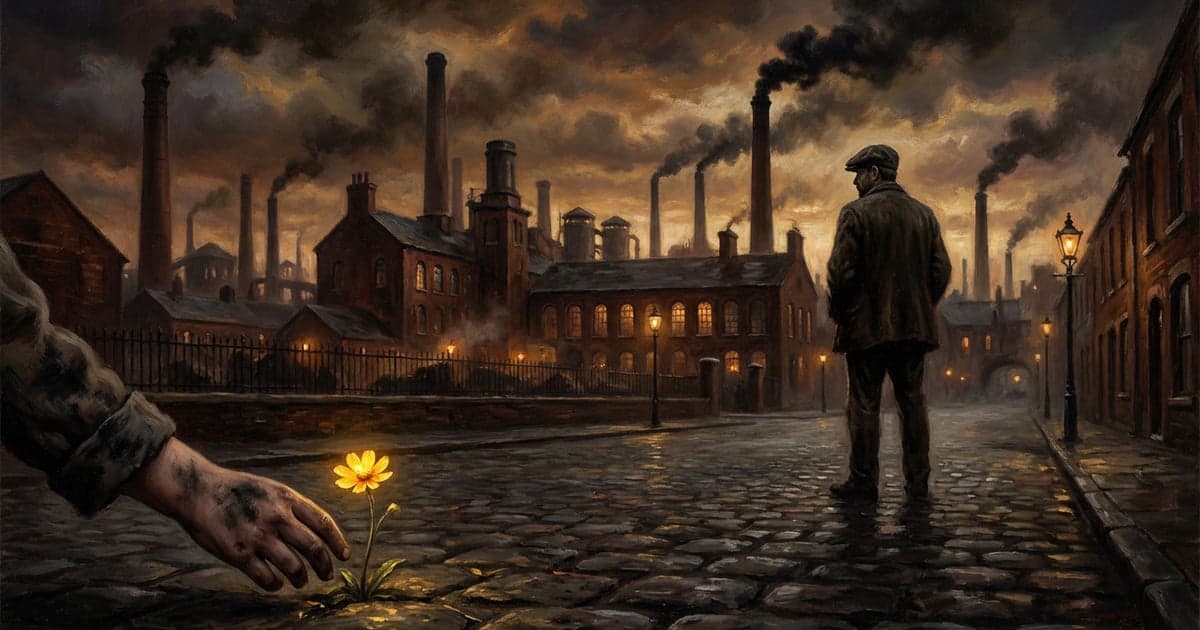
THE Fairy palaces burst into illumination, before pale morning showed the monstrous serpents of smoke trailing themselves over Coketown. A clattering of clogs upon the pavement; a rapid ringing of bells; and all the melancholy mad elephants, polished and oiled up for the day’s monotony, were at their heavy exercise again. Stephen bent over his loom, quiet, watchful, and steady. A special contrast, as every man was in the forest of looms where Stephen worked, to the crashing, smashing, tearing piece of mechanism at which he laboured. Never fear, good people of an anxious turn of mind, that Art will…

Public-domain chapter text, formatted for reading.

Master this chapter. Complete your experience

Purchase the complete book to access all chapters and support classic literature

Buy at Powell'sBuy on Amazon

Available in paperback, hardcover, and e-book formats

Now let's explore the literary elements.

Key Quotes & Analysis

"Sparsit, easily ambling along with her netting-needles, raised the Coriolanian eyebrows and shook her head, as much as to say, ‘The great know trouble as well as the small."

— Sparsit

Context: From this chapter's narrative

A verified line from the chapter text spanning its arc.

In Today's Words:

Mrs. Sparsit raises her brows as if to say the great know trouble too, a performative sympathy that costs her nothing. When a weaver pleads, gentility watches like sport. Rank allows distance dressed as wisdom, and her small gesture tells Stephen that his pain will be consumed as gossip upstairs, not addressed as policy failure.

"The rain fell, and the Smoke-serpents, submissive to the curse of all that tribe, trailed themselves upon the earth."

— Narrator

Context: From this chapter's narrative

A verified line from the chapter text spanning its arc.

In Today's Words:

Rain threads the smoke stacks like serpents on the ground, the town performing submission to its curse. Environmental poetry meets economics: the tribe of profit bends everything, even weather, to service. A modern reader sees rivers overdue for cleanups while quarterly reports stay green, and the image insists that industry does not float above nature; it drags nature into its shape.

"There _is_ such a law."

— Josiah Bounderby

Context: Refusing Stephen

Justice priced out.

In Today's Words:

There is such a law, the manufacturer says when a weaver asks how to leave a brutal marriage, but the law is priced for people with spare rooms and lawyers. For Stephen it means no how. Justice exists on paper the way a mansion exists across town: real, unreachable, and defended by men who treat his question as impiety rather than need.

"Out with it, lad!’ Stephen happened to glance towards Mrs."

— Narrator

Context: From this chapter's narrative

A verified line from the chapter text spanning its arc.

In Today's Words:

Bounderby barks for the answer while others perform concern. The office scene is familiar: rush the worker, hide the institution. Urgency is theater that protects the boss from sitting with the cost of no, and the command treats Stephen's plea like insolence delaying production rather than a life asking for lawful help.

Thematic Threads

Class and power

In This Chapter

Divorce for the rich; piece-work obedience for Stephen

Development

Worker trap made explicit

In Your Life:

You may see rights that exist on paper but not in your paycheck.

Dehumanizing systems

In This Chapter

Soul unfathomable at mill; marriage reduced to institution

Development

Extends Coketown keynote into personal law

In Your Life:

You may notice when policy measures everything except suffering.

Industrial dehumanization

In This Chapter

Mind your piece-work

Development

Bounderby reduces moral crisis to productivity

In Your Life:

You may hear keep working when you ask for structural help.

You now have the context. Time to form your own thoughts.

Discussion Questions

This is not a test. Five prompts guide you through the chapter, from how it opens to how it closes, so you notice context and rhythm rather than facts to memorize. Sit with each question in your own words. When you see "One way to read it," treat it as a starting point, not the only answer.

  1. 1

    Dickens says the engine's power can be weighed to the pound, but no calculator can measure the good or evil in a worker's soul. Why does Stephen then climb to Bounderby's house to ask for lawful advice instead of simply acting on his own?

    ▶One way to read it

    Stephen is a man of perfect integrity, not a rebel. He wants a legal path, not scandal or violence. The opening passage sets up the gap between what machines can measure and what human lives need, which is exactly what his marriage question exposes.

    analysis • surface
  2. 2

    When Stephen asks to be rid of his wife so he can marry Rachael, why does Bounderby list a law for every punishment but answer that divorce exists only at a cost of a thousand pounds or more, not for a Hand like him?

    ▶One way to read it

    Relief is priced like a luxury good. Hurt, flee, or remarry and the law arrives quickly. Help exists on paper but only for people who can afford courts, lawyers, and Parliament. Bounderby admits the law, then closes the door on class grounds.

    analysis • medium
  3. 3

    Stephen says wealthy people can live in separate rooms, buy their way free, and obtain divorces for smaller wrongs than his, while poor folk with one room cannot. Where do you see rights or remedies that exist officially but stay out of reach for people without money?

    ▶One way to read it

    Think of legal fees that block custody changes, bail that functions as a price tag, healthcare tied to employment, or housing appeals that require time and counsel workers cannot spare. The system calls the remedy available; the price says otherwise.

    application • medium
  4. 4

    Stephen tells Bounderby that sanctity in marriage is kept down, not up, and that supposed unbreakable bonds bring blood, battle, and sudden death among common folk. What is he arguing about institutions that praise endurance but offer no exit?

    ▶One way to read it

    He is not asking for sentiment. He is naming damage done when law binds the poor permanently while the rich can buy distance. A rule praised as moral can become a trap when relief costs more than a lifetime's wages and every honest path still punishes you.

    application • deep
  5. 5

    Stephen leaves saying, 'Tis a muddle,' while Bounderby tells him to mind his piece-work and accuses him of wanting turtle soup and venison. Why is muddle the accurate word, and why does Bounderby reframe a plea for help as greed?

    ▶One way to read it

    Muddle is precise because every option leads to punishment and the one lawful exit is unaffordable. Bounderby reframes need as ingratitude because institutions prefer workers who weave and do not ask who the law protects. Accusing Stephen of coveting luxury avoids answering show me the law to help me.

    reflection • deep

Critical Thinking Exercise

10 minutes

Map Punishment and Relief

Pick a personal or legal problem people face in your community. List the penalties for acting outside the rules, then list the official remedies and what they cost in money, time, or status.

Consider:

  • •Who can afford the remedy
  • •What happens to people who stay honorable but trapped
  • •Who tells them to accept the institution anyway

Journaling Prompt

Write about a time you were told the rule exists but not for someone in your position.

Coming Up Next...

Chapter 12: The Old Woman

Leaving Bounderby's house, Stephen meets a strange old country woman who only wanted a glimpse of the great manufacturer and asks if he is happy at the factory.

Continue to Chapter 12
Previous
Stephen Blackpool
Contents
Next
The Old Woman
Keep exploring

Continue Exploring

Study guides, teaching tools, themes, and the full library.More ways to read Hard Times: study guides, teaching tools, and the wider library.

  • Hard Times Study Guide
  • Teaching Resources
  • Essential Life Index
  • Browse by Theme
  • All Books

What this chapter teaches

Theme analyses that draw on this chapter and apply it to modern life.

  • Seeing Through Productivity ObsessionExplore seeing through productivity obsession through Hard Times by Charles Dickens. Timeless wisdom for modern life.

You Might Also Like

A Tale of Two Cities cover

A Tale of Two Cities

Charles Dickens

Also by Charles Dickens

Great Expectations cover

Great Expectations

Charles Dickens

Also by Charles Dickens

A Christmas Carol cover

A Christmas Carol

Charles Dickens

Also by Charles Dickens

Heart of Darkness cover

Heart of Darkness

Joseph Conrad

Explores society & class

Browse all 106+ books

Share This Chapter

Know someone who'd enjoy this? Spread the wisdom!

TwitterFacebookLinkedInEmail

Go further with Prestige

Unlock study guides and downloads, early access, and exclusive content — and support free access for everyone.

Subscribe to PrestigeCreate free account
Intelligence Amplifier
Intelligence Amplifier™Powering Wide Reads

Exploring human-AI collaboration through books, essays, and philosophical dialogues. Classic literature transformed into navigational maps for modern life.

2025 Books

→ The Amplified Human Spirit→ The Alarming Rise of Stupidity Amplified→ San Francisco: The AI Capital of the World
Visit intelligenceamplifier.org
hello@widereads.com

WideReads Originals

→ You Are Not Lost→ The Last Chapter First→ The Lit of Love→ Wealth and Poverty→ Wisdom for the Wounded
Arvintech
arvintechAmplify your Mind
Visit at arvintech.com

Navigate

  • Home
  • Library
  • Essential Life Index
  • How It Works
  • Subscribe
  • Account
  • About
  • Contact
  • Authors
  • Suggest a Book
  • Landings

Made For You

  • Trending
  • Students
  • Educators
  • Families
  • Readers
  • Literary Analysis
  • Finding Purpose
  • Letting Go
  • Recovering from a Breakup
  • Corruption
  • Gaslighting in the Classics

Newsletter

Weekly insights from the classics. Amplify Your Mind.

Legal

  • Privacy Policy
  • Terms of Service
  • Editorial Standards
  • Cookie Policy
  • Accessibility

Why Public Domain?

We focus on public domain classics because these timeless works belong to everyone. No paywalls, no restrictions—just wisdom that has stood the test of centuries, freely accessible to all readers.

Public domain books have shaped humanity's understanding of love, justice, ambition, and the human condition. By amplifying these works, we help preserve and share literature that truly belongs to the world.

A Pilgrimage

Powell's City of Books

Portland, Oregon

If you ever find yourself in Portland, walk to the corner of Burnside and 10th. The building takes up an entire city block. Inside is over a million books, new and used on the same shelf, organized by color-coded rooms with names like the Rose Room and the Pearl Room. You can lose an afternoon. You can lose a weekend. You will find a book you have been looking for your whole life, and three you did not know existed.

It is a pilgrimage. We cannot find a bookstore like it anywhere on earth. If you read the classics, and you ever get the chance, go. It belongs on every reader's bucket list.

Visit powells.com

We are not in any way affiliated with Powell's. We are just a very big fan.

© 2026 Wide Reads™. All Rights Reserved.

Intelligence Amplifier™ and Wide Reads™ are proprietary trademarks of Arvin Lioanag.

Copyright Protection: All original content, analyses, discussion questions, pedagogical frameworks, and methodology are protected by U.S. and international copyright law. Unauthorized reproduction, distribution, web scraping, or use for AI training is strictly prohibited. See our Copyright Notice for details.

Disclaimer: The information provided on this website is for general informational and educational purposes only and does not constitute professional, legal, financial, or technical advice. While we strive to ensure accuracy and relevance, we make no warranties regarding completeness, reliability, or suitability. Any reliance on such information is at your own risk. We are not liable for any losses or damages arising from use of this site. By using this site, you agree to these terms.