
The Reframe · No. 24
El Filibusterismo is not a revolution manual. José Rizal never wrote one.
Most readers arrive calling it the revolution sequel — reform failed in Noli Me Tángere, so Fili must tell you to pick up the bomb. That is the cliché. It is not the book José Rizal actually wrote.
Rizal trained as a doctor, wrote in Spanish from European exile, and published El Filibusterismo in Ghent in 1891 as the sequel's darker half: Simoun returned, students waiting on a friar's permit, land taken harvest by harvest, and a lamp moving toward a cathedral wedding. When the Katipunan rose in 1896 he opposed armed revolt. A military court still executed him for what he had written.
The reframe is not that colonial abuse is invented. Rizal names it on the first page. The reframe is that the novel refuses the poster ending — expose, fuse, win. Padre Florentino answers Simoun's excuses, rejects hate as redemption, and sinks the treasure so greed cannot fund the next attempt.
What most readers assume
“The revolution sequel — reform failed in Noli, so Rizal tells you to arm the fuse and finish what petitions could not.”
Rizal units · national-hero shorthand · Simoun as patriot blueprint
What Rizal actually stages
Not a revolution manual — a cost accounting. The Ship of State on the Pasig, courts that bless friar land, physics class without inquiry, Simoun's lamp — and a priest who will not bless the explosion and throws the chest into the sea.
El Filibusterismo · José Rizal · 1891
Posters sell the fuse. The book sells the priest who says hate breeds monsters, throws the chest into the sea, and asks where the youth are.
The novel opens as a joke about the Ship of State
In Chapter 1, the steamer Tabo labours up the Pasig while passengers joke that the boat might be taken for the Ship of State: dirty, majestic, stuck on sandbars, smoking like a tyrant who rules by shouting. Brown faces crowd the lower deck and pole the hull; friars, clerks, and Europeans lounge under an awning. Simoun the jeweler listens from the lower deck with a canal plan that would treat prisoners and villagers like pyramid builders.
Rizal's opening is satire, not a battle hymn. He is teaching you to read the room before anyone lights a fuse.
Cabesang Tales learns what paper costs
Naming corruption is not the same as moving it. In Chapter 4, Cabesang Tales clears forest with his family's labour; a religious corporation raises the rent each harvest; judges who are good fathers at home still give the fields to the friars because their own salaries depend on peace. Tales arms himself with a shotgun, then a bolo, then an ax. Juli sells her freedom to ransom a father the law will not protect.
The poster version skips this middle: it jumps from Noli's reform hope to Simoun's fuse. Rizal spends chapters showing what happens when petitions meet courts that already know who pays them.
 Read chapter 39
The source · Chapter 39, El Filibusterismo
“Wrong! Hate never produces anything but monsters and crime criminals! Love alone realizes wonderful works, virtue alone can save!”José Rizal, El Filibusterismo, Conclusion (Charles E. Derbyshire trans.; public domain)
Education as control, not a shortcut
Students collect centavos for a Castilian academy and wait on a friar's permit while Simoun smirks from the steerage deck. In Chapter 13, the physics classroom has a blackboard scarcely used, walls bare of apparatus, and Placido Penitente walks out of a lesson that teaches obedience instead of inquiry. Rizal is not saying study is useless. He is showing what colonial permission does to a subject that requires experiment.
The ending is a verdict, not a detonation
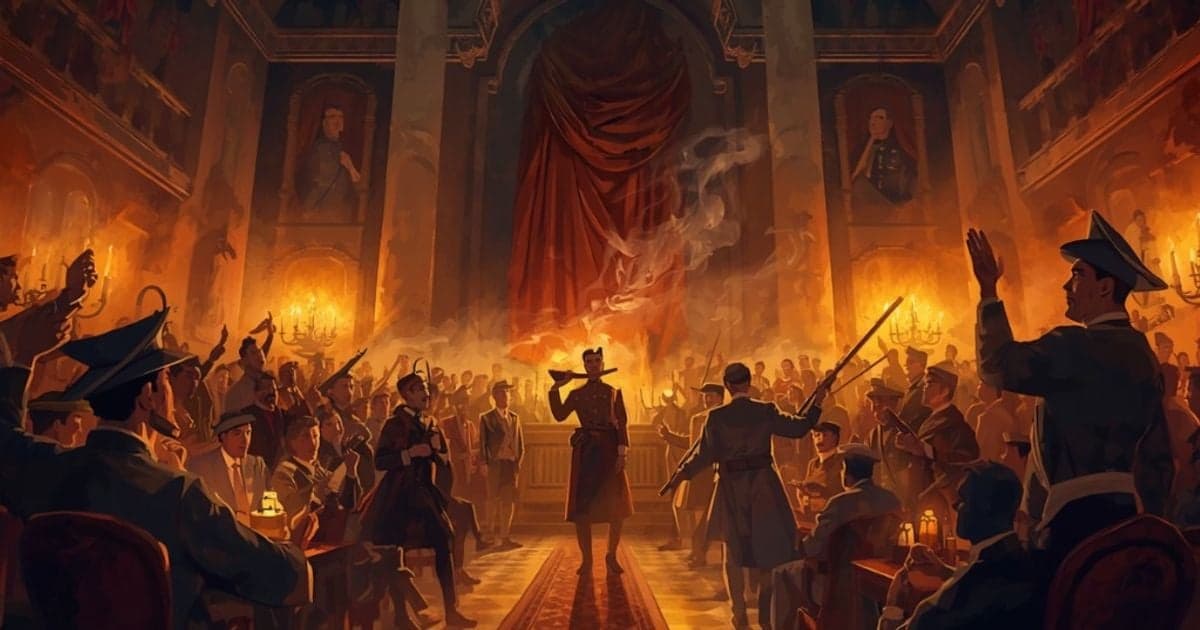
Chapter 39 does not hand you a successful uprising. Simoun confesses as Ibarra, chooses poison over torture, and dies in Padre Florentino's house by the sea. Florentino tells him that redemption presupposes virtue, virtue sacrifice, and sacrifice love. Then he commits the jeweler's chest to the Pacific and asks where the youth are who will bring back vigour without becoming monsters.
Execution in 1896 does not erase that scene. National memory can treat Rizal as the revolution's author; the novel keeps Simoun's conspiracy and Florentino's refusal in the same binding.
Bring this to the table
You know Simoun's lamp. Can you quote what Padre Florentino does with the treasure — or why Rizal opposed armed revolt while writing the fuse?
Common Questions
Search questions about El Filibusterismo — Simoun, Padre Florentino, the Ship of State, and what Rizal staged beyond the revolution poster.
Is El Filibusterismo actually a revolution manual?
Not in the way school shorthand often claims. Rizal stages Simoun's returned grief, the lamp plot, and a jeweler rich enough to rent influence — then sends Padre Florentino to answer each excuse with moral law and throw the treasure chest into the sea so gold cannot distort the next struggle. When the Katipunan rose in 1896 Rizal opposed armed revolt; a military court still convicted him for what he had written. The novel keeps that tension on the page.
Does Rizal endorse Simoun's conspiracy?
The text refuses it. Simoun is Crisóstomo Ibarra returned after loss and exile, and his lamp is a real plot. Padre Florentino tells him that hate breeds monsters, that redemption presupposes virtue and sacrifice, and that if the country is to be free it will not be through vice and crime. The closing movement sinks the jeweler's chest rather than hand it to the next avenger.
What is El Filibusterismo really about?
What patience costs once reform is already ash. Rizal names colonial performance on the Tabo, education used as control in the physics class, land and courts that side with a religious corporation against Cabesang Tales, and grief that hardens into conspiracy. The sequel to Noli is not louder patriotism. It is a question about means once naming corruption no longer moves the powerful.
Why do people call it the revolution novel?
Because the title names filibusterism, because Simoun stockpiles fuses, and because Rizal was executed after 1896. National memory often pairs the two novels as reform then revolt. The novel itself keeps Simoun's conspiracy and Rizal's own opposition to armed revolt in the same frame, and saves its last word for a priest who will not bless the explosion.
Who is Simoun?
Crisóstomo Ibarra from Noli Me Tángere, returned after thirteen years as a wealthy jeweler with blue goggles and a canal scheme that treats villagers like pyramid builders. He sells jewels to the officials he plans to ruin and moves toward a cathedral wedding rigged with a lamp. He is the novel's temptation toward revenge, not its author speaking in his own voice.
What does Padre Florentino do at the end?
He hears Simoun's confession, rejects hate as redemption, prays for youth to bring back vigour and purity, and commits the treasure chest to the sea so avarice cannot foment the next revolt. Rizal hands the unfinished work to a generation not yet corrupted — and to the reader who must answer Florentino's question about where the youth are.
Read what Rizal actually staged.
El Filibusterismo is thirty-nine chapters from the Tabo's upper deck to Padre Florentino's sea — Simoun, Cabesang Tales, student cells, and the lamp that is not the author's prescription. We narrate it chapter by chapter in plain language. Pair with Noli Me Tángere if you want the full argument: first how reform fails, then what temptation looks like once it has.