Teaching The Idiot
by Fyodor Dostoevsky (1869)
Teaching Map
This guide is not only for literature teachers. Parents, tutors, book clubs, and anyone reading The Idiot together can use it to open conversation — not just recap plot. Each Why it matters note is a question-starter: ask toward a Collision (two views meet and something shifts), a Reframe (the same facts suddenly mean something different), or a Recognition (what was always there finally becomes visible). The map shows how the book breaks into stages, which anchor scenes to lean on, and where each Lesson fits — whether you are planning a term or a single evening.
Part I
Chapters 1–11 · The train, the Epanchins, and Nastasya's birthday
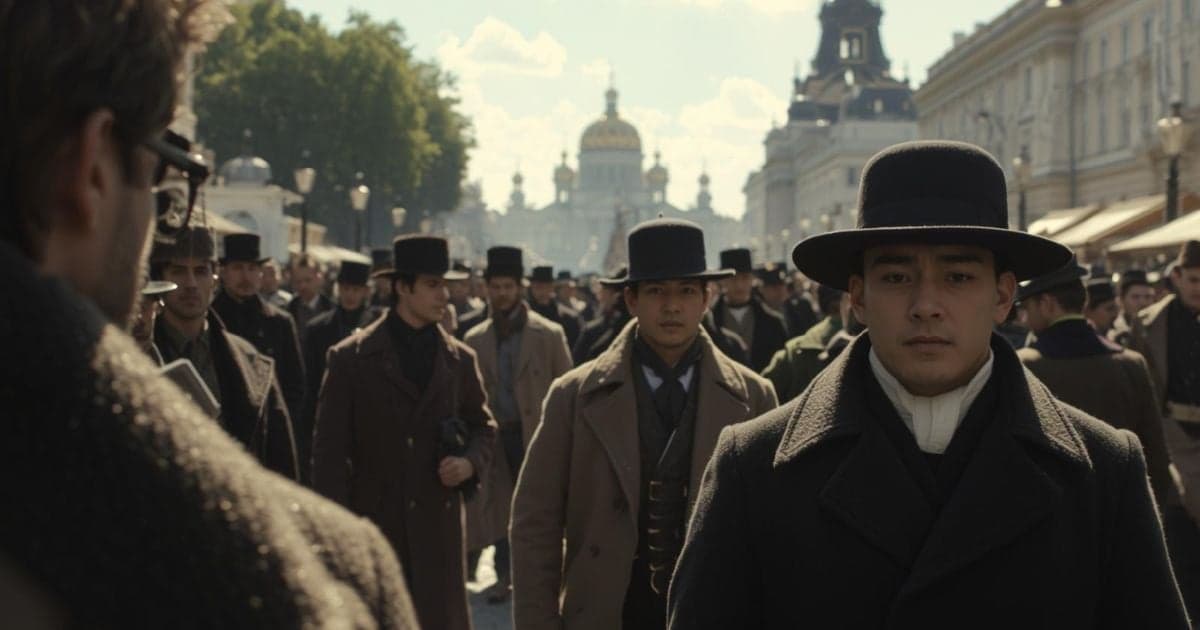
The third-class carriage with Rogozhin
“Towards the end of November, during a thaw, at nine o’clock one morning, a train on the Warsaw and Petersburg…”
Why it matters
Ask a question — toward Collision, Reframe, or Recognition.
People can share struggles to connect or to manipulate sympathy. On the train Myshkin admits illness and poverty while Rogozhin tests whether anyone wants him beyond his inheritance. Notice whether someone's openness invites mutual honesty or positions them as the one who needs saving.
Distinguishing Intensity from Depth
“Towards the end of November, during a thaw, at nine o’clock one morning, a train on the Warsaw and Petersburg…”
Why it matters
Ask a question — toward Collision, Reframe, or Recognition.
People can share struggles to connect or to manipulate sympathy. On the train Myshkin admits illness and poverty while Rogozhin tests whether anyone wants him beyond his inheritance. Notice whether someone's openness invites mutual honesty or positions them as the one who needs saving.
Maintaining Goodness Without Naivety
“General Ivan Fedorovitch Epanchin was standing in the middle of the room, and gazed with great curiosity at the prince…”
Why it matters
Ask a question — toward Collision, Reframe, or Recognition.
Every social call carries an unspoken invoice. In Epanchin's study Myshkin claims no business while Gania negotiates a marriage tied to Nastasya's fortune. Ask what each speaker gains before you accept their friendliness at face value.
Setting Boundaries With Compassion
“General Ivan Fedorovitch Epanchin was standing in the middle of the room, and gazed with great curiosity at the prince…”
Why it matters
Ask a question — toward Collision, Reframe, or Recognition.
Every social call carries an unspoken invoice. In Epanchin's study Myshkin claims no business while Gania negotiates a marriage tied to Nastasya's fortune. Ask what each speaker gains before you accept their friendliness at face value.
Recognizing Destructive Love
“General Ivan Fedorovitch Epanchin was standing in the middle of the room, and gazed with great curiosity at the prince…”
Why it matters
Ask a question — toward Collision, Reframe, or Recognition.
Every social call carries an unspoken invoice. In Epanchin's study Myshkin claims no business while Gania negotiates a marriage tied to Nastasya's fortune. Ask what each speaker gains before you accept their friendliness at face value.
Reading Authenticity vs Performance
“Mrs. General Epanchin was a proud woman by nature. What must her feelings have been when she heard that Prince…”
Why it matters
Ask a question — toward Collision, Reframe, or Recognition.
People who have seen violence or death often speak with uncomfortable precision. In the Epanchin boudoir Myshkin describes executions while the family toggles between laughter and unease. Treat startling clarity as testimony, not theater, before you dismiss the speaker.
Knowing Compassion's Limits
“Here you all are,” began the prince, “settling yourselves down to listen to me with so much curiosity, that if…”
Why it matters
Ask a question — toward Collision, Reframe, or Recognition.
Groups often punish outcasts while calling it morality. In the Swiss village adults ostracize Marie while Myshkin teaches children to see her humanity. Watch whether a group's story makes cruelty feel virtuous before you join in.
Nastasya's birthday and the fire
“When the prince ceased speaking all were gazing merrily at him—even Aglaya; but Lizabetha Prokofievna looked the jolliest of all.…”
Why it matters
Ask a question — toward Collision, Reframe, or Recognition.
Urgent pleas often disguise bargains for guaranteed outcomes. Gania begs Aglaya for one saving word while refusing to break his mercenary engagement first. Ask whether someone's vulnerability is asking for sympathy or for insurance before they act.
Part II
Chapters 12–24 · Pavlofsk, the Poor Knight, and the fire
The Poor Knight recitation
“Katia, the maid-servant, made her appearance, terribly frightened. “Goodness knows what it means, ma’am,” she said. “There is a whole…”
Why it matters
Ask a question — toward Collision, Reframe, or Recognition.
People sometimes invite disorder so witnesses cannot look away from a choice. Nastasia orders Rogozhin's rowdy crew admitted with a hundred thousand roubles while polite guests stay to watch. Ask what decision someone wants you to witness before you treat their chaos as accidental.
The public humiliation
“I _did_ not expect you, gentlemen,” began the prince. “I have been ill until to-day. A month ago,” he continued,…”
Why it matters
Ask a question — toward Collision, Reframe, or Recognition.
A generous offer made before witnesses can read as charity instead of justice. Myshkin hears a libel read aloud on the terrace, then offers ten thousand roubles while Burdovsky's party and the Epanchins watch. Ask whether the audience will make your help feel like repair or insult.
Part III
Chapters 25–36 · Ippolit, Aglaya's dinner, and the Holbein
The Holbein Christ in Rogozhin's house
“The Epanchin family, or at least the more serious members of it, were sometimes grieved because they seemed so unlike…”
Why it matters
Ask a question — toward Collision, Reframe, or Recognition.
Clever dinner speeches often test loyalty more than they pursue truth. Evgenie Pavlovitch lectures on Russian liberals while the mother fumes over an anonymous letter tying Aglaya to Nastasia. Ask who is being evaluated when a gathering turns ideological on a summer evening.
Truth and lies in the garden
“She laughed, but she was rather angry too. “He’s asleep! You were asleep,” she said, with contemptuous surprise. “Is it…”
Why it matters
Ask a question — toward Collision, Reframe, or Recognition.
Invented stories often probe loyalty more than they seek truth. Aglaya meets Myshkin on the bench, lies about Ganya and a candle, then produces Nastasia's letters and threatens an asylum if she writes again. When someone admits they lied to test you, name the insecurity underneath before you answer the performance.
Part IV
Chapters 37–50 · The wedding that never happens and the morning on the floor
The wedding that never happens
“While he feasted his eyes upon Aglaya, as she talked merrily with Evgenie and Prince N., suddenly the old anglomaniac,…”
Why it matters
Ask a question — toward Collision, Reframe, or Recognition.
Sincerity can destroy acceptance when feeling outruns the setting. Myshkin denounces Catholicism at the Epanchins' dinner, breaks the Chinese vase, asks if he is forgiven, then falls writhing in Aglaya's arms. When truth rises faster than the room can hold, pause before you ask everyone to bear your whole inner weather at once.
The aftermath and final reckonings
“When the widow hurried away to Pavlofsk, she went straight to Daria Alexeyevna’s house, and telling all she knew, threw…”
Why it matters
Ask a question — toward Collision, Reframe, or Recognition.
One person's catastrophe rewrites many lives; your task is to choose your role in the aftermath. Rogojin is sentenced, Myshkin returns to Schneider unrecognized, and Evgenie with Vera keep watch through letters while Aglaya flees into a disastrous marriage. List what you owe the crisis versus what you inherited before you volunteer for every repair.
Why Teach The Idiot?
Prince Lev Nikolayevich Myshkin returns from a Swiss clinic to Petersburg and meets Parfyon Rogozhin on a third-class train. He offers marriage to Nastasya Filippovna without calculating a dowry, fails Aglaya Epanchin's public test at Princess Belokonskaya's dinner, and ends on the floor beside a murdered woman, stroking the murderer's hair. Dostoevsky wrote the novel after his infant daughter Sonya died, trying to invent a positively good man and refusing to protect him from the plot.
Lessons from The Idiot
Six named pressures the book tests, each tied to a chapter and a deeper lesson page. Send students to one when a theme hooks them, then back to the scene that proves it.
Maintaining Goodness Without Naivety
Sit with Myshkin on the train in chapter 1: honesty with no angle, and a city that can only call it idiocy.
Reading Authenticity vs Performance
Hear the Poor Knight, the truth game, and the dinner for Belokonskaya, and tell a person from a scene.
Distinguishing Intensity from Depth
Set Rogozhin's knife and packet against Myshkin's offer: heat is not the same thing as a life.
Setting Boundaries With Compassion
Name the yes that cannot become a no, from Marie's village to the vigil that cannot stop the knife.
Knowing Compassion's Limits
Stay with the choice that wrecks Aglaya: he will not abandon Nastasya, and the kindness has a cost.
Recognizing Destructive Love
Watch Nastasya and Rogozhin from the hundred thousand in the fire to the house police open in the morning.
Suggested Teaching Approach
1Before class: map the setup
Read Part I for the third-class carriage, the Epanchins' charity case who turns out to have a mind, and Nastasya's birthday where Rogozhin's hundred thousand goes into the fire. You need the offer of marriage with no ledger attached before Pavlofsk can test it.
2Discussion starter: name the mechanism
Skip plot recall. Ask where students see this book's pressures play out in their own lives, from The third-class carriage with Rogozhin (Ch. 1) to The aftermath and final reckonings (Ch. 50). Tie every answer to a chapter number, not a theme label alone.
3Modern connections: use the six lessons
Six pressures Dostoevsky tests from the wet November carriage to the morning police open the door: goodness without naivety in a city that calls honesty idiocy, destructive love in the fire and the house on Gorokhovaya, intensity mistaken for depth, authenticity against performance in public tests, compassion's limits when the yes cannot become a no, and boundaries that arrive too late to stop the knife. Each spoke ties named chapters to the proof.
4Assessment: application, not recall
Essay prompts that work: compare The third-class carriage with Rogozhin (Ch. 1) to The Holbein Christ in Rogozhin's house (Ch. 29); trace how it pays off by the ending. Pair with a current-events angle, then require a scene from the book as counterweight. Assess application, not recall. AI cannot help with lived experience.
Chapter-by-Chapter Resources
The Prince Meets His Future
Why it matters: People can share struggles to connect or to manipulate sympathy. On the train Myshkin admits illness and poverty while Rogozhin tests whether…
The General's Household
Why it matters: Titles and uniforms train us to confuse rank with wisdom. In Epanchin's ante-chamber a footman judges Myshkin by his bundle until a…
An Awkward Introduction and Hidden Motives
Why it matters: Every social call carries an unspoken invoice. In Epanchin's study Myshkin claims no business while Gania negotiates a marriage tied to Nastasya's…
Family Dynamics and Hidden Agendas
Why it matters: Respectable language often hides transactional harm. Totski and Epanchin discuss Nastasya's marriage over tea as if it were a business exit, not…
First Impressions and Hidden Depths
Why it matters: People who have seen violence or death often speak with uncomfortable precision. In the Epanchin boudoir Myshkin describes executions while the family…
The Prince's Story of Marie
Why it matters: Groups often punish outcasts while calling it morality. In the Swiss village adults ostracize Marie while Myshkin teaches children to see her…
The Portrait's Power
Why it matters: Urgent pleas often disguise bargains for guaranteed outcomes. Gania begs Aglaya for one saving word while refusing to break his mercenary engagement…
Living Arrangements and Family Tensions
Why it matters: People often punish family for humiliations they cannot fix outside. Gania snaps at mother and sister while shame over lodgers and Nastasia's…
When Worlds Collide at Home
Why it matters: Borrowed stories often signal fear that the authentic self is not enough. General Ivolgin tells a newspaper tale to impress Nastasia and…
When Money Meets Pride
Why it matters: Money and rage often turn private deals into auctions of dignity. Rogozhin stacks roubles in Gania's parlor while Myshkin blocks violence with…
The Art of Sincere Apology
Why it matters: Sincere remorse can arrive and vanish within the same conversation. Gania embraces Myshkin in real guilt, then pivots back to marrying Nastasia…
A Drunken Guide's False Promises
Why it matters: Charismatic people often offer access they cannot deliver. Drunk General Ivolgin pockets Myshkin's money, rings the wrong flat, and presents him to…
The Dangerous Game Begins
Why it matters: Party games can weaponize confession while pretending to celebrate authenticity. Ferdishenko proposes faults-and-forfeits at Nastasia's birthday while she warns cowards to stay…
The Truth Game Explodes
Why it matters: Public honesty prompts often hunt embarrassment, not understanding. Ferdishenko asks if everyone steals and spotlights Myshkin's blush at Nastasia's party. Refuse the…
The Hundred Thousand Ruble Gamble
Why it matters: People sometimes invite disorder so witnesses cannot look away from a choice. Nastasia orders Rogozhin's rowdy crew admitted with a hundred thousand…
The Fire Test of Character
Why it matters: Burning cash in front of witnesses turns greed into a visible choice. Nastasia throws hundred thousand roubles into the fire and dares…
The Prince's Mysterious Absence
Why it matters: Silence after someone leaves often reveals how much they mattered. The Epanchins avoid Myshkin's name for months, yet Aglaya hides his letter…
Lebedeff's Household and Hidden Motives
Why it matters: Go-betweens in feuds often profit from keeping trouble alive. Lebedeff shelters Nastasia, serves Rogojin, and rents Pavlofsk villas while quoting Scripture and…
The Knife Between Friends
Why it matters: Obsessive pursuit can sound like love while planning harm. Rogojin tells Myshkin he could have poisoned him, then asks him to stay…
The Exchange of Crosses
Why it matters: Sacred gestures can feel like peace while rivalry stays active underneath. Rogojin and Myshkin exchange crosses and receive a mother's blessing, then…
The Stalker in the Shadows
Why it matters: Hypervigilance can make ordinary details feel like proof that danger is already here. Myshkin hunts a shop marked sixty copecks, sees Rogojin…
The Overprotective Host and Social Tensions
Why it matters: Care offered with locked doors is often care mixed with leverage. Lebedeff hovers at the prince's door, blocks visitors, then reveals a…
The Poor Knight's Secret
Why it matters: Shared references let a group target one person while everyone else applauds the performance. Aglaya recites Pushkin's Poor Knight with changed initials…
The Public Humiliation
Why it matters: A generous offer made before witnesses can read as charity instead of justice. Myshkin hears a libel read aloud on the terrace,…
Truth Unveiled, Pride Exposed
Why it matters: Proving a claim false does not automatically heal the shame the claim created. Gania proves Burdovsky is not Pavlicheff's son; Burdovsky refuses…
When Truth Becomes a Weapon
Why it matters: Accurate facts can still be deployed as weapons in a crowded room. Hippolyte exposes Lebedeff's editing, then turns his dying voice on…
The Weight of Suspicion
Why it matters: Sincere confession and a loan request can arrive in the same breath. Keller weeps through his sins to Myshkin, then admits he…
The Mother's Interrogation
Why it matters: A mother's exile speech can mask worry more than rejection. The mother bans Myshkin from her house, then drags him back when…
Family Anxieties and Political Arguments
Why it matters: Clever dinner speeches often test loyalty more than they pursue truth. Evgenie Pavlovitch lectures on Russian liberals while the mother fumes over…
Public Meltdown and Unexpected Defenders
Why it matters: Public chaos reveals defenders and performers faster than polite talk ever will. Aglaya defends Myshkin at dinner; Nastasia's park entrance turns the…
Secrets and Midnight Confessions
Why it matters: A withheld smile can feel like love when you have been starving for it. Aglaya teaches Myshkin to load a pistol on…
Birthday Revelations and Philosophical Debates
Why it matters: The loudest voice at a gathering is rarely the truest one. Lebedeff sermonizes about railways and cannibal monks on the verandah while…
The Sealed Confession
Why it matters: A dying person's public confession can be a plea to be seen, not a show to consume. Hippolyte wakes panicked about sunrise,…
The Weight of Final Convictions
Why it matters: Terminal pressure can surface cruelty and charity in the same person within days. Hippolyte mocks Surikoff's dead child, returns a lost wallet…
The Failed Suicide and Its Aftermath
Why it matters: A failed public crisis can humiliate someone as deeply as the pain that caused it. Hippolyte fires an uncapped pistol at sunrise;…
Truth and Lies in the Garden
Why it matters: Invented stories often probe loyalty more than they seek truth. Aglaya meets Myshkin on the bench, lies about Ganya and a candle,…
The Missing Money Mystery
Why it matters: A crisis offered for help may smuggle a control request underneath. Lebedeff mourns four hundred stolen roubles, clears Keller, then asks Myshkin…
Letters from the Abyss
Why it matters: Obsessive love often demands public proof of how you feel. Nastasia kneels in the road to ask if Myshkin is happy after…
The Weight of Ordinary Lives
Why it matters: Clever mediocrity often envies the steady more than the brilliant. Dostoevsky dissects commonplace strivers, then Varia tells Gania the prince is formally…
When Family Secrets Explode
Why it matters: True words can still function as weapons in a family pile-on. Gania denies his father's hero story; Hippolyte admits hate as his…
The Art of Gentle Confrontation
Why it matters: People sometimes turn another person's guilt into a show they call love or curiosity. Lebedeff finds the missing roubles, hides them again,…
When Stories Become Shields
Why it matters: Inflated pasts often grow as the present shrinks. General Ivolgin tells Myshkin he was Napoleon's page, then collapses in the street while…
The Hedgehog's Message
Why it matters: High-stakes feelings often travel as jokes, gifts, or tests that can be denied. Aglaya sends Myshkin a hedgehog, asks before her family…
The Art of Social Performance
Why it matters: Groups often rehearse disaster before an event and call it preparation. Aglaya tells Myshkin to upset the Chinese vase at her mother's…
The Breaking Point
Why it matters: Sincerity can destroy acceptance when feeling outruns the setting. Myshkin denounces Catholicism at the Epanchins' dinner, breaks the Chinese vase, asks if…
The Confrontation of Two Worlds
Why it matters: Public either-or scenes turn comfort into a vote whether you intend it or not. Aglaya and Nastasia demand Myshkin choose at Daria…
The Price of Impossible Love
Why it matters: Duty to prevent harm can dress itself as love when desire is gone. Myshkin tells Evgenie he will marry Nastasia because she…
The Wedding That Never Was
Why it matters: Dignity after public harm can be healing or a cover for the next urgent move. Myshkin tells witnesses Nastasia's flight fits her…
The Final Confrontation
Why it matters: Some truths exceed solo processing; witness without support can break the witness. Rogojin leads Myshkin to Nastasia's body; they whisper through the…
The Aftermath and Final Reckonings
Why it matters: One person's catastrophe rewrites many lives; your task is to choose your role in the aftermath. Rogojin is sentenced, Myshkin returns to…
Start with one chapter
Assign Chapter 1 with the summary and audio, then open discussion with a life-skill question instead of a plot question. Expand chapter by chapter from there.