Wide Reads
Literature MattersLife IndexEducators
Sign in
Where to Begin
War and Peace - When Family Drama Crashes the Party

Leo Tolstoy

War and Peace

When Family Drama Crashes the Party

Home›Books›War and Peace›Chapter 20
Previous
20 of 361
Next

Summary

The Rostov family's evening entertainment takes an emotional turn when Natasha discovers her friend Sonya sobbing in the hallway. Sonya is heartbroken because Nicholas is leaving for military service, and worse, his sister Vera has threatened to tell their mother about Sonya's romantic feelings for her cousin Nicholas. The situation seems impossible—cousin marriages require special permission, and Vera has made it clear that Nicholas should marry the wealthy Julie instead. Natasha immediately drops her own happiness to comfort her friend, using gentle reassurance and practical hope to lift Sonya's spirits. She reminds Sonya of previous conversations where they'd figured out solutions, mentions other cousin marriages that worked out, and insists that Nicholas doesn't care for Julie at all. The comfort works—Sonya transforms from a sobbing mess back into a hopeful young woman. They return to the party where the evening continues with music and dancing. Nicholas sings a romantic song, and the night culminates in an impromptu dance performance by the Count and the formidable Marya Dmitrievna. Their enthusiastic, slightly ridiculous dancing delights everyone, including the household servants who gather to watch their master make merry. The chapter shows how genuine care between friends can turn despair into hope, and how shared joy—even something as simple as watching an older couple dance with abandon—can unite an entire household in happiness.

Coming Up in Chapter 21

The party winds down, but the evening's emotional revelations have set new dynamics in motion. Meanwhile, Pierre finds himself drawn deeper into conversations that will challenge his understanding of the world around him.

Share it with friends

Previous ChapterNext Chapter
GO ADS FREE — JOIN US
Original text
complete·2,047 words
T

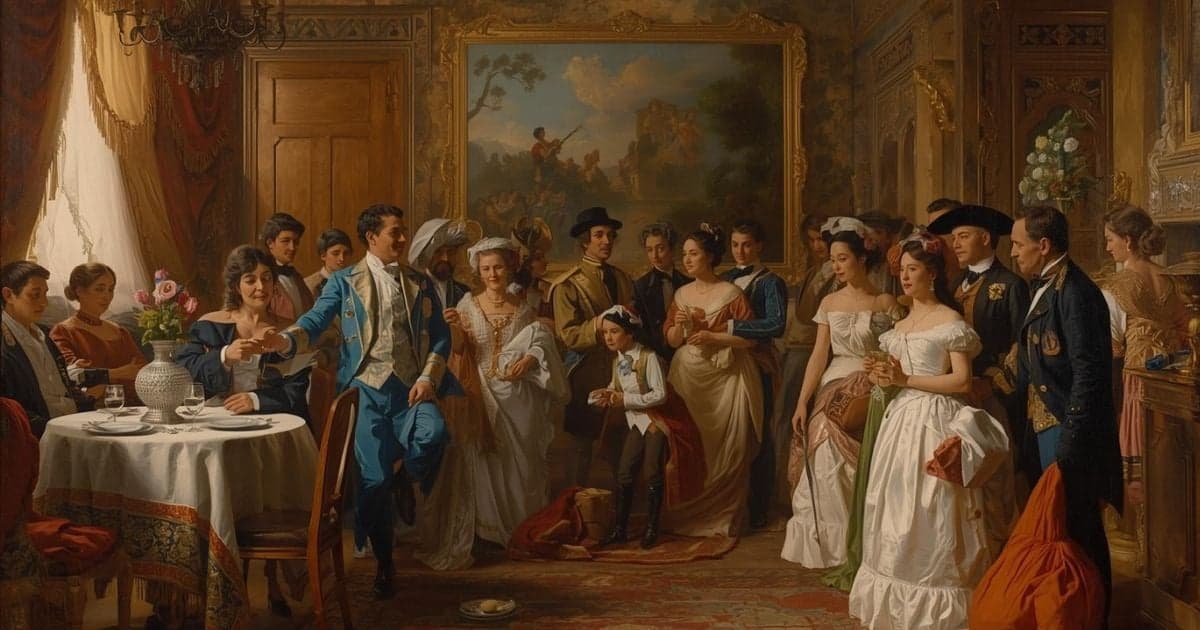
he card tables were drawn out, sets made up for boston, and the count’s visitors settled themselves, some in the two drawing rooms, some in the sitting room, some in the library.

The count, holding his cards fanwise, kept himself with difficulty from dropping into his usual after-dinner nap, and laughed at everything. The young people, at the countess’ instigation, gathered round the clavichord and harp. Julie by general request played first. After she had played a little air with variations on the harp, she joined the other young ladies in begging Natásha and Nicholas, who were noted for their musical talent, to sing something. Natásha, who was treated as though she were grown up, was evidently very proud of this but at the same time felt shy.

“What shall we sing?” she said.

“‘The Brook,’” suggested Nicholas.

“Well, then, let’s be quick. Borís, come here,” said Natásha. “But where is Sónya?”

She looked round and seeing that her friend was not in the room ran to look for her.

1 / 13

Master this chapter. Complete your experience

Purchase the complete book to access all chapters and support classic literature

Read Free on GutenbergBuy at Powell'sBuy on Amazon

As an Amazon Associate, we earn a small commission from qualifying purchases at no additional cost to you.

Available in paperback, hardcover, and e-book formats

GO ADS FREE — JOIN US

Why This Matters

Connect literature to life

Skill: Crisis Response Recognition

This chapter teaches how to distinguish between someone having a bad day and someone in genuine crisis, then respond appropriately to each.

Practice This Today

This week, notice when someone's distress feels different—more raw, more desperate—and practice the Stop-Sit-Solve framework instead of offering quick fixes.

GO ADS FREE — JOIN US

Now let's explore the literary elements.

Key Quotes & Analysis

"The chest in the passage was the place of mourning for the younger female generation in the Rostov household."

— Narrator

Context: When Natasha finds Sonya crying in their secret hiding spot

This reveals that even in wealthy households, young women had so little privacy and control that they needed secret places to express their real emotions. It shows how their feelings were considered unimportant by the adult world.

In Today's Words:

Every house has that one spot where the kids go to cry when life gets overwhelming.

"Uncle married his first cousin, and we are only second cousins, you know."

— Natasha

Context: When she's trying to give Sonya hope about marrying Nicholas

Natasha uses practical examples to show Sonya that their situation isn't hopeless. She's being a good friend by offering concrete reasons for optimism rather than just empty comfort.

In Today's Words:

Look, if they could make it work, so can you - your situation isn't even as complicated as theirs was.

"Nicholas does not care for Julie at all, I know he doesn't."

— Natasha

Context: Reassuring Sonya about the competition from wealthy Julie

This shows Natasha's loyalty and her ability to read people's true feelings. She's not just saying what Sonya wants to hear - she's sharing genuine observations to give her friend real hope.

In Today's Words:

Trust me, he's totally not into her - I can tell.

Thematic Threads

Class Barriers

In This Chapter

Sonya's romantic hopes are crushed by class expectations—cousin marriages need permission, and Vera pushes Nicholas toward wealthy Julie instead

Development

Deepening from earlier social distinctions to show how class directly destroys personal relationships

In Your Life:

You might recognize this when family pressures you to date someone 'appropriate' rather than who you actually love.

Female Solidarity

In This Chapter

Natasha immediately abandons her own fun to comfort Sonya, while Vera uses social pressure to crush her romantic rival

Development

Introduced here as contrast between supportive and competitive female relationships

In Your Life:

You see this choice daily—whether to support other women or compete with them for limited opportunities.

Hope vs Despair

In This Chapter

Sonya transforms from sobbing despair to renewed hope through Natasha's specific reassurances and problem-solving

Development

Introduced here as showing how genuine support can shift emotional states

In Your Life:

You experience this when someone takes time to really listen and help you see solutions instead of just problems.

Social Performance

In This Chapter

The evening continues with music and dancing, everyone performing happiness while real dramas play out behind the scenes

Development

Building on earlier themes of maintaining appearances while managing private struggles

In Your Life:

You do this when you smile through family gatherings while dealing with personal crises no one else knows about.

Generational Joy

In This Chapter

The Count and Marya Dmitrievna's enthusiastic dancing delights everyone, bridging age gaps through shared celebration

Development

Introduced here as showing how authentic joy transcends social boundaries

In Your Life:

You see this when older relatives let loose at weddings and everyone remembers they're still people, not just authority figures.

GO ADS FREE — JOIN US

You now have the context. Time to form your own thoughts.

Discussion Questions

  1. 1

    What specific actions did Natasha take when she found Sonya crying, and how did those actions change Sonya's emotional state?

    analysis • surface
  2. 2

    Why was Natasha's approach to comforting Sonya more effective than just saying 'everything will be okay'?

    analysis • medium
  3. 3

    Think about your workplace or family - when have you seen someone drop everything to help a friend in crisis? What made that response effective or ineffective?

    application • medium
  4. 4

    If your best friend came to you sobbing about a seemingly impossible situation, how would you apply Natasha's three-step approach: Stop, Sit, and Solve?

    application • deep
  5. 5

    What does this chapter reveal about the difference between surface-level friendship and the kind that sustains us through real hardship?

    reflection • deep

Critical Thinking Exercise

10 minutes

Crisis Response Audit

Think of the last three times someone came to you with a real problem or crisis. Write down what you actually did versus what Natasha did. Did you Stop (drop your agenda), Sit (be fully present), and Solve (offer specific help)? Rate your response honestly and identify which step you typically skip.

Consider:

  • •Most people rush to the 'Solve' step without doing 'Stop' and 'Sit' first
  • •Your natural tendency might be to minimize problems or compare them to your own
  • •The quality of your crisis response determines whether people will come to you again

Journaling Prompt

Write about a time when someone responded to your crisis the way Natasha responded to Sonya's. How did their response change your relationship with them?

GO ADS FREE — JOIN US

Coming Up Next...

Chapter 21: Vultures Circle the Dying Count

The party winds down, but the evening's emotional revelations have set new dynamics in motion. Meanwhile, Pierre finds himself drawn deeper into conversations that will challenge his understanding of the world around him.

Continue to Chapter 21
Previous
War Talk and Dinner Courage
Contents
Next
Vultures Circle the Dying Count

Continue Exploring

War and Peace Study GuideTeaching ResourcesEssential Life IndexBrowse by ThemeAll Books
Power & CorruptionLove & RelationshipsIdentity & Self-Discovery

You Might Also Like

Anna Karenina cover

Anna Karenina

Leo Tolstoy

Also by Leo Tolstoy

The Idiot cover

The Idiot

Fyodor Dostoevsky

Explores love & romance

Moby-Dick cover

Moby-Dick

Herman Melville

Explores mortality & legacy

Dracula cover

Dracula

Bram Stoker

Explores love & romance

Browse all 47+ books

Share This Chapter

Know someone who'd enjoy this? Spread the wisdom!

TwitterFacebookLinkedInEmail

Read ad-free with Prestige

Get rid of ads, unlock study guides and downloads, and support free access for everyone.

Subscribe to PrestigeCreate free account
Intelligence Amplifier
Intelligence Amplifier™Powering Wide Reads

Exploring human-AI collaboration through books, essays, and philosophical dialogues. Classic literature transformed into navigational maps for modern life.

2025 Books

→ The Amplified Human Spirit→ The Alarming Rise of Stupidity Amplified→ San Francisco: The AI Capital of the World
Visit intelligenceamplifier.org
hello@widereads.com

WideReads Originals

→ You Are Not Lost→ The Last Chapter First→ The Lit of Love→ Wealth and Poverty→ 10 Paradoxes in the Classics · coming soon
Arvintech
arvintechAmplify your Mind
Visit at arvintech.com

Navigate

  • Home
  • Library
  • Essential Life Index
  • How It Works
  • Subscribe
  • Account
  • About
  • Contact
  • Authors
  • Suggest a Book
  • Landings

Made For You

  • Students
  • Educators
  • Families
  • Readers
  • Literary Analysis
  • Finding Purpose
  • Letting Go
  • Recovering from a Breakup
  • Corruption
  • Gaslighting in the Classics

Newsletter

Weekly insights from the classics. Amplify Your Mind.

Legal

  • Privacy Policy
  • Terms of Service
  • Cookie Policy
  • Accessibility

Why Public Domain?

We focus on public domain classics because these timeless works belong to everyone. No paywalls, no restrictions—just wisdom that has stood the test of centuries, freely accessible to all readers.

Public domain books have shaped humanity's understanding of love, justice, ambition, and the human condition. By amplifying these works, we help preserve and share literature that truly belongs to the world.

A Pilgrimage

Powell's City of Books

Portland, Oregon

If you ever find yourself in Portland, walk to the corner of Burnside and 10th. The building takes up an entire city block. Inside is over a million books, new and used on the same shelf, organized by color-coded rooms with names like the Rose Room and the Pearl Room. You can lose an afternoon. You can lose a weekend. You will find a book you have been looking for your whole life, and three you did not know existed.

It is a pilgrimage. We cannot find a bookstore like it anywhere on earth. If you read the classics, and you ever get the chance, go. It belongs on every reader's bucket list.

Visit powells.com

We are not in any way affiliated with Powell's. We are just a very big fan.

© 2026 Wide Reads™. All Rights Reserved.

Intelligence Amplifier™ and Wide Reads™ are proprietary trademarks of Arvin Lioanag.

Copyright Protection: All original content, analyses, discussion questions, pedagogical frameworks, and methodology are protected by U.S. and international copyright law. Unauthorized reproduction, distribution, web scraping, or use for AI training is strictly prohibited. See our Copyright Notice for details.

Disclaimer: The information provided on this website is for general informational and educational purposes only and does not constitute professional, legal, financial, or technical advice. While we strive to ensure accuracy and relevance, we make no warranties regarding completeness, reliability, or suitability. Any reliance on such information is at your own risk. We are not liable for any losses or damages arising from use of this site. By using this site, you agree to these terms.