Wide Reads
Literature MattersLife IndexEducators
Sign in
Where to Begin
War and Peace - War Talk and Dinner Courage

Leo Tolstoy

War and Peace

War Talk and Dinner Courage

Home›Books›War and Peace›Chapter 19
Previous
19 of 361
Next

Summary

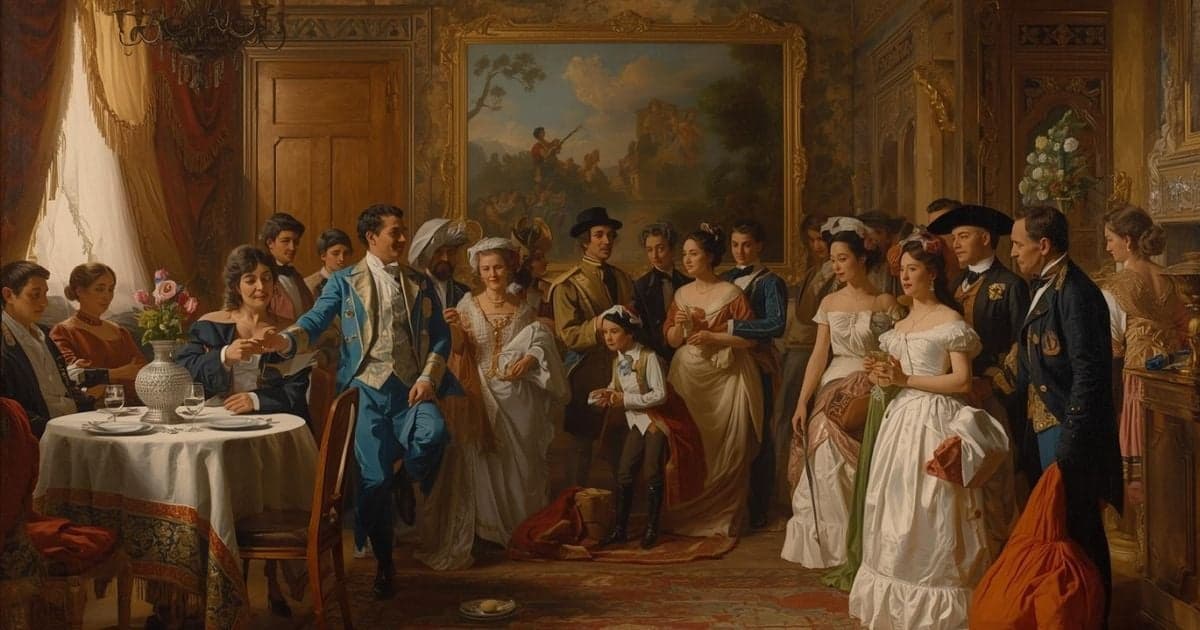
At the Rostov dinner party, war talk dominates the men's conversation. A German colonel recites official propaganda about why Russia must fight Napoleon, while the cynical Shinshín questions the wisdom of getting involved. Young Nicholas, eager to prove his military enthusiasm, declares Russians must 'die or conquer'—words that sound hollow even as he speaks them. His dramatic patriotism impresses some guests but reveals his inexperience more than his courage. Meanwhile, Natasha creates her own small rebellion by boldly demanding to know what dessert will be served, repeatedly challenging the formidable Márya Dmítrievna despite social protocol. Her audacity delights everyone precisely because it breaks the rules—unlike the men's war talk, which follows predictable scripts. The contrast is telling: while the men perform courage through empty phrases about dying for the emperor, Natasha shows real boldness by risking social disapproval over something as simple as ice cream flavors. Tolstoy reveals how dinner party conversations often mask deeper anxieties—the adults speak of war with rehearsed confidence while privately fearing what's coming. The chapter exposes the gap between public performance and private uncertainty, showing how people use familiar social roles to navigate unfamiliar fears. Both the war discussion and Natasha's dessert rebellion demonstrate how individuals assert themselves within group dynamics, though with vastly different stakes and authenticity.

Coming Up in Chapter 20

The evening continues as the guests move to other rooms, but the war preparations that dominated dinner conversation are about to become much more personal and immediate for the Rostov family.

Share it with friends

Previous ChapterNext Chapter
GO ADS FREE — JOIN US
Original text
complete·1,123 words
A

t the men’s end of the table the talk grew more and more animated. The colonel told them that the declaration of war had already appeared in Petersburg and that a copy, which he had himself seen, had that day been forwarded by courier to the commander in chief.

“And why the deuce are we going to fight Bonaparte?” remarked Shinshín. “He has stopped Austria’s cackle and I fear it will be our turn next.”

The colonel was a stout, tall, plethoric German, evidently devoted to the service and patriotically Russian. He resented Shinshín’s remark.

“It is for the reasson, my goot sir,” said he, speaking with a German accent, “for the reasson zat ze Emperor knows zat. He declares in ze manifessto zat he cannot fiew wiz indifference ze danger vreatening Russia and zat ze safety and dignity of ze Empire as vell as ze sanctity of its alliances...” he spoke this last word with particular emphasis as if in it lay the gist of the matter.

Then with the unerring official memory that characterized him he repeated from the opening words of the manifesto:

1 / 7

Master this chapter. Complete your experience

Purchase the complete book to access all chapters and support classic literature

Read Free on GutenbergBuy at Powell'sBuy on Amazon

As an Amazon Associate, we earn a small commission from qualifying purchases at no additional cost to you.

Available in paperback, hardcover, and e-book formats

GO ADS FREE — JOIN US

Why This Matters

Connect literature to life

Skill: Detecting Borrowed Authority

This chapter teaches how to distinguish between people speaking from genuine experience versus those performing expertise with borrowed language.

Practice This Today

This week, notice when someone uses impressive-sounding phrases that could have come from anywhere—then ask yourself what their actual experience might be.

GO ADS FREE — JOIN US

Now let's explore the literary elements.

Key Quotes & Analysis

"And why the deuce are we going to fight Bonaparte?"

— Shinshín

Context: He questions the wisdom of going to war while others recite patriotic rhetoric

This simple question cuts through all the official propaganda and patriotic posturing to the heart of the matter. Shinshín dares to voice what others might be thinking but won't say - that this war might not be in Russia's best interests.

In Today's Words:

Why are we getting involved in this mess?

"It is for the reasson, my goot sir, for the reasson zat ze Emperor knows zat"

— The German Colonel

Context: His response to Shinshín's skeptical question about the war

The colonel's broken English and appeal to imperial authority show how he deflects difficult questions with official doctrine. He can't really answer why the war is necessary, so he falls back on 'the Emperor knows best.'

In Today's Words:

Because that's what the boss decided, and the boss knows what's best

"We must die or conquer"

— Nicholas Rostov

Context: His dramatic declaration of patriotic resolve during the dinner conversation

These grand words sound heroic but reveal Nicholas's inexperience and romantic view of war. He's performing the role of a brave soldier without understanding what death or conquest actually mean.

In Today's Words:

We'll give it everything we've got, no matter what it takes

Thematic Threads

Social Performance

In This Chapter

Nicholas performs patriotic fervor with borrowed phrases while Natasha shows genuine boldness through simple directness

Development

Introduced here

In Your Life:

You might recognize this when you catch yourself using language that sounds impressive but doesn't reflect your actual thoughts or experience.

Class Expectations

In This Chapter

Dinner party conversation follows predictable scripts based on social roles—men discuss war, women manage social harmony

Development

Building from earlier social gatherings

In Your Life:

You see this in how different groups at work or family gatherings have unspoken rules about what topics are acceptable for whom.

Authentic Rebellion

In This Chapter

Natasha's dessert demands break social protocol but reveal genuine personality, unlike the men's scripted war talk

Development

Continues Natasha's pattern of authentic self-expression

In Your Life:

You might notice how small, genuine acts of self-assertion often feel more risky but more satisfying than grand gestures.

Hidden Anxiety

In This Chapter

Adults speak confidently about war while privately uncertain, using familiar social roles to mask deeper fears

Development

Introduced here

In Your Life:

You see this when people become more formal or use more jargon when they're actually feeling most uncertain about a situation.

You now have the context. Time to form your own thoughts.

Discussion Questions

  1. 1

    What's the difference between how Nicholas talks about war and how Natasha approaches getting dessert information?

    analysis • surface
  2. 2

    Why does Nicholas use grand phrases like 'die or conquer' when he's never been in battle?

    analysis • medium
  3. 3

    Where do you see people using borrowed impressive language instead of speaking from their own experience?

    application • medium
  4. 4

    How can you tell when someone (including yourself) is performing confidence versus actually feeling confident?

    application • deep
  5. 5

    What does this chapter suggest about the relationship between real courage and social approval?

    reflection • deep

Critical Thinking Exercise

10 minutes

Script vs. Authentic Response Audit

Think of three situations where you regularly speak or act: work meetings, family discussions, social media, parenting, etc. For each situation, write down one thing you typically say that sounds good but might be borrowed from others, and one thing you'd say if you spoke purely from your own experience. Notice the difference in how each feels to write.

Consider:

  • •Borrowed language often sounds more impressive but feels hollow when you examine it
  • •Authentic responses might seem smaller but usually contain more practical wisdom
  • •The gap between performed and genuine responses reveals where you feel most pressure to impress others

Journaling Prompt

Write about a time when you used impressive-sounding words or actions to cover uncertainty. What were you actually feeling? What would have happened if you'd been more authentic about not knowing?

Coming Up Next...

Chapter 20: When Family Drama Crashes the Party

The evening continues as the guests move to other rooms, but the war preparations that dominated dinner conversation are about to become much more personal and immediate for the Rostov family.

Continue to Chapter 20
Previous
The Art of Social Performance
Contents
Next
When Family Drama Crashes the Party

Continue Exploring

War and Peace Study GuideTeaching ResourcesEssential Life IndexBrowse by ThemeAll Books
Power & CorruptionLove & RelationshipsIdentity & Self-Discovery

You Might Also Like

Anna Karenina cover

Anna Karenina

Leo Tolstoy

Also by Leo Tolstoy

The Idiot cover

The Idiot

Fyodor Dostoevsky

Explores love & romance

Moby-Dick cover

Moby-Dick

Herman Melville

Explores mortality & legacy

Dracula cover

Dracula

Bram Stoker

Explores love & romance

Browse all 47+ books

Share This Chapter

Know someone who'd enjoy this? Spread the wisdom!

TwitterFacebookLinkedInEmail

Read ad-free with Prestige

Get rid of ads, unlock study guides and downloads, and support free access for everyone.

Subscribe to PrestigeCreate free account
Intelligence Amplifier
Intelligence Amplifier™Powering Wide Reads

Exploring human-AI collaboration through books, essays, and philosophical dialogues. Classic literature transformed into navigational maps for modern life.

2025 Books

→ The Amplified Human Spirit→ The Alarming Rise of Stupidity Amplified→ San Francisco: The AI Capital of the World
Visit intelligenceamplifier.org
hello@widereads.com

WideReads Originals

→ You Are Not Lost→ The Last Chapter First→ The Lit of Love→ Wealth and Poverty→ 10 Paradoxes in the Classics · coming soon
Arvintech
arvintechAmplify your Mind
Visit at arvintech.com

Navigate

  • Home
  • Library
  • Essential Life Index
  • How It Works
  • Subscribe
  • Account
  • About
  • Contact
  • Authors
  • Suggest a Book
  • Landings

Made For You

  • Students
  • Educators
  • Families
  • Readers
  • Literary Analysis
  • Finding Purpose
  • Letting Go
  • Recovering from a Breakup
  • Corruption
  • Gaslighting in the Classics

Newsletter

Weekly insights from the classics. Amplify Your Mind.

Legal

  • Privacy Policy
  • Terms of Service
  • Cookie Policy
  • Accessibility

Why Public Domain?

We focus on public domain classics because these timeless works belong to everyone. No paywalls, no restrictions—just wisdom that has stood the test of centuries, freely accessible to all readers.

Public domain books have shaped humanity's understanding of love, justice, ambition, and the human condition. By amplifying these works, we help preserve and share literature that truly belongs to the world.

A Pilgrimage

Powell's City of Books

Portland, Oregon

If you ever find yourself in Portland, walk to the corner of Burnside and 10th. The building takes up an entire city block. Inside is over a million books, new and used on the same shelf, organized by color-coded rooms with names like the Rose Room and the Pearl Room. You can lose an afternoon. You can lose a weekend. You will find a book you have been looking for your whole life, and three you did not know existed.

It is a pilgrimage. We cannot find a bookstore like it anywhere on earth. If you read the classics, and you ever get the chance, go. It belongs on every reader's bucket list.

Visit powells.com

We are not in any way affiliated with Powell's. We are just a very big fan.

© 2026 Wide Reads™. All Rights Reserved.

Intelligence Amplifier™ and Wide Reads™ are proprietary trademarks of Arvin Lioanag.

Copyright Protection: All original content, analyses, discussion questions, pedagogical frameworks, and methodology are protected by U.S. and international copyright law. Unauthorized reproduction, distribution, web scraping, or use for AI training is strictly prohibited. See our Copyright Notice for details.

Disclaimer: The information provided on this website is for general informational and educational purposes only and does not constitute professional, legal, financial, or technical advice. While we strive to ensure accuracy and relevance, we make no warranties regarding completeness, reliability, or suitability. Any reliance on such information is at your own risk. We are not liable for any losses or damages arising from use of this site. By using this site, you agree to these terms.