Wide Reads
Literature MattersLife IndexEducators
Sign in
Where to Begin
War and Peace - The Art of Political Survival

Leo Tolstoy

War and Peace

The Art of Political Survival

Home›Books›War and Peace›Chapter 196
Previous
196 of 361
Next

Summary

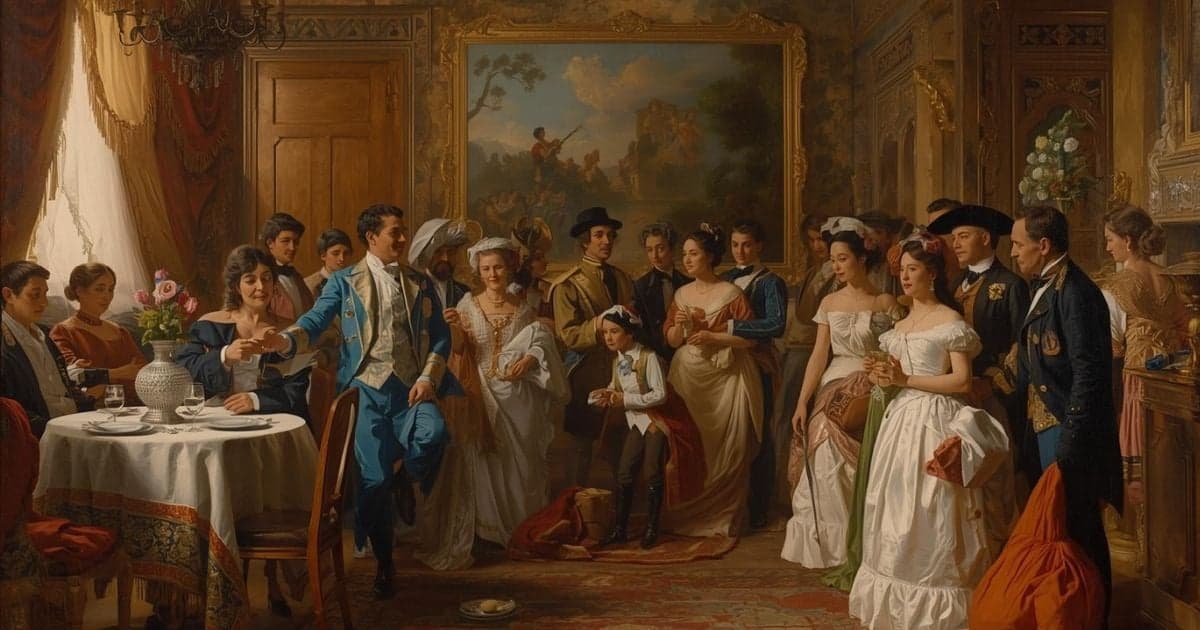
This chapter exposes the shallow, self-serving nature of Petersburg's elite social circles during wartime. Two competing salons dominate the scene: Anna Pávlovna's pro-Russian circle and Hélène's pro-French gathering. Despite the life-and-death struggle happening on battlefields, these aristocrats treat the war like entertainment, switching their opinions based on what's fashionable rather than what's true. Prince Vasíli becomes the perfect example of political opportunism—he bounces between both salons, often mixing up his talking points and saying pro-French things at the Russian salon and vice versa. The most telling moment comes when Kutúzov gets appointed commander-in-chief. Just days earlier, Prince Vasíli was calling Kutúzov a 'decrepit, blind old man' unfit for command. But the moment Kutúzov receives the appointment, Prince Vasíli instantly transforms into his biggest supporter, claiming he's 'admirable' and 'adored by everybody.' When reminded of his previous harsh criticism, Prince Vasíli dismisses it with a wave: 'He sees well enough.' This isn't just about Russian aristocrats—it's about how people in positions of privilege often care more about staying relevant than staying consistent. Tolstoy shows us that while soldiers die for principles, the political class treats those same principles as disposable accessories. The chapter reveals how social pressure and self-interest can make people abandon their stated beliefs in an instant, and how the real battles for power often happen in drawing rooms, not battlefields.

Coming Up in Chapter 197

While Petersburg's salons play their political games, the real war continues to unfold. The focus shifts back to the actual consequences of these drawing room decisions as military reality collides with aristocratic fantasies.

Share it with friends

Previous ChapterNext Chapter
GO ADS FREE — JOIN US
Original text
complete·1,570 words
A

mong the innumerable categories applicable to the phenomena of human life one may discriminate between those in which substance prevails and those in which form prevails. To the latter—as distinguished from village, country, provincial, or even Moscow life—we may allot Petersburg life, and especially the life of its salons. That life of the salons is unchanging. Since the year 1805 we had made peace and had again quarreled with Bonaparte and had made constitutions and unmade them again, but the salons of Anna Pávlovna and Hélène remained just as they had been—the one seven and the other five years before. At Anna Pávlovna’s they talked with perplexity of Bonaparte’s successes just as before and saw in them and in the subservience shown to him by the European sovereigns a malicious conspiracy, the sole object of which was to cause unpleasantness and anxiety to the court circle of which Anna Pávlovna was the representative. And in Hélène’s salon, which Rumyántsev himself honored with his visits, regarding Hélène as a remarkably intelligent woman, they talked with the same ecstasy in 1812 as in 1808 of the “great nation” and the “great man,” and regretted our rupture with France, a rupture which, according to them, ought to be promptly terminated by peace.

1 / 10

Master this chapter. Complete your experience

Purchase the complete book to access all chapters and support classic literature

Read Free on GutenbergBuy at Powell'sBuy on Amazon

As an Amazon Associate, we earn a small commission from qualifying purchases at no additional cost to you.

Available in paperback, hardcover, and e-book formats

GO ADS FREE — JOIN US

Why This Matters

Connect literature to life

Skill: Detecting Opportunistic Position-Switching

This chapter teaches how to spot people who abandon their stated beliefs the moment those beliefs become inconvenient or unfashionable.

Practice This Today

This week, notice when someone dramatically changes their stance on an issue after the power dynamics shift—then watch if they deny ever holding their previous position.

GO ADS FREE — JOIN US

Now let's explore the literary elements.

Key Quotes & Analysis

"That life of the salons is unchanging."

— Narrator

Context: Opening description of Petersburg's elite social circles

Tolstoy reveals how the wealthy and powerful remain detached from real-world consequences. While wars rage and people die, their social games continue unchanged, showing their fundamental disconnection from reality.

In Today's Words:

Rich people's drama stays the same no matter what's happening in the real world.

"He sees well enough."

— Prince Vasíli

Context: When reminded that he previously called Kutuzov a 'blind old man'

This dismissive response shows how easily Prince Vasili abandons his previous harsh criticism when it becomes inconvenient. He doesn't even try to explain his contradiction - he just waves it away.

In Today's Words:

Oh, that? Never mind what I said before.

"They talked with the same ecstasy in 1812 as in 1808 of the 'great nation' and the 'great man.'"

— Narrator

Context: Describing the consistency of pro-French sentiment in Hélène's salon

Shows how these aristocrats treat political positions like fashion statements - unchanging regardless of circumstances. Their 'ecstasy' reveals how they romanticize foreign power while their own country suffers.

In Today's Words:

They gushed about their foreign heroes the same way for years, no matter what was actually happening.

Thematic Threads

Class

In This Chapter

Elite aristocrats treat war as social entertainment while soldiers die for their amusement

Development

Deepening critique of aristocratic detachment from real consequences

In Your Life:

You might see this when wealthy people make policies affecting workers they'll never meet

Social Expectations

In This Chapter

Prince Vasíli changes his entire personality based on which salon he's visiting

Development

Showing how social pressure corrupts individual integrity

In Your Life:

You might catch yourself agreeing with different groups just to fit in

Identity

In This Chapter

Characters have no fixed identity—they become whoever serves their interests

Development

Exploring how some people lack authentic core selves

In Your Life:

You might question whether you truly know someone who constantly shifts positions

Power

In This Chapter

Real power happens in drawing rooms through influence and connections, not battlefield courage

Development

Contrasting political maneuvering with genuine leadership

In Your Life:

You might recognize how office politics often matters more than actual competence

Truth

In This Chapter

Truth becomes whatever serves the moment—yesterday's facts are today's inconveniences

Development

Showing how self-interest corrupts even basic honesty

In Your Life:

You might notice people rewriting history about their past statements or actions

GO ADS FREE — JOIN US

You now have the context. Time to form your own thoughts.

Discussion Questions

  1. 1

    What specific changes did Prince Vasíli make to his opinion about Kutúzov, and how quickly did this transformation happen?

    analysis • surface
  2. 2

    Why does Prince Vasíli bounce between the two competing salons, and what does this reveal about his priorities?

    analysis • medium
  3. 3

    Where have you seen people completely flip their stated opinions when it became socially or professionally advantageous to do so?

    application • medium
  4. 4

    How would you maintain your own principles while navigating workplace or family situations where changing your stance might be easier?

    application • deep
  5. 5

    What does Prince Vasíli's behavior teach us about the difference between having opinions and having values?

    reflection • deep

Critical Thinking Exercise

10 minutes

Track the Flip-Flopper

Think of someone in your life (workplace, family, social circle) who changes their stated opinions based on their audience. Write down three specific examples of positions they've taken that shifted when circumstances changed. Then identify what they were really trying to protect or gain each time they flipped.

Consider:

  • •Focus on patterns of behavior, not isolated incidents
  • •Consider what underlying need (acceptance, power, safety) drives their inconsistency
  • •Think about how this affects your trust and relationship with them

Journaling Prompt

Write about a time when you felt pressure to change a position you held. What was at stake? How did you handle it, and what would you do differently now?

Coming Up Next...

Chapter 197: Napoleon Meets a Russian Peasant

While Petersburg's salons play their political games, the real war continues to unfold. The focus shifts back to the actual consequences of these drawing room decisions as military reality collides with aristocratic fantasies.

Continue to Chapter 197
Previous
The Weight of Command and Loss
Contents
Next
Napoleon Meets a Russian Peasant

Continue Exploring

War and Peace Study GuideTeaching ResourcesEssential Life IndexBrowse by ThemeAll Books
Power & CorruptionLove & RelationshipsIdentity & Self-Discovery

You Might Also Like

Anna Karenina cover

Anna Karenina

Leo Tolstoy

Also by Leo Tolstoy

The Idiot cover

The Idiot

Fyodor Dostoevsky

Explores love & romance

Moby-Dick cover

Moby-Dick

Herman Melville

Explores mortality & legacy

Dracula cover

Dracula

Bram Stoker

Explores love & romance

Browse all 47+ books

Share This Chapter

Know someone who'd enjoy this? Spread the wisdom!

TwitterFacebookLinkedInEmail

Read ad-free with Prestige

Get rid of ads, unlock study guides and downloads, and support free access for everyone.

Subscribe to PrestigeCreate free account
Intelligence Amplifier
Intelligence Amplifier™Powering Wide Reads

Exploring human-AI collaboration through books, essays, and philosophical dialogues. Classic literature transformed into navigational maps for modern life.

2025 Books

→ The Amplified Human Spirit→ The Alarming Rise of Stupidity Amplified→ San Francisco: The AI Capital of the World
Visit intelligenceamplifier.org
hello@widereads.com

WideReads Originals

→ You Are Not Lost→ The Last Chapter First→ The Lit of Love→ Wealth and Poverty→ 10 Paradoxes in the Classics · coming soon
Arvintech
arvintechAmplify your Mind
Visit at arvintech.com

Navigate

  • Home
  • Library
  • Essential Life Index
  • How It Works
  • Subscribe
  • Account
  • About
  • Contact
  • Authors
  • Suggest a Book
  • Landings

Made For You

  • Students
  • Educators
  • Families
  • Readers
  • Literary Analysis
  • Finding Purpose
  • Letting Go
  • Recovering from a Breakup
  • Corruption
  • Gaslighting in the Classics

Newsletter

Weekly insights from the classics. Amplify Your Mind.

Legal

  • Privacy Policy
  • Terms of Service
  • Cookie Policy
  • Accessibility

Why Public Domain?

We focus on public domain classics because these timeless works belong to everyone. No paywalls, no restrictions—just wisdom that has stood the test of centuries, freely accessible to all readers.

Public domain books have shaped humanity's understanding of love, justice, ambition, and the human condition. By amplifying these works, we help preserve and share literature that truly belongs to the world.

A Pilgrimage

Powell's City of Books

Portland, Oregon

If you ever find yourself in Portland, walk to the corner of Burnside and 10th. The building takes up an entire city block. Inside is over a million books, new and used on the same shelf, organized by color-coded rooms with names like the Rose Room and the Pearl Room. You can lose an afternoon. You can lose a weekend. You will find a book you have been looking for your whole life, and three you did not know existed.

It is a pilgrimage. We cannot find a bookstore like it anywhere on earth. If you read the classics, and you ever get the chance, go. It belongs on every reader's bucket list.

Visit powells.com

We are not in any way affiliated with Powell's. We are just a very big fan.

© 2026 Wide Reads™. All Rights Reserved.

Intelligence Amplifier™ and Wide Reads™ are proprietary trademarks of Arvin Lioanag.

Copyright Protection: All original content, analyses, discussion questions, pedagogical frameworks, and methodology are protected by U.S. and international copyright law. Unauthorized reproduction, distribution, web scraping, or use for AI training is strictly prohibited. See our Copyright Notice for details.

Disclaimer: The information provided on this website is for general informational and educational purposes only and does not constitute professional, legal, financial, or technical advice. While we strive to ensure accuracy and relevance, we make no warranties regarding completeness, reliability, or suitability. Any reliance on such information is at your own risk. We are not liable for any losses or damages arising from use of this site. By using this site, you agree to these terms.