Wide Reads
Literature MattersLife IndexEducators
Sign in
Where to Begin
War and Peace - When Children Burst the Adult Facade

Leo Tolstoy

War and Peace

When Children Burst the Adult Facade

Home›Books›War and Peace›Chapter 11
Previous
11 of 361
Next

Summary

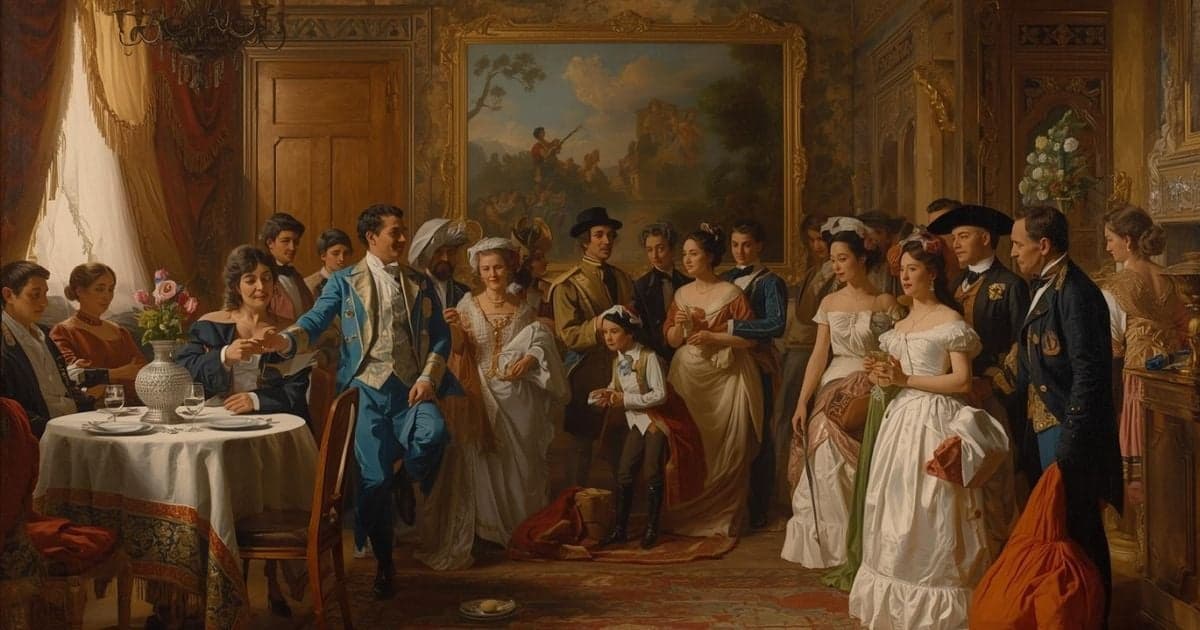
The stuffy drawing room conversation between the countess and her formal visitor gets completely upended when thirteen-year-old Natasha bursts in, clutching her doll and radiating pure, infectious joy. What starts as polite social obligation transforms into genuine human connection as Natasha's laughter proves impossible to resist—even the prim visitor can't help but smile. This scene reveals the stark contrast between the artificial world of adult social expectations and the authentic world of childhood emotion. Natasha represents something vital that the adult world has lost: the ability to find genuine delight in simple things and express it without shame. When the visitor tries to condescend to Natasha about her doll, the girl sees right through the patronizing tone and refuses to play along, showing a wisdom beyond her years. The young people—Boris, Nicholas, Sonya, and little Petya—hover between these two worlds, still capable of real joy but increasingly aware they must contain it to fit adult expectations. Boris demonstrates this perfectly: he can joke about Natasha's broken doll with genuine warmth, but he's also learning to navigate social situations with calculated charm. The chapter shows how families function as bridges between authenticity and social performance, and how the youngest members often serve as truth-tellers who expose what everyone else is pretending not to see. Natasha's energy doesn't just disrupt the boring adult conversation—it reveals how much life gets drained out of us when we prioritize appearances over genuine connection.

Coming Up in Chapter 12

Boris follows Natasha from the room, suggesting a deeper connection between these two young people than mere childhood friendship. Their private conversation may reveal truths that the formal drawing room could never contain.

Share it with friends

Previous ChapterNext Chapter
GO ADS FREE — JOIN US
Original text
complete·871 words
S

ilence ensued. The countess looked at her callers, smiling affably, but not concealing the fact that she would not be distressed if they now rose and took their leave. The visitor’s daughter was already smoothing down her dress with an inquiring look at her mother, when suddenly from the next room were heard the footsteps of boys and girls running to the door and the noise of a chair falling over, and a girl of thirteen, hiding something in the folds of her short muslin frock, darted in and stopped short in the middle of the room. It was evident that she had not intended her flight to bring her so far. Behind her in the doorway appeared a student with a crimson coat collar, an officer of the Guards, a girl of fifteen, and a plump rosy-faced boy in a short jacket.

The count jumped up and, swaying from side to side, spread his arms wide and threw them round the little girl who had run in.

“Ah, here she is!” he exclaimed laughing. “My pet, whose name day it is. My dear pet!”

1 / 6

Master this chapter. Complete your experience

Purchase the complete book to access all chapters and support classic literature

Read Free on GutenbergBuy at Powell'sBuy on Amazon

As an Amazon Associate, we earn a small commission from qualifying purchases at no additional cost to you.

Available in paperback, hardcover, and e-book formats

GO ADS FREE — JOIN US

Why This Matters

Connect literature to life

Skill: Recognizing Authentic Emotion

This chapter teaches how to distinguish between genuine feeling and social performance, and how authentic emotion transforms interactions.

Practice This Today

This week, notice when someone drops their social mask and expresses real joy, frustration, or vulnerability—then practice matching their authenticity instead of staying in polite mode.

GO ADS FREE — JOIN US

Now let's explore the literary elements.

Key Quotes & Analysis

"Ah, here she is! My pet, whose name day it is. My dear pet!"

— Count Ilya Rostov

Context: When Natasha bursts into the formal drawing room

Shows genuine parental joy that completely ignores social propriety. His repeated 'pet' reveals how much he treasures his daughter's spirit, even when it disrupts adult expectations.

In Today's Words:

There's my girl! My absolute favorite!

"Ma chère, there is a time for everything"

— Countess Rostova

Context: Gently scolding her husband for encouraging Natasha's exuberance

The classic parental balance between maintaining social appearances and allowing authentic family connection. She's performing disapproval more than feeling it.

In Today's Words:

Honey, read the room - we have company

"This black-eyed, wide-mouthed girl, not pretty but full of life"

— Narrator

Context: Describing Natasha as the adults observe her

Tolstoy immediately establishes that Natasha's power comes from vitality, not conventional beauty. Her life force is what makes her magnetic and disruptive to social pretense.

In Today's Words:

She wasn't Instagram-pretty, but she had that spark that made everyone notice her

Thematic Threads

Authenticity vs Performance

In This Chapter

Natasha's genuine joy disrupts the formal drawing room conversation and transforms the social dynamic

Development

Building on earlier scenes of social pretense, now showing how authentic emotion can break through

In Your Life:

You might recognize this when someone's real emotion cuts through workplace small talk or family politeness

Generational Wisdom

In This Chapter

Natasha sees through adult condescension about her doll and refuses to play along with patronizing conversation

Development

Introduced here as children's ability to spot adult pretense

In Your Life:

You might notice how children or newer employees sometimes see through dynamics that everyone else accepts

Social Expectations

In This Chapter

The young people hover between childhood authenticity and adult performance, learning to contain their joy

Development

Continuing exploration of how society shapes behavior, now focusing on the transition from child to adult

In Your Life:

You might see this in how you've learned to moderate your enthusiasm in professional settings

Class Performance

In This Chapter

The formal visitor's attempt to maintain dignity crumbles in the face of Natasha's infectious laughter

Development

Expanding on class dynamics to show how authentic emotion transcends social barriers

In Your Life:

You might recognize this when genuine connection happens across professional or social hierarchies

Family Dynamics

In This Chapter

The family serves as a bridge between authentic emotion and social performance, with youngest members as truth-tellers

Development

Building on earlier family scenes to show how families navigate public and private selves

In Your Life:

You might notice how family gatherings reveal who's performing and who's being real

You now have the context. Time to form your own thoughts.

Discussion Questions

  1. 1

    What happens when Natasha bursts into the formal drawing room conversation, and how does everyone react?

    analysis • surface
  2. 2

    Why does Natasha's genuine joy have such a powerful effect on the adults, even the prim visitor who was trying to maintain proper social distance?

    analysis • medium
  3. 3

    Think about your workplace or family gatherings - when have you seen someone's authentic emotion cut through the polite performance and change the whole dynamic?

    application • medium
  4. 4

    When someone offers you genuine emotion in a situation where everyone else is being polite and surface-level, how do you decide whether to match their authenticity or stay in 'performance mode'?

    application • deep
  5. 5

    What does this chapter reveal about the cost of always maintaining social facades versus the risk of being genuinely yourself?

    reflection • deep

Critical Thinking Exercise

10 minutes

Map Your Authenticity Moments

Think of three recent interactions where you felt something genuine but held back versus one where you let your real reaction show. Write down what happened in each situation and how people responded. Look for the pattern - when does authenticity create connection and when does it create awkwardness?

Consider:

  • •Notice the difference between appropriate authenticity and emotional dumping
  • •Consider how your genuine reactions affect others' willingness to drop their own facades
  • •Pay attention to which relationships can handle your real emotions and which ones can't

Journaling Prompt

Write about a time when someone's unexpected genuine emotion - joy, frustration, excitement, worry - completely shifted a conversation you were having. What did you learn about that person, and how did it change your relationship with them?

Coming Up Next...

Chapter 12: Young Hearts on Display

Boris follows Natasha from the room, suggesting a deeper connection between these two young people than mere childhood friendship. Their private conversation may reveal truths that the formal drawing room could never contain.

Continue to Chapter 12
Previous
Social Networks and Family Connections
Contents
Next
Young Hearts on Display

Continue Exploring

War and Peace Study GuideTeaching ResourcesEssential Life IndexBrowse by ThemeAll Books
Power & CorruptionLove & RelationshipsIdentity & Self-Discovery

You Might Also Like

Anna Karenina cover

Anna Karenina

Leo Tolstoy

Also by Leo Tolstoy

The Idiot cover

The Idiot

Fyodor Dostoevsky

Explores love & romance

Moby-Dick cover

Moby-Dick

Herman Melville

Explores mortality & legacy

Dracula cover

Dracula

Bram Stoker

Explores love & romance

Browse all 47+ books

Share This Chapter

Know someone who'd enjoy this? Spread the wisdom!

TwitterFacebookLinkedInEmail

Read ad-free with Prestige

Get rid of ads, unlock study guides and downloads, and support free access for everyone.

Subscribe to PrestigeCreate free account
Intelligence Amplifier
Intelligence Amplifier™Powering Wide Reads

Exploring human-AI collaboration through books, essays, and philosophical dialogues. Classic literature transformed into navigational maps for modern life.

2025 Books

→ The Amplified Human Spirit→ The Alarming Rise of Stupidity Amplified→ San Francisco: The AI Capital of the World
Visit intelligenceamplifier.org
hello@widereads.com

WideReads Originals

→ You Are Not Lost→ The Last Chapter First→ The Lit of Love→ Wealth and Poverty→ 10 Paradoxes in the Classics · coming soon
Arvintech
arvintechAmplify your Mind
Visit at arvintech.com

Navigate

  • Home
  • Library
  • Essential Life Index
  • How It Works
  • Subscribe
  • Account
  • About
  • Contact
  • Authors
  • Suggest a Book
  • Landings

Made For You

  • Students
  • Educators
  • Families
  • Readers
  • Literary Analysis
  • Finding Purpose
  • Letting Go
  • Recovering from a Breakup
  • Corruption
  • Gaslighting in the Classics

Newsletter

Weekly insights from the classics. Amplify Your Mind.

Legal

  • Privacy Policy
  • Terms of Service
  • Cookie Policy
  • Accessibility

Why Public Domain?

We focus on public domain classics because these timeless works belong to everyone. No paywalls, no restrictions—just wisdom that has stood the test of centuries, freely accessible to all readers.

Public domain books have shaped humanity's understanding of love, justice, ambition, and the human condition. By amplifying these works, we help preserve and share literature that truly belongs to the world.

A Pilgrimage

Powell's City of Books

Portland, Oregon

If you ever find yourself in Portland, walk to the corner of Burnside and 10th. The building takes up an entire city block. Inside is over a million books, new and used on the same shelf, organized by color-coded rooms with names like the Rose Room and the Pearl Room. You can lose an afternoon. You can lose a weekend. You will find a book you have been looking for your whole life, and three you did not know existed.

It is a pilgrimage. We cannot find a bookstore like it anywhere on earth. If you read the classics, and you ever get the chance, go. It belongs on every reader's bucket list.

Visit powells.com

We are not in any way affiliated with Powell's. We are just a very big fan.

© 2026 Wide Reads™. All Rights Reserved.

Intelligence Amplifier™ and Wide Reads™ are proprietary trademarks of Arvin Lioanag.

Copyright Protection: All original content, analyses, discussion questions, pedagogical frameworks, and methodology are protected by U.S. and international copyright law. Unauthorized reproduction, distribution, web scraping, or use for AI training is strictly prohibited. See our Copyright Notice for details.

Disclaimer: The information provided on this website is for general informational and educational purposes only and does not constitute professional, legal, financial, or technical advice. While we strive to ensure accuracy and relevance, we make no warranties regarding completeness, reliability, or suitability. Any reliance on such information is at your own risk. We are not liable for any losses or damages arising from use of this site. By using this site, you agree to these terms.