Chapter 18
Lebedeff's Household and Hidden Motives
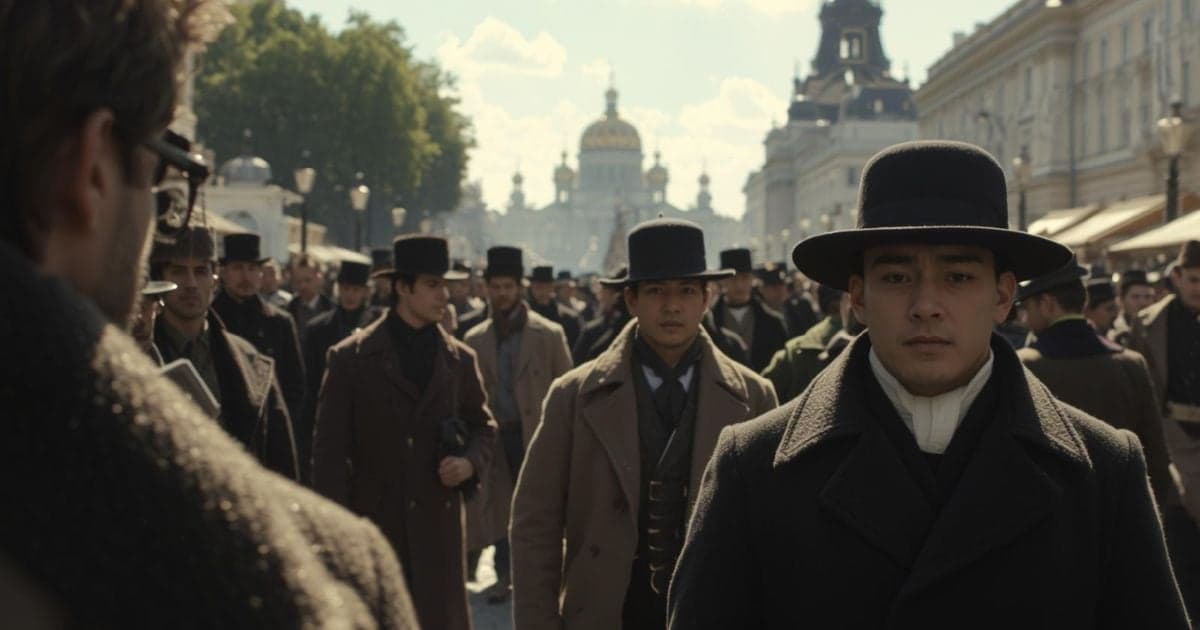
It was the beginning of June, and for a whole week the weather in St. Petersburg had been magnificent. The Epanchins had a luxurious country-house at Pavlofsk, [One of the fashionable summer resorts near St. Petersburg.] and to this spot Mrs. Epanchin determined to proceed without further delay. In a couple of days all was ready, and the family had left town. A day or two after this removal to Pavlofsk, Prince Muishkin arrived in St. Petersburg by the morning train from Moscow. No one met him; but, as he stepped out of the carriage, he suddenly became aware of…
Public-domain chapter text, formatted for reading.
Master this chapter. Complete your experience
Purchase the complete book to access all chapters and support classic literature
Available in paperback, hardcover, and e-book formats
Now let's explore the literary elements.
Key Quotes & Analysis
"glowing eyes"
Context: Describing what Myshkin sees when he steps off the Moscow train
The image signals danger before any name is spoken, as if Rogojin's world is already watching.
In Today's Words:
He thinks he sees two strange glowing eyes in the crowd, then cannot find them again. Whether hallucination or warning, the effect lingers. When you return to an old trouble, your body sometimes spots the threat before your schedule admits it. Do not dismiss that jolt too quickly.
"To humble myself"
Context: Explaining why he gave the prince a false version of his Christian name
False humility becomes another costume Lebedeff can wear when caught in a lie.
In Today's Words:
He murmurs that he lied about his name in order to humble himself, which is a remarkable alibi for a man who loves theatrics. Real humility does not usually require inventing a new identity on the spot. When someone reframes deception as virtue, check what they want you to stop asking.
"cowardly and base"
Context: Agreeing with his nephew's verdict on gambling away borrowed money
Lebedeff can name moral failure accurately in others and still repeat the same patterns himself.
In Today's Words:
He says the words flatly about his nephew's choice, as if moral clarity were a specialty he rents by the hour. Recognizing cowardice in someone else costs him nothing. The test is whether the recognition changes his own scheming, and this household suggests it does not.
"I am entirely free"
Context: Quoted by Lebedeff as her refrain after fleeing Rogojin again
Freedom becomes both her claim and her torment because no one around her believes it will last.
In Today's Words:
She repeats entirely free while hiding, fleeing, and bargaining with men who refuse to let go. The phrase is true legally and false emotionally. When someone shouts independence while surrounded by pursuers, listen for the fear under the slogan before you plan your next move.
Thematic Threads
Deception
In This Chapter
Lebedeff lies about his own name and plays multiple sides while presenting himself as humble and religious
Development
Evolving from earlier chapters where characters wore social masks - now showing active manipulation
In Your Life:
You might recognize this in people who constantly reinvent their story depending on their audience
Performance
In This Chapter
Everyone in Lebedeff's household performs roles - he's the dramatic patriarch, nephew is the righteous accuser, children are the interrupting chorus
Development
Building on themes of social performance, now showing how families can become theater troupes
In Your Life:
You see this in families where everyone has assigned roles they perform instead of being authentic
Control
In This Chapter
Lebedeff maintains power through chaos, using drama and religious rhetoric to deflect accountability
Development
Deepening from earlier power dynamics to show how manipulation can masquerade as helplessness
In Your Life:
You might experience this with people who control situations by appearing to be out of control
Class
In This Chapter
The nephew's accusations reveal how Lebedeff exploits class differences, serving both wealthy Myshkin and Rogojin while maintaining his servant status
Development
Continuing exploration of how class position enables certain types of manipulation
In Your Life:
You see this in workplaces where people use their position to play different groups against each other
Fear
In This Chapter
Nastasya Filippovna's terror drives her into hiding, while Lebedeff's schemes are motivated by financial insecurity
Development
Showing how fear creates the conditions that manipulators exploit
In Your Life:
You might recognize how your own fears make you vulnerable to people who offer false solutions
You now have the context. Time to form your own thoughts.
Discussion Questions
This is not a test. Five prompts guide you through the chapter, from how it opens to how it closes, so you notice context and rhythm rather than facts to memorize. Sit with each question in your own words. When you see "One way to read it," treat it as a starting point, not the only answer.
- 1
Lebedeff performs religious speeches while his nephew demands money and children interrupt. What is communication like in this house?
analysis • surfaceOne way to read it
Everyone acts; almost no one listens. Drama replaces dialogue so Lebedeff can feel important and avoid straight answers about whom he serves.
- 2
The nephew accuses Lebedeff of helping both Myshkin and Rogozhin. How does a double agent profit in this plot?
analysis • mediumOne way to read it
Information is currency: he sells proximity to each passionate man while posing as ally. Playing all sides lets him rent villas, spread rumors, and survive no matter who wins Nastasia.
- 3
Nastasia has fled Rogozhin again and hides in Petersburg, afraid of both men who 'love' her. What does her fear clarify?
analysis • mediumOne way to read it
Possession and rescue both feel like traps. She runs because obsession and gentleness can each erase her agency when men decide what her freedom should look like.
- 4
Lebedeff offers Myshkin a villa near the Epanchins in Pavlofsk. When should you accept help from someone whose motives are obviously mixed?
application • deepOne way to read it
The housing solves a real need while binding the prince to Lebedeff's network. Useful pattern: take practical aid with boundaries, assume the helper will bill you in influence later, and verify facts he 'generously' provides.
- 5
When have you seen piety or ideology used as smoke for ordinary scheming?
reflection • deepOne way to read it
Lebedeff even lies about his name 'to humble himself.' The chapter trains your ear for holy language attached to petty gain, a pattern that survives in workplaces and politics as readily as in salons.
Critical Thinking Exercise
Decode the Drama Pattern
Think of someone in your life who always seems to be in crisis or creates dramatic situations. Map out their pattern: What triggers the drama? Who gets pulled in? What does the person avoid dealing with while everyone focuses on their latest crisis? Write down three specific examples of this pattern playing out.
Consider:
- •Notice how the timing of crises often coincides with accountability moments
- •Observe who gets cast in supporting roles during these dramatic episodes
- •Consider what legitimate concerns get buried under the emotional chaos
Journaling Prompt
Write about a time when you either used drama to avoid a difficult conversation, or when someone used it on you. How did you recognize what was really happening, and what would you do differently now?
Coming Up Next...
Chapter 19: The Knife Between Friends
As plans form for the move to Pavlofsk, the stage is set for an inevitable collision between Myshkin's hopes and the harsh realities waiting in the summer resort where all the key players will soon converge..