
The Art of War
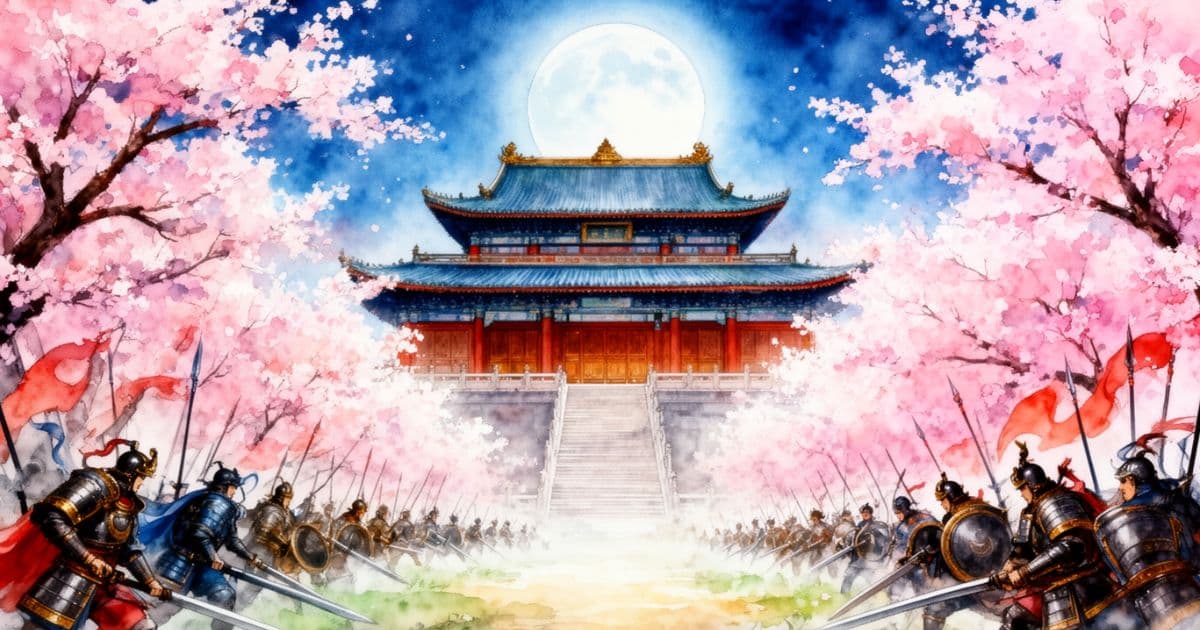
Sun Tzu
0:00 / 0:00
A general sits in his temple and counts before anyone draws a sword. Moral law, heaven, earth, the commander, method: five factors scored while the army is still at rest. Tradition gives the book to Sun Tzu and the state of Wu, likely compiled around 500 BC. A fight that has not been scored is already a waste of chariots and silver. The book everyone treats as a manual for aggression is a manual for making the fight unnecessary.
Sun Tzu is the commander tradition gives to King Helü of Wu: a professional who treats war as expense, not glory. The sovereign who will not listen is as dangerous as the enemy. The general who fights from anger is already beaten. The book keeps four other pressures in view: the army that can be made to fight like a coiled snake, the spy who costs gold and saves a campaign, the terrain that decides before tactics do, and the opponent whose alliances can be broken without a siege. The only antagonist who never leaves the page is the leader who starts moving before he has finished counting.
Chapter 1 scores the five constant factors and says the general who wins has already calculated in the temple. Chapter 2 names the drain: no country has ever benefited from a prolonged war. Chapter 3 ranks the attacks: strategy first, then alliances, then the army, then the city last, and names supreme excellence as breaking resistance without fighting. Chapter 4 says first become undefeatable, then wait. Chapter 5 releases force like a falcon's swoop. Chapter 6 flows like water toward weakness. Chapter 7 turns the devious into the direct. Chapter 8 lists five faults that make a general predictable. Chapter 9 reads dust, birds, and humble words as signals. Chapters 10 and 11 classify terrain and the nine situations, including the desperate ground where retreat is cut off. Chapter 12 uses fire as leverage and forbids fighting from anger. Chapter 13 closes by saying ignorance of the enemy, if you grudged the outlay for spies, is the height of inhumanity.
The treatise never treats a siege as the main event, or a long campaign as proof of seriousness. It refuses the comforting claim that courage can substitute for calculation. Deception is a method, not a personality. Mercy, when it arrives, arrives as the city you did not have to storm. What remains is not a hymn to conquest. It is a picture of how preparation, terrain, and paid knowledge decide a contest before the first drum.
Five factors are scored while the swords are still in their sheaths. Skip that work and the later chapters are only a bill for a fight you already lost while sitting still in the temple. Calculating Before You Commit is chapter 1's temple count and chapter 4's rule: first become undefeatable, then wait. Winning Without Fighting is chapter 3 ranking attacks from strategy down to the city, then chapter 6 flowing like water toward weakness. Concentrated Force and Timing is chapter 5's falcon swoop, force released at one point instead of everywhere. Reading Terrain and Situation is chapter 9's dust and birds, then chapters 10 and 11 classifying the six terrains and the nine situations, including the desperate ground where retreat is cut off. The Cost of Prolonged War is chapter 2's drain, chapter 7's exhausted march, and chapter 12's rule that you move only for advantage. Varying Tactics Under Pressure is chapter 8's five faults that make a general predictable, and the command you must sometimes refuse.
The spy still costs gold and saves a campaign. A falcon still waits for the one point of impact. The city you did not storm is still standing. Dust, birds, and humble words are still signals before anyone names a tactic. Wide Reads posts summaries, quotes, and audio on all thirteen chapters, and the last cruelty is still grudging the outlay for spies.
Lessons from The Art of War
Theme-by-theme chapter breakdowns of the essential skills in this classic work.
Lessons from The Art of War
Theme-by-theme chapter breakdowns of the essential skills in this classic work.Deep dives
Chapter-by-chapter breakdowns
Concentrated Force and Timing
Watch chapter 5's falcon, then the point of impact, and mass strength where it lands instead of everywhere.
The quality of decision is like the well-timed swoop of a falcon which enables it to strike and destroy its victim.
Reading Terrain and Situation
Walk chapters 9, 10, and 11 through dust, six terrains, and the nine situations, and let the ground revise the plan.
If you know the enemy and know yourself, your victory will not stand in doubt.
Table of Contents
Laying Plans
Sun Tzu opens with a stark declaration: war is a matter of life and death, and no serious leader can...
Waging War
Sun Tzu addresses the economics of competition. Raising and maintaining a large force is enormously ...
Attack by Stratagem
This chapter contains Sun Tzu's most famous principle: 'Supreme excellence consists in breaking the ...
Tactical Dispositions
Sun Tzu introduces a crucial sequence: first become undefeatable, then wait for the enemy to become ...
Energy
Weak Points and Strong
This chapter is about attack selection and adaptability. The skilled strategist chooses where and wh...
Maneuvering
This chapter addresses the complexities of moving forces into position, the operational level betwee...
Variation in Tactics
Chapter 8 is the shortest in the book , and one of the most practical. Its core argument: there are...
The Army on the March
Chapter 9 is Sun Tzu's field manual. It covers two things with precision: how to move through differ...
Terrain
Chapter 10 is a framework for reading the ground beneath your feet before you commit to fighting on ...
The Nine Situations
Chapter 11 is Sun Tzu's longest , and his most psychological. It maps nine distinct strategic situa...
The Attack by Fire
Chapter 12 is Sun Tzu's guide to force multiplication , using fire as a weapon that destroys withou...
The Use of Spies
Sun Tzu closes the entire book with what he considers the foundation on which everything else rests:...
Common Questions About The Art of War
Trending search questions mapped to the six lessons in this treatise—what readers actually ask Google about the five constant factors, winning without fighting, Sun Tzu's use of spies, the falcon's swoop, and why a long campaign ruins the winner too.
What are the five constant factors in The Art of War?
Chapter 1 names five factors a commander must score before a war starts: the Moral Law that unites people with their ruler, Heaven's timing, Earth's terrain, the Commander's character, and Method and Discipline. Sun Tzu says the general who wins has already made these calculations in the temple, before a single chariot moves. Skip the count and the campaign is a bet, not a strategy.
Explore Calculating Before You CommitWhat does "winning without fighting" mean in The Art of War?
Chapter 3 calls it supreme excellence: breaking the enemy's resistance without a battle, by attacking his strategy first, then his alliances, then his army, and only as a last resort his walled cities. Fighting is the most expensive option on the list, not proof that you were serious. The skilled strategist wins the argument before anyone reaches for a sword.
Explore Winning Without FightingWhy does Sun Tzu say a long war ruins the winner too in The Art of War?
Chapter 2 opens with arithmetic instead of heroics: a hundred thousand men cost a thousand ounces of silver a day before a single battle is fought, and there is no instance of a country having benefited from prolonged warfare. Weapons dull, treasure drains, and rival states start watching while the campaign drags on. Chapter 12 closes the same point: move only when there is something to gain.
Explore The Cost of Prolonged WarWhat is the falcon's swoop in The Art of War?
Chapter 5 compares concentrated force to a falcon's strike, which works because the timing and the release happen as one motion, not two. Energy, in Sun Tzu's terms, is direct and indirect methods combined so an ordinary force can land like an extraordinary one at a single point. Spread that same strength across every front and it becomes weak everywhere instead.
Explore Concentrated Force and TimingWhat are the nine situations in The Art of War?
Chapters 10 and 11 classify ground from dispersive, where troops fight closest to home, to desperate, where retreat is already cut off and people fight because there is no alternative. Sun Tzu reads dust, birds, and a scout's report as signals before naming a tactic, because the terrain decides more of the outcome than courage does. A general who ignores the ground has already lost an argument he never noticed he was having.
Explore Reading Terrain and SituationWhat are the five faults of a general in The Art of War?
Chapter 8 lists recklessness, cowardice, a hasty temper, a delicacy of honour, and over-concern for the men as faults that make a commander readable. Each one is a lever an opponent can pull on a schedule, not a private flaw. Sun Tzu's point is not moral: a predictable strength is easier to exploit than a hidden weakness.
Explore Varying Tactics Under PressureAbout Sun Tzu
Published -500
Sun Tzu (c. 544-496 BC) is the name tradition gives to the strategist of Wu during the Eastern Zhou, when Chinese states were still fighting over rivers, grain, and succession. The historical man is thinner than the reputation. What survives is the method: treat war as a bill you pay daily, count before you move, and prefer the city you do not have to storm.
The Art of War was compiled for commanders, not for classrooms. Later readers made it a business book, a sports book, and a slogan. The text itself is colder. It inventories chariots and silver, ranks attacks from strategy down to siege, and ends by saying that grudging the cost of spies is a kind of cruelty, because ignorance spends lives.
The book still finds readers who recognize the meeting that started before anyone had scored the five factors, the campaign that lasted long enough to ruin the winner, and the moment they attacked a person instead of a plan. Strategy here is not a mood you wait to feel. It is the daily work of knowing whether you should fight at all.
Why Sun Tzu Matters Today
Sun Tzu speaks to the moment when the odds look fixed and brute force feels like the only honest move: the bigger competitor, the hostile board member, the negotiation where you are outnumbered and under-resourced. His answer is not aggression. It is assessment. Victory, he insists, is calculated before the fight begins. Most people lose because they make the battle itself their strategy.
What makes him indispensable is that he never romanticized conflict. He wrote for rulers who could not afford vanity or prolonged campaigns. The Art of War is not a trophy text for executives. It is a discipline for reading terrain, timing, morale, and deception before you commit resources you cannot replace. Thirteen chapters, each dense enough to carry into a product launch, a custody dispute, a career pivot, or the week you realize you have been fighting on ground your opponent chose.
Strategy books are often mistaken for permission to manipulate. Sun Tzu is the correction. He demands clarity about cost, intelligence before action, and the highest excellence: breaking resistance without fighting. Generals, coaches, and founders still keep this manual close because it names what competitive life actually rewards: preparation, adaptability, and the courage to wait until the advantage is real.
Wide Reads is different.
Plot, characters, and themes — plus audio, source text, and patterns you can use after class
Two ways in
Read & listen to the summary
Chapter by chapter, with audio. The meaning arrives because you experienced it — not because someone listed bullet points.
Start with this.
Read the original text
The actual words the author wrote, alongside every summary. Use the guide, then step into the source.
Then step into the source.
Either way, the door opens inward.
— and most of all, Why does this matter?
Get the Full Book
Purchase the complete book to access all chapters and support classic literature

Available in paperback, hardcover, and e-book formats
You Might Also Like


Free to read • No account required
