Chapter 02
The Fall of Troy
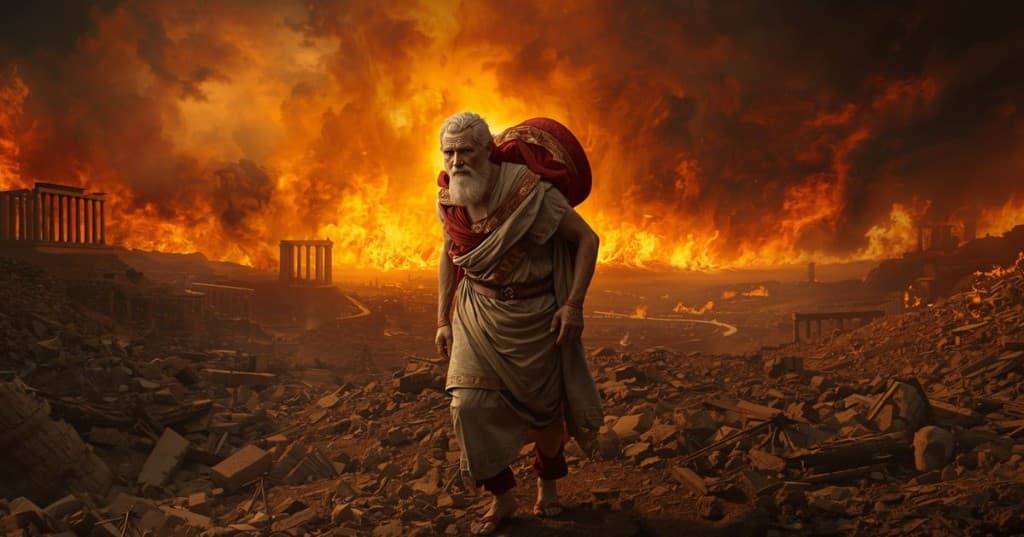
THE ARGUMENT. Aeneas relates how the city of Troy was taken, after a ten years’ siege, by the treachery of Sinon, and the stratagem of a wooden horse. He declares the fixed resolution he had taken not to survive the ruin of his country, and the various adventures he met with in defence of it. At last, having been before advised by Hector’s ghost, and now by the appearance of his mother Venus, he is prevailed upon to leave the town, and settle his household gods in another country. In order to this, he carries off his father on his…
Public-domain chapter text, formatted for reading.
Master this chapter. Complete your experience
Purchase the complete book to access all chapters and support classic literature
Available in paperback, hardcover, and e-book formats
Now let's explore the literary elements.
Key Quotes & Analysis
"Trust not their presents, nor admit the horse.'"
Context: The priest warns Troy against accepting the Greeks' wooden offering.
His counsel names the oldest security rule: gifts from enemies may conceal invasion.
In Today's Words:
Laocoon tells Trojans not to trust Greek gifts or bring the horse inside the walls. He is right, but the city is too exhausted to listen. The line survives because it names a recurring trap: when you want peace badly, danger disguised as generosity gets inside.
"O goddess-born! escape, by timely flight,"
Context: Hector's spirit appears to Aeneas amid the sack and orders him to leave.
The dead hero reframes survival as duty rather than cowardice when the city is already lost.
In Today's Words:
Hector's ghost tells Aeneas to flee while Troy still burns because the city cannot be saved. The command changes escape from shame into mission. Sometimes leaving is not failure; it is the only way to preserve what must continue elsewhere. The same pattern shows up wherever leaders must carry grief in public while others depend
"Haste, my dear father, ('tis no time to wait,)"
Context: Flames approach and Aeneas urges Anchises to mount his shoulders.
Action replaces debate when disaster compresses time and family obligation becomes physical.
In Today's Words:
Aeneas stops arguing with Anchises and loads him onto his shoulders while fire closes in. The line turns piety into motion. In crises, love often becomes logistics: who you carry, what you grab, and how fast you move. The same pattern shows up wherever leaders must carry grief in public while others depend on their
"Nor tears, nor cries, can give the dead relief."
Context: Creusa's spirit tells Aeneas that grief cannot restore her.
Her appearance redirects his energy from impossible rescue toward ordained exile in Italy.
In Today's Words:
Creusa tells Aeneas that weeping will not bring her back from death. She releases him from endless search and points him toward Italy. The moment teaches that mourning must sometimes end so duty to the living can begin. The same pattern shows up wherever leaders must carry grief in public while others depend on their
Thematic Threads
Deception
In This Chapter
The Greeks use elaborate psychological manipulation - the wooden horse, Sinon's false story, and perfectly timed 'divine' intervention to overcome Trojan defenses
Development
Introduced here as a central mechanism of power
In Your Life:
You might recognize this when someone has a convenient explanation for every red flag you raise
Class
In This Chapter
The royal family falls just as hard as common citizens - Priam dies brutally despite his crown, showing that status offers no protection from larger forces
Development
Introduced here through the destruction of hierarchy
In Your Life:
You might see this when economic crashes or health crises hit rich and poor alike
Identity
In This Chapter
Aeneas must abandon his identity as a Trojan warrior and defender to become a refugee and future founder
Development
Introduced here as forced transformation
In Your Life:
You might face this when job loss, illness, or family changes force you to rebuild who you are
Personal Growth
In This Chapter
Aeneas learns to prioritize future duty over present emotion, carrying his father instead of dying gloriously in battle
Development
Introduced here as choosing responsibility over personal desires
In Your Life:
You might experience this when caring for aging parents conflicts with your own dreams
Human Relationships
In This Chapter
Family bonds prove stronger than individual will - Anchises only agrees to leave when divine signs protect his grandson's future
Development
Introduced here through the power of generational thinking
In Your Life:
You might see this when family members make sacrifices they wouldn't make for themselves alone
You now have the context. Time to form your own thoughts.
Discussion Questions
This is not a test. Five prompts guide you through the chapter, from how it opens to how it closes, so you notice context and rhythm rather than facts to memorize. Sit with each question in your own words. When you see "One way to read it," treat it as a starting point, not the only answer.
- 1
Opening scene: Why does Aeneas warn Dido that even Greeks wept to hear this tale?
analysis • surfaceOne way to read it
He frames the story as shared human catastrophe, not Trojan propaganda. The preface asks listeners to receive grief without triumphal scoring.
- 2
Middle movement: What makes Sinon's deception more effective than force alone?
analysis • mediumOne way to read it
He offers a story that fits Trojan hopes and explains away Laocoon's warning. Emotional relief becomes the weapon that opens the gates.
- 3
Middle movement: Why does Anchises initially refuse to leave Troy?
application • mediumOne way to read it
He chooses dignified death over exile. His resistance shows how attachment to homeland can feel more honorable than survival among strangers.
- 4
Closing movement: How does Creusa's ghost change Aeneas's direction?
analysis • deepOne way to read it
She forbids endless mourning and names Italy as future home. Personal loss is absorbed into public destiny, painful but redirecting.
- 5
Closing movement: When have you seen exhaustion make a risky offer look like rescue?
reflection • deepOne way to read it
Strong answers describe one tired decision point, one ignored warning, and one safeguard that would have slowed the choice.
Critical Thinking Exercise
Spot Your Personal Trojan Horses
Think of a time when you ignored warning signs because you really wanted something to work out - a relationship, job opportunity, purchase, or major decision. Write down what the 'red flags' were and what story you told yourself to explain them away. Then identify what made you vulnerable in that moment.
Consider:
- •What were you exhausted from or desperate for when this happened?
- •Who was your 'Laocoon' - the person or gut feeling that tried to warn you?
- •What would you tell a friend in the exact same situation?
Journaling Prompt
Write about your current 'Laocoons' - the people, instincts, or warning signs in your life right now that you might be tempted to ignore. What are they trying to tell you, and what makes it hard to listen?
Coming Up Next...
Chapter 3: The Journey Through False Hopes
Having buried Troy in words, Aeneas will trace the long sea road from Thrace to Sicily: bleeding omens, false oracles, Harpies, reunion with Andromache, Helenus's prophecy, and Anchises's death before Juno's storm drives the fleet to Carthage.