
Hard Times
Charles Dickens
0:00 / 0:00
Girl number twenty cannot define a horse. Thomas Gradgrind wants Facts, nothing else, planted and rooted until wonder is gone, and the schoolroom answers as vessels before the book even names him. Dickens published Hard Times in 1854. What he plants in that first lesson is a catechism built to make useful people, then a harvest: a daughter who cannot feel, a son who steals, and a prize pupil who hunts with a clean conscience.
Thomas Gradgrind is a Member of Parliament and a schoolmaster of the measurable. Louisa and Tom are his proof. Josiah Bounderby recites a hard-luck childhood as if it were a hymn and calls factory workers Hands. Stephen Blackpool is an honest weaver trapped in a marriage the law will not let a poor man leave. Rachael stays beside him. Sissy Jupe, the circus girl Gradgrind adopts after her father vanishes, fails every scored lesson and keeps the one thing the school cannot count. James Harthouse arrives as a bored political ornament. Slackbridge demands union solidarity. Bitzer can define a horse and cannot name a heart. Around them Dickens places Mrs. Sparsit on her staircase of other people's falls, Mrs. Pegler who is not supposed to exist, and Sleary's circus, which treats mercy as something you do, not something you price.
Gradgrind frames Bounderby's proposal as a calculation and Louisa says yes because she was never taught another language. Stephen asks for help and is refused. He will not join Slackbridge, and both sides cast him out. Tom robs the bank and leaves Stephen to take the blame. Harthouse sees the hollow in Louisa and moves toward it. She almost follows, then walks through a storm into her father's study, curses the hour she was born to such a destiny, and collapses at his feet. Facts have no answer for a daughter who asks what he did with the garden that should have bloomed. Sissy sends Harthouse away. Bounderby's elderly mother appears and exposes the childhood he invented. Stephen is found in an abandoned mine shaft and dies after clearing his name. Bitzer hunts Tom with the self-interest Gradgrind taught him. Sleary's circus is the only force left that will help a ruined father without calling mercy a bargain.
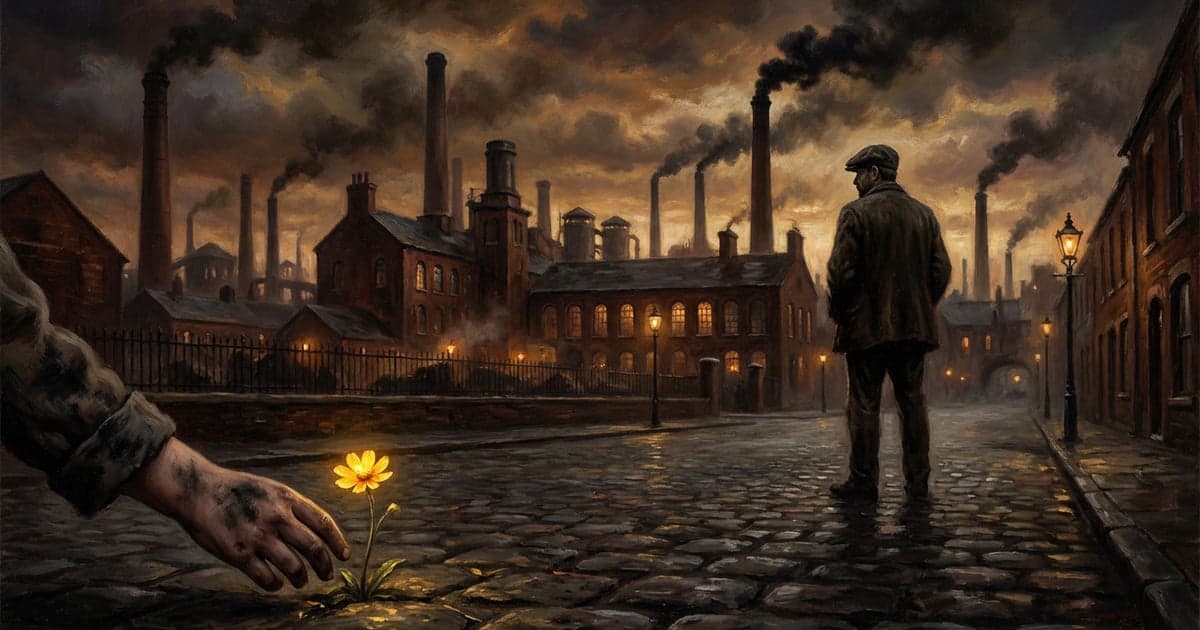
Dickens builds all of it in three books, Sowing, Reaping, and Garnering, as his most direct attack on utilitarian philosophy: the Victorian idea that society should be organized for maximum measurable efficiency and that human value can be calculated. He never treats Coketown as a curiosity of smoke. The school, the mill, the bank, and the law are one machine. Gradgrind is not a cartoon of cruelty. He is a sincere believer who discovers too late that a life without feeling is a life that cannot recognize its own children. The ending is not comfort. Some people change. Some people die. The prize pupil still has the catechism.
Recognizing dehumanizing systems is the first planting: vessels in a schoolroom become Hands in a mill, and the same logic names a person as a function until their inner life is a cost item. Louisa pays for emotional suppression by staring into the fire without asking what she feels, then walking through a storm to ask what he did with the garden. Reclaiming imagination is Fancy scored as failure, Sissy keeping what cannot be counted, Sleary's circus helping a ruined father without a price. Productivity obsession is Bounderby's invented childhood and Bitzer hunting with a clean conscience, a story of output that collapses when Mrs. Pegler walks in. Worker dignity is Stephen remaining a man instead of a Hand when both sides cast him out. Rigid thinking breaks only when Gradgrind hears the catechism quoted back at its author and can finally see his own children.
Girl number twenty still cannot define a horse. Louisa has already asked what became of the garden, and Bitzer still hunts with the self-interest he was taught. The last help in Coketown comes from Sleary's circus, which will not price a rescue. Wide Reads keeps summaries, quotes, and audio for all thirty-six chapters, sown, reaped, and garnered in three books.
Lessons from Hard Times
Six lessons from this classic novel.
Lessons from Hard Times
Six lessons from this classic novel.Deep dives
Chapter-by-chapter breakdowns
Reclaiming Imagination
Understand why creativity and play are not luxuries but necessities, and how to restore them after years of purely rational living.
dost thou think that thou wilt always kill outright the robber Fancy lurking within—or sometimes only maim him and distort him!
Seeing Through Productivity Obsession
Identify when efficiency culture has colonized your sense of self-worth, and find your way back to a life that measures more than output.
A man who was the Bully of humility.
Table of Contents
The One Thing Needful
Hard Times opens with a manifesto, not a plot. In a plain, bare, monotonous vault of a schoolroom, a...
Murdering the Innocents
Thomas Gradgrind names himself at last: a man of facts and calculations who carries scales in his po...
A Loophole
Gradgrind walks home pleased with his model school and his five model children, raised from infancy ...
Mr. Bounderby
The Keynote
Gradgrind and Bounderby walk into Coketown, and Dickens paints the industrial town as a triumph of f...
Sleary's Horsemanship
Gradgrind and Bounderby follow Sissy up the steep stairs of the Pegasus's Arms into the circus lodgi...
Mrs. Sparsit
Never Wonder
Sissy's Progress
Sissy Jupe would have run away from Stone Lodge except for one unarithmetical faith: her father did ...
Stephen Blackpool
Dickens opens among the Hands in the hardest-working quarter of Coketown and introduces Stephen Blac...
No Way Out
The mills wake again, and Dickens pauses over Stephen at his loom. Steam power can be weighed to the...
The Old Woman
Stephen leaves Bounderby's house still carrying the morning's no way out, and an old country woman t...
Rachael
The Great Manufacturer
Years pass in Coketown the way a factory logs output: material consumed, power spent, money made. Lo...
Father and Daughter
Gradgrind's study is a blue chamber of books and a deadly statistical clock. Louisa sits by the wind...
Husband and Wife
Bounderby's first worry about his engagement is telling Mrs. Sparsit. He buys smelling salts and ent...
Common Questions About Hard Times
Trending search questions mapped to the six lessons in this novel: what readers actually ask Google about Louisa's marriage to Bounderby, Stephen Blackpool's fate, Sissy Jupe's failed lessons, Bounderby's invented childhood, and why workers are called Hands.
Why does Louisa marry Bounderby in Hard Times?
Louisa has been raised on Facts alone and taught that looking into the fire and asking what she feels is a waste of time. When Gradgrind frames Bounderby's proposal as a calculation, she agrees, because feeling was never given a name she could use to refuse it. The marriage is not romance failing. It is an education succeeding exactly as designed.
Explore Recovering from Emotional SuppressionWhat happens to Stephen Blackpool at the end of Hard Times?
Stephen refuses to join Slackbridge's union and refuses to flatter Bounderby, so both sides cast him out and the mill withdraws his work. He leaves Coketown to find work elsewhere, falls into an abandoned mine shaft, and is found and carried out only in time to clear his name of the bank robbery before he dies.
Explore Understanding Worker DignityWhy does Sissy Jupe fail every lesson in Hard Times?
Bitzer can define a horse as a graminivorous quadruped with forty teeth. Sissy has lived beside horses her whole life and cannot produce the definition, so Gradgrind marks her as empty. Dickens is exact about the failure: the test was written to exclude exactly the kind of knowledge Sissy actually has.
Explore Reclaiming ImaginationWhy does Josiah Bounderby lie about growing up in a ditch in Hard Times?
Bounderby recites a hard-luck childhood, a drunken grandmother, a ditch, as if it were a hymn to his own self-made success, and uses it to justify paying his workers as little as possible. His elderly mother, Mrs. Pegler, later appears and exposes the whole story as invented. He had a decent, loving upbringing he chose to erase.
Explore Seeing Through Productivity ObsessionWhy does Dickens call the factory workers 'Hands' in Hard Times?
Bounderby and the mill owners refer to their workers only as Hands, counted the same way the mill counts horse steam power. The name is the cruelty: once a person is a Hand, the rest of them, the private life, the grief, the opinion, has no column on the ledger and does not officially exist.
Explore Recognizing Dehumanizing SystemsWhat life lessons does Hard Times teach?
Six lessons run through the novel: recognize a system that renames people as Hands, vessels, or headcount before it ever raises a hand against them; recover from a childhood or workplace that trained you to treat feeling as nonsense; reclaim imagination as the one capacity a scored life cannot replace; see through a self-made story that hides who actually helped you; understand worker dignity as refusing to be filed by either side that only wants a unit; and watch rigid thinking break only when the person who wrote the rule hears it quoted back at them. Those skills, not a schoolroom cartoon, are why the book still answers modern searches.
About Charles Dickens
Published 1854
Charles Dickens (1812-1870) was the most widely read novelist of the Victorian era and one of the most politically committed writers in the English language. Born into genteel poverty, he spent part of his childhood working in a blacking factory while his father was imprisoned for debt. That experience never left him. It shaped every novel he wrote.
He used fiction as a weapon. He attacked debtors' prisons, child labor, corrupt schools, and the brutal logic of the Poor Laws. He serialized his novels in magazines, making literature reachable for working-class readers who could not afford bound books. He understood that a story could do what an editorial could not: make you feel the cost of injustice in your body.
Hard Times, published in 1854, is his most direct attack on utilitarian philosophy, the Victorian idea that society should be organized for maximum measurable efficiency and that human value could be calculated. He had watched industrialization turn England into factories, poverty, and interchangeable lives. He wrote a short, fierce novel in three books arguing that facts without feeling produce monsters, and that imagination is not an indulgence but what makes us human.
Why Dickens Matters Today
Charles Dickens speaks to the moment a workplace, a school, or a whole town starts measuring people by what they produce and calling anything else waste: the dashboard that reduces a person to a number, the interview that scores lived experience as a wrong answer, the childhood story a manager invents to justify what he pays you. Hard Times names that trap through a schoolroom that fills children like vessels and a mill that counts its weavers the way it counts steam power.
What makes him indispensable is that he built the case from a debt he never stopped repaying. Dickens spent part of his own childhood working in a blacking factory while his father sat in a debtors' prison, and he never let that experience become distant. He serialised his novels so factory workers could afford them, understanding that a story could make you feel a cost that a report never would. Hard Times, his shortest and angriest novel, spent three books, Sowing, Reaping, and Garnering, showing what a life of facts alone actually harvests.
Readers still meet Gradgrind's logic in dashboards, scorecards, and any system that renames a person as a Hand, a headcount, or a resource before it ever mistreats them. Dickens does not let Coketown stay a curiosity of smoke. The school, the mill, and the bank share one grammar, and the novel still works because it never blames a single villain. It blames a whole method for measuring a life, and a prize pupil who is still reciting the answer.
More by Charles Dickens in Our Library



Wide Reads is different.
Plot, characters, and themes — plus audio, source text, and patterns you can use after class
Two ways in
Read & listen to the summary
Chapter by chapter, with audio. The meaning arrives because you experienced it — not because someone listed bullet points.
Start with this.
Read the original text
The actual words the author wrote, alongside every summary. Use the guide, then step into the source.
Then step into the source.
Either way, the door opens inward.
— and most of all, Why does this matter?
Get the Full Book
Purchase the complete book to access all chapters and support classic literature

Available in paperback, hardcover, and e-book formats
You Might Also Like

Free to read • No account required