Wide Reads
Literature MattersLife IndexEducators
Sign in
Where to Begin
Hard Times - The Mill Owner's True Face

Charles Dickens

Hard Times

The Mill Owner's True Face

Home›Books›Hard Times›Chapter 14
Previous
14 of 36
Next

Summary

The Mill Owner's True Face

Hard Times by Charles Dickens

0:000:00
Listen to Next Chapter

'Time went on in Coketown like its own machinery: so much material wrought up, so much fuel consumed, so many powers worn out, so much money made.' In this way Dickens fast-forwards through several years. Louisa becomes almost a young woman. Thomas becomes almost a young man, then a young man in a long-tailed coat at Bounderby's bank. Sissy is withdrawn from school — Gradgrind, disappointed, tells her she is backward and below the mark, deficient in facts, and that her early circumstances were probably too unfavourable for her reason to develop. He acknowledges she is affectionate and earnest, and they must 'make that do.' She thanks him with a curtsey. He cannot quite tick her off into columns in a parliamentary return. Gradgrind himself becomes MP for Coketown — one of the deaf, dumb, blind, lame honourable gentlemen, deaf to every consideration beyond figures. Louisa at twilight is still watching sparks fall and die in the fire. One evening Gradgrind holds her and says, 'My dear Louisa, you are a woman.' He asks her to come to his study in the morning. That night Tom comes to her. He hints that father and Bounderby have been meeting at the Bank, away from Mrs. Sparsit's ears. He coaxes Louisa close and asks her to think of how much better things could be for him — 'It would be a splendid thing for me. It would be uncommonly jolly!' She gives him an affectionate good-night. She stands at the door watching his departing steps, which retreat quickly, as glad to get away from Stone Lodge.

Coming Up in Chapter 15

The focus shifts to a deeply personal conversation between father and daughter, where family bonds are tested against the harsh realities of Bounderby's world. Expect revelations that will change how we see several key relationships.

Share it with friends

Previous ChapterNext Chapter
GO ADS FREE — JOIN US
Original text
complete·1,712 words
T

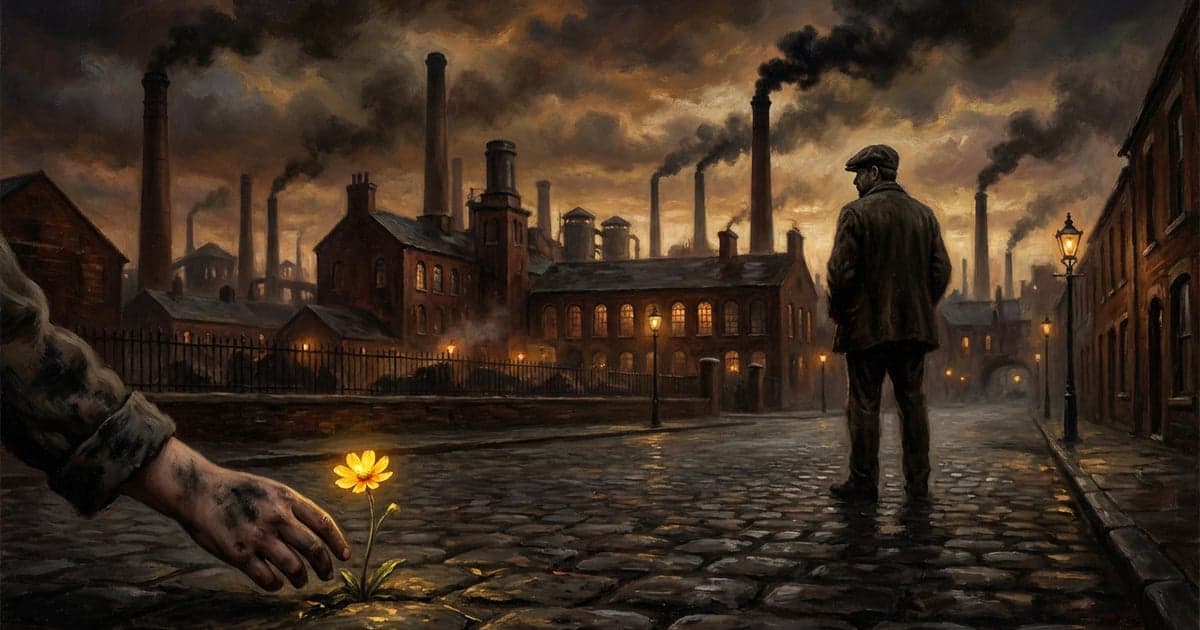
IME went on in Coketown like its own machinery: so much material wrought up, so much fuel consumed, so many powers worn out, so much money made. But, less inexorable than iron, steel, and brass, it brought its varying seasons even into that wilderness of smoke and brick, and made the only stand that ever was made in the place against its direful uniformity.

‘Louisa is becoming,’ said Mr. Gradgrind, ‘almost a young woman.’

Time, with his innumerable horse-power, worked away, not minding what anybody said, and presently turned out young Thomas a foot taller than when his father had last taken particular notice of him.

‘Thomas is becoming,’ said Mr. Gradgrind, ‘almost a young man.’

Time passed Thomas on in the mill, while his father was thinking about it, and there he stood in a long-tailed coat and a stiff shirt-collar.

‘Really,’ said Mr. Gradgrind, ‘the period has arrived when Thomas ought to go to Bounderby.’

Time, sticking to him, passed him on into Bounderby’s Bank, made him an inmate of Bounderby’s house, necessitated the purchase of his first razor, and exercised him diligently in his calculations relative to number one.

1 / 11

Master this chapter. Complete your experience

Purchase the complete book to access all chapters and support classic literature

Read Free on GutenbergBuy at Powell'sBuy on Amazon

As an Amazon Associate, we earn a small commission from qualifying purchases at no additional cost to you.

Available in paperback, hardcover, and e-book formats

GO ADS FREE — JOIN US

Why This Matters

Connect literature to life

Skill: Reading Power Dynamics

This chapter teaches how to recognize when authority figures stop seeing people as human beings and start treating them as expendable resources.

Practice This Today

This week, notice when managers, supervisors, or anyone in authority talks about people using business language—'human capital,' 'redundancies,' 'optimization'—instead of acknowledging real human impact.

GO ADS FREE — JOIN US

Now let's explore the literary elements.

Key Quotes & Analysis

"There's not a Hand in this town, sir, man or woman, but has one ultimate object in life. That object is, to be fed on turtle soup and venison with a gold spoon."

— Bounderby

Context: Bounderby dismissing worker complaints by claiming they all have unrealistic expectations

This reveals Bounderby's complete disconnect from workers' actual needs. He can't imagine they want basic dignity and fair treatment—he assumes they're just greedy for luxury.

In Today's Words:

These employees all think they deserve champagne tastes on a beer budget

"I ha' never had no fratch afore, wi' any o' my fellow weavers."

— Stephen Blackpool

Context: Stephen explaining he's never had trouble with coworkers before the union conflict

Shows Stephen as a peaceful man who just wants to work and get along. His dialect emphasizes his working-class background and genuine nature.

In Today's Words:

I've never had problems with my coworkers before this whole mess started

"The masters against the men, the men against the masters, both sometimes against the public."

— Narrator

Context: Describing the ongoing conflict between factory owners and workers

Dickens shows how labor disputes create divisions that hurt everyone, including the community. He's calling for understanding between classes rather than endless conflict.

In Today's Words:

Management fights workers, workers fight back, and regular people get caught in the middle

Thematic Threads

Class

In This Chapter

Bounderby's complete disconnect from worker experiences reveals how class creates psychological distance that enables exploitation

Development

Evolved from earlier hints of his arrogance to full exposure of his systematic dehumanization of workers

In Your Life:

You might see this when managers who've never done front-line work make policies that ignore practical realities.

Power

In This Chapter

Economic power over workers transforms Bounderby's worldview, making cruelty seem like good business sense

Development

Introduced here as the corrupting force behind his earlier bluster and self-importance

In Your Life:

You might notice this when you gain authority over others and start justifying decisions that benefit you at their expense.

Identity

In This Chapter

Bounderby's identity as a successful manufacturer requires him to see workers as costs rather than people

Development

Builds on his self-made man mythology by showing how it justifies treating others as expendable

In Your Life:

You might experience this when your professional identity conflicts with treating people compassionately.

Relationships

In This Chapter

True relationships become impossible when one person systematically dehumanizes others for profit

Development

Introduced here as the inevitable result of prioritizing money over human connection

In Your Life:

You might see this in workplaces where genuine care between levels becomes impossible due to economic pressures.

GO ADS FREE — JOIN US

You now have the context. Time to form your own thoughts.

Discussion Questions

  1. 1

    How does Bounderby actually treat his workers when we see him in action, and how does this compare to his speeches about being a self-made man?

    analysis • surface
  2. 2

    What allows Bounderby to see his workers as replaceable parts rather than human beings with families and struggles?

    analysis • medium
  3. 3

    Where do you see this same pattern today - people in power treating others like numbers or resources instead of human beings?

    application • medium
  4. 4

    If you were working under someone like Bounderby, what specific strategies would you use to protect yourself and maintain your dignity?

    application • deep
  5. 5

    What does Bounderby's behavior reveal about how financial success can change how people see others, and how can someone avoid this trap?

    reflection • deep

Critical Thinking Exercise

10 minutes

Map Your Workplace Power Dynamic

Draw a simple diagram of your workplace (or a workplace you know well) showing who has power over whom. For each person with authority, write one example of how they treat the people under them - as humans or as resources. Then identify one specific way someone could maintain their humanity in that environment.

Consider:

  • •Look for patterns in how different levels of management communicate with workers
  • •Notice whether decision-makers know the names and situations of the people affected by their choices
  • •Consider how physical distance (separate offices, floors, buildings) might contribute to dehumanization

Journaling Prompt

Write about a time when someone in authority over you made you feel like a number instead of a person. What did that experience teach you about how you want to treat others when you have power?

Coming Up Next...

Chapter 15: When Your Past Catches Up

The focus shifts to a deeply personal conversation between father and daughter, where family bonds are tested against the harsh realities of Bounderby's world. Expect revelations that will change how we see several key relationships.

Continue to Chapter 15
Previous
Finding Light in Dark Places
Contents
Next
When Your Past Catches Up

Continue Exploring

Hard Times Study GuideTeaching ResourcesEssential Life IndexBrowse by ThemeAll Books

You Might Also Like

Great Expectations cover

Great Expectations

Charles Dickens

Also by Charles Dickens

Jane Eyre cover

Jane Eyre

Charlotte Brontë

Explores personal growth

The Strange Case of Dr Jekyll and Mr Hyde cover

The Strange Case of Dr Jekyll and Mr Hyde

Robert Louis Stevenson

Explores personal growth

Don Quixote cover

Don Quixote

Miguel de Cervantes Saavedra

Explores personal growth

Browse all 47+ books

Share This Chapter

Know someone who'd enjoy this? Spread the wisdom!

TwitterFacebookLinkedInEmail

Read ad-free with Prestige

Get rid of ads, unlock study guides and downloads, and support free access for everyone.

Subscribe to PrestigeCreate free account
Intelligence Amplifier
Intelligence Amplifier™Powering Wide Reads

Exploring human-AI collaboration through books, essays, and philosophical dialogues. Classic literature transformed into navigational maps for modern life.

2025 Books

→ The Amplified Human Spirit→ The Alarming Rise of Stupidity Amplified→ San Francisco: The AI Capital of the World
Visit intelligenceamplifier.org
hello@widereads.com

WideReads Originals

→ You Are Not Lost→ The Last Chapter First→ The Lit of Love→ Wealth and Poverty→ 10 Paradoxes in the Classics · coming soon
Arvintech
arvintechAmplify your Mind
Visit at arvintech.com

Navigate

  • Home
  • Library
  • Essential Life Index
  • How It Works
  • Subscribe
  • Account
  • About
  • Contact
  • Authors
  • Suggest a Book
  • Landings

Made For You

  • Students
  • Educators
  • Families
  • Readers
  • Literary Analysis
  • Finding Purpose
  • Letting Go
  • Recovering from a Breakup
  • Corruption
  • Gaslighting in the Classics

Newsletter

Weekly insights from the classics. Amplify Your Mind.

Legal

  • Privacy Policy
  • Terms of Service
  • Cookie Policy
  • Accessibility

Why Public Domain?

We focus on public domain classics because these timeless works belong to everyone. No paywalls, no restrictions—just wisdom that has stood the test of centuries, freely accessible to all readers.

Public domain books have shaped humanity's understanding of love, justice, ambition, and the human condition. By amplifying these works, we help preserve and share literature that truly belongs to the world.

A Pilgrimage

Powell's City of Books

Portland, Oregon

If you ever find yourself in Portland, walk to the corner of Burnside and 10th. The building takes up an entire city block. Inside is over a million books, new and used on the same shelf, organized by color-coded rooms with names like the Rose Room and the Pearl Room. You can lose an afternoon. You can lose a weekend. You will find a book you have been looking for your whole life, and three you did not know existed.

It is a pilgrimage. We cannot find a bookstore like it anywhere on earth. If you read the classics, and you ever get the chance, go. It belongs on every reader's bucket list.

Visit powells.com

We are not in any way affiliated with Powell's. We are just a very big fan.

© 2026 Wide Reads™. All Rights Reserved.

Intelligence Amplifier™ and Wide Reads™ are proprietary trademarks of Arvin Lioanag.

Copyright Protection: All original content, analyses, discussion questions, pedagogical frameworks, and methodology are protected by U.S. and international copyright law. Unauthorized reproduction, distribution, web scraping, or use for AI training is strictly prohibited. See our Copyright Notice for details.

Disclaimer: The information provided on this website is for general informational and educational purposes only and does not constitute professional, legal, financial, or technical advice. While we strive to ensure accuracy and relevance, we make no warranties regarding completeness, reliability, or suitability. Any reliance on such information is at your own risk. We are not liable for any losses or damages arising from use of this site. By using this site, you agree to these terms.