
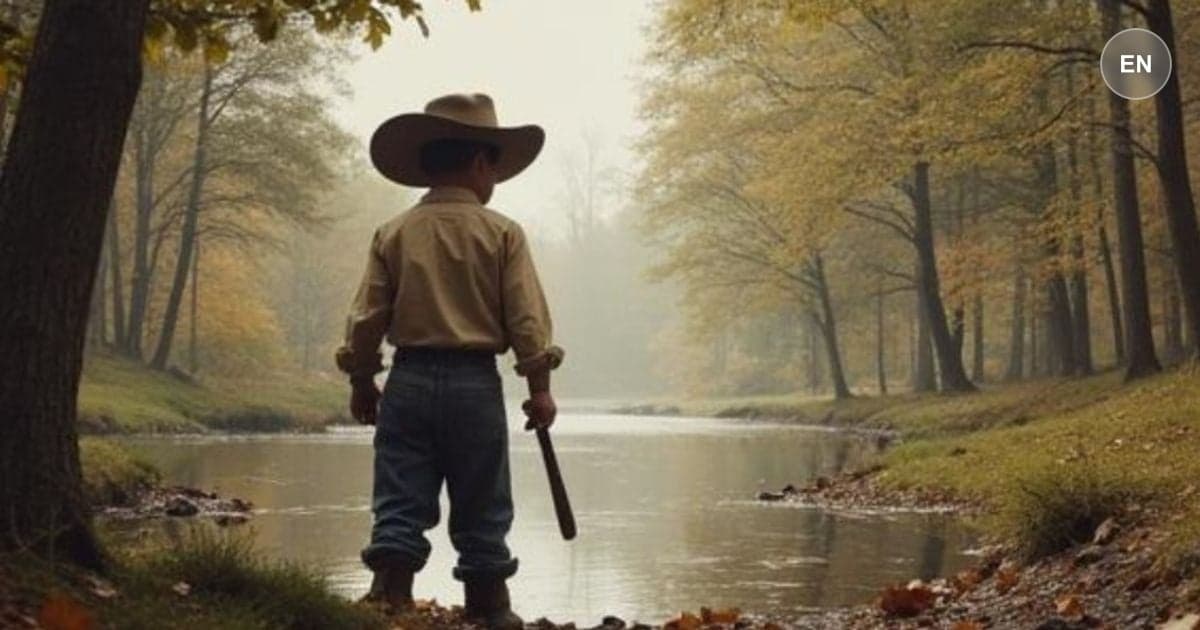
A tick on a slate is already a government. Tom and Joe Harper do not wait for the school day to become interesting. They legislate a sport small enough to hide from the teacher. Twain is comic here, and he is also exact: the boy who can mint a world from almost nothing will later need that mint when the world refuses to cooperate.
Heartbreak sends Tom to the woods to try on Sherwood. Rejection becomes a script with better lines. Then the script grows legs. Jackson's Island is not a daydream. It is provisions, a skiff, and names spoken as if a coast guard might hear them. The island eventually fails as a substitute for home. That failure is part of the education. Imagination can carry boredom and spite. It cannot permanently carry the people you miss.
The cave is the audit. Becky is not an audience. The last candle is not a prop. Tom marks the walls and talks hope because years of pirate law, treasure lore, and tick-game focus trained him to keep scanning when panic wants a speech. Twain never claims play is the same as danger. He claims play is how a mind learns to stay inside a problem long enough to find a hole of blue sky.
The Central Lesson
Imagination as a survival tool, in The Adventures of Tom Sawyer, is a tick game in a dead classroom, a Sherwood afternoon after a slammed door, a pirate camp that still has to come home, a treasure method borrowed from books, and a cave where the last candle is not a metaphor. Twain's lesson is that play trains the mind to stay inside a problem. The cave is where you find out whether the training was real. Keep the rehearsal. Do not confuse it with the dark.
Applying This to Your Life
Build a Small World When the Big One Stalls
The tick game is not childish waste. It is attention rescued from a dead hour. When a job, a wait, or a hospital day has no plot, invent a bounded game with rules. The point is not distraction forever. It is keeping a mind that can still choose.
Inhabit the Role Long Enough to Test It
Tom does not only fantasize piracy. He camps it. If you are considering a change, give it a weekend of real conditions: the tools, the hours, the boredom. Imagination that never leaves the woods will not tell you whether the island is livable.
Know What the Story Cannot Replace
Homesickness on Jackson's Island is data. Some longings are not puzzles for creativity to solve. If what you miss is a person, no new identity will be a fair trade. Use imagination to endure the hour. Do not use it to pretend the missing thing was optional.
Other lessons in this book
More life-skill deep dives from the same classic.
Courage That Costs You
The Kind That Cannot Be Narrated Yet
Take Becky's whipping, name Injun Joe in court, and walk the cave when looking brave is no longer enough.
6 chapters·Explore AnalysisLessons Hidden in Play
The Charter Was Practice
Track pirates, treasure, and Huck at a window, and treat the games as rehearsal for the night a life depends on them.
7 chapters·Explore AnalysisMastering Persuasion
The Fence Was Already a Market
Sell a Saturday fence as privilege, then a funeral as a dream, and watch how badly a town wants the story Tom is offering.
7 chapters·Explore AnalysisReading What People Actually Want
Style, Not Service
Watch Aunt Polly, Sunday school, and a grieving town, and name the gap between what people request and what they will pay to feel.
10 chapters·Explore AnalysisThe Weight of Secrets
What Silence Buys
Sit with the blood oath, Muff in jail, and the courtroom, and feel what a secret costs once it starts to belong to someone else.
7 chapters·Explore Analysis
Continue exploring
Explore this theme
The same lessons in other books
See how other books teach the same life skills.

Siddhartha
Living in the PresentStay at the ferry until past and future stop being places you can live.
The Blue Castle
Building a Life of Your OwnLeave Elm Street for Mistawis, lock a house that is yours, and keep the Blue Castle after the excuse to live is withdrawn.The Blue Castle
Seeing Past ReputationRevise Barney the jailbird, Cissy the disgrace, and the John Foster study Deerwood never bothered to check.
Where the lesson lives in the book
A Tick, a Pin, a Whole Sport
School is a trap of minutes. Tom and Joe Harper build a game from a captive tick and a pin, with rules, sides, and total absorption. The classroom does not change. Their attention does. Becky is watching. The game still happens.
Key Insight:
Constraint is raw material. The other children are equally bored. Tom is the one who manufactures a world small enough to hide in his desk.
“as long as he is on your side you can stir him up and I'll let him alone”
Sherwood Before the River
Becky has shut him out. Tom goes to the woods and tries on outlaw, soldier, Indian chief, each identity rehearsed until it could be lived. He would rather be an outlaw a year in Sherwood than President forever. The heartbreak is not denied. It is recast as a role with lines.
Key Insight:
Imagination here is not a lie about the pain. It is a usable shape for it. Tom survives the afternoon by giving grief a costume that can walk.
“They said they would rather be outlaws a year in Sherwood Forest than President of the United States forever.”
The Black Avenger Ships Out
The fantasy leaves the woods. Tom names himself, recruits Joe and Huck, gathers provisions, and crosses to Jackson's Island. There is no pirate fleet. There is a camp, a river, and three boys who will inhabit the story until homesickness taxes it.
Key Insight:
Tom's gift is making the untrue executable. He does not wait for a ship. He builds conditions in which the role can be worn for days.
“Tom Sawyer, the Black Avenger of the Spanish Main. Name your names.”
The Cannon Meant Us
On Jackson's Island the pirates fish, swim, and invent omens until cannon fire rolls upriver. Tom names the truth: the town is burying them. Grief becomes glory until night brings homesickness Joe cannot quite voice and Tom answers with bark notes in the dark.
Key Insight:
Imagination turns noise into a script you can live inside. Being 'dead' is a role until the role needs a witness who is still alive.
“Boys, I know who's drownded—it's us!”
When the Island Stops Paying
Storm, swimming, tobacco, new games: Tom works to keep the pirate charter alive. Joe wants home. Even Tom feels the pull. The invented world has a load limit. Longing for Aunt Polly is not a failure of imagination. It is a fact imagination cannot permanently replace.
Key Insight:
A survival tool that cannot admit its ceiling becomes another prison. Tom learns that belonging is not a boredom he can paint over.
Digging by the Book
There comes a time, Twain says, when a rightly constructed boy must dig for treasure. Tom's method is folklore: dead limb, midnight, haunted house. The conviction is complete. The map is borrowed from stories that never had to find anything.
Key Insight:
Imagination can generate energy that outruns evidence. The hunt is real labour pointed by a fictional manual. Test the manual or you will be confident in the wrong hole.
“There comes a time in every rightly-constructed boy's life when he has a raging desire to go somewhere and dig for hidden treasure.”
The Last Candle
McDougal's cave is not a pirate set. Becky says they are lost. The last piece of candle is a fact. Tom marks walls, pays out a kite string of trial, and talks hope he does not own. The identities he practiced now have one job: keep her moving until daylight exists again.
Key Insight:
Rehearsal ends when there is no audience and no exit door you can invent. What remains is the habit of scanning, marking, and speaking calm you do not feel.
“Tom, we're lost! we're lost!”