
The Adventures of Tom Sawyer

Mark Twain
0:00 / 0:00
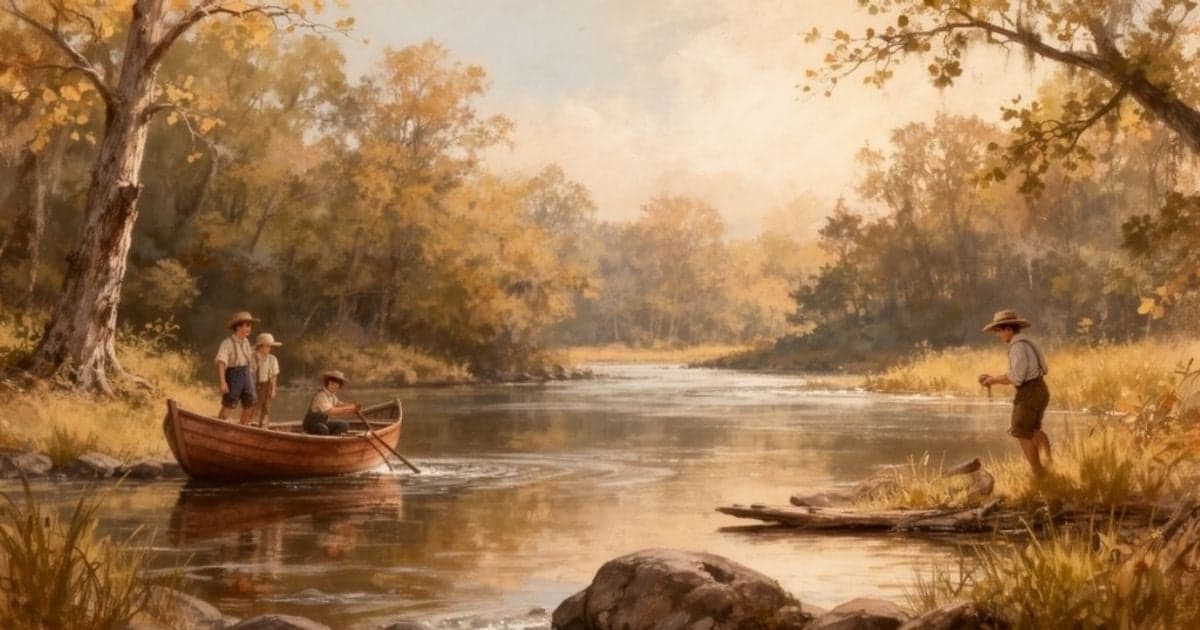
Aunt Polly calls Tom's name through the house and finds only the closet, the jam, and a boy already calculating his next escape. She sends him to whitewash the fence as punishment. By afternoon the fence is done, the other boys have paid him for the privilege, and Tom is rich in apples and marbles he never earned by labour. Twain published the book in 1876, his first full-length novel and a river-town memory of Hannibal. The boy everyone treats as a nuisance is the only one who can read a town well enough to save it, and he still has to grow into the kind of courage that does not need an audience.
Tom Sawyer lives with Aunt Polly in St. Petersburg, a Mississippi river town that stands in for Twain's Hannibal: quick, theatrical, and so hungry for a story that he will turn a chore, a Sunday school, or a funeral into a performance. Huckleberry Finn is the outcast who sleeps in barrels and does not answer to anyone, the only friend Tom trusts with a real secret. Becky Thatcher is the new girl whose favour Tom treats as a prize until the cave makes her a person he has to keep alive. Injun Joe is the man they watch kill Dr. Robinson in the graveyard, then watch the town blame Muff Potter. Aunt Polly loves Tom and still cannot catch him. Sid tells on him. Mary tries to civilize him. Joe Harper signs on as a Jackson's Island pirate. Muff Potter stays drunk and doomed until Tom speaks. Judge Thatcher holds the law. The Widow Douglas will owe Huck a rescue because a game taught him how to listen at a window.
The book spends a fence, a graveyard, a courtroom, and a cave. Tom sells the whitewashing as privilege and banks the loot. In the graveyard he and Huck see Injun Joe stab the doctor and frame Muff. They swear in blood and then watch the town hunt the wrong man. They run to Jackson's Island, are mourned as drowned, and crash their own funeral. Tom takes Becky's whipping for the torn page. He stands in court and names the killer while Injun Joe goes out the window. He and Huck track the treasure to the haunted house, then to the cave. Becky and Tom get lost in McDougal's cave; Injun Joe is using the same dark. Tom finds the way out. The town seals the cave. They find Injun Joe dead at the door, and later they find the gold.
Twain wrote the book as remembrance and refused to make it only sunny. He never treats the fence as a cute trick, or the graveyard as a gothic accident the boys will outgrow. Play is training. Performance is a tool until it becomes a habit that cannot carry a murder. The town's respectability needs a villain it can understand, and it nearly hangs Muff to keep the story simple. Mercy, when it arrives, arrives as testimony Tom did not want to give and a rescue in the dark that no audience can see. What remains is not a sermon against mischief. It is a picture of how a boy learns the difference between looking brave and being brave when the cost is real.
The fence is already a sale before it is a punishment. Mastering Persuasion is that Saturday whitewash, the Sunday-school tickets, the dream story after the funeral, and a town that keeps buying the story Tom is offering. Imagination as a Survival Tool is the tick game, Jackson's Island, the treasure hunt, and McDougal's cave, play becoming the only map he has when the dark is real. The Weight of Secrets is the blood oath after the graveyard, Muff in jail, and a trial Tom cannot sit through without speaking. Reading What People Actually Want is Aunt Polly's grief, a town that wants a drowned-boy story, and the gap between what people request and what they will pay to feel. Courage That Costs You is the whipping he takes for Becky's torn page, the name he speaks in court while Injun Joe goes out the window, and the dark he walks so she can follow. Lessons Hidden in Play is the pirates and the treasure, then the night Huck listens at a window and saves a life because a game taught him how.
The whitewash is still wet when the other boys start paying for the brush. Injun Joe dies at a cave door the town sealed too late. Wide Reads carries summaries, quotes, and audio through all thirty-five chapters, and does not let the Saturday con pretend it was only a game.
Lessons from The Adventures of Tom Sawyer
Six lessons from this classic novel.
Lessons from The Adventures of Tom Sawyer
Six lessons from this classic novel.Deep dives
Chapter-by-chapter breakdowns
The Weight of Secrets
Sit with the blood oath, Muff in jail, and the courtroom, and feel what a secret costs once it starts to belong to someone else.
They're humans! One of 'em is, anyway.
Reading What People Actually Want
Watch Aunt Polly, Sunday school, and a grieving town, and name the gap between what people request and what they will pay to feel.
they were her state pair, the pride of her heart, and were built for 'style,' not service.
Table of Contents
Tom's Great Escape and First Fight
Aunt Polly calls for Tom and hunts him through the house. She catches him with jam on his face and g...
The Great Fence Con
Saturday morning should be for play, but Aunt Polly orders Tom to whitewash thirty yards of fence. T...
Tom's Triumph and First Heartbreak
Tom goes home and tells Aunt Polly the fence is finished. She does not believe him until she walks o...
Sunday School Performance and Public Humiliation
Sunday morning means church prep. Tom struggles to memorize Bible verses about the poor in spirit. M...
Church, Chaos, and a Pinchbug's Revenge
The church bell rings and the whole town files into pews. Tom sits far from the window so he cannot ...
The Art of Strategic Misbehavior
Monday morning Tom dreads school and pretends to be sick. He groans about a sore toe until Aunt Poll...
The Tick Game and First Love
Tom cannot focus in the hot, sleepy classroom. The noon bell feels hours away. He and Joe Harper pla...
Escape, Dreams, and Childhood Magic
Tom runs through the woods to escape Becky's anger. He crosses a stream three times because boys bel...
Common Questions About The Adventures of Tom Sawyer
Trending search questions mapped to the lessons in this novel—what readers actually ask Google about the whitewashed fence, the graveyard oath, Jackson's Island, the courtroom, McDougal's cave, and boyhood that trains real courage.
What is The Adventures of Tom Sawyer about?
Tom Sawyer lives in St. Petersburg, a Mississippi river town Twain built from Hannibal memory: Aunt Polly's jam raids, Sunday school tickets, a fence that becomes a market, and a graveyard where two boys watch Injun Joe kill a doctor and frame Muff Potter. They swear in blood, run to Jackson's Island, crash their own funeral, lose Becky in McDougal's cave, and find gold the town almost let a killer keep. Twain refuses to write only mischief. Play trains markets and maps; performance fails when a murder needs a sentence in court.
Explore Lessons Hidden in PlayWhy does Tom trick the other boys into whitewashing the fence in The Adventures of Tom Sawyer?
Saturday was meant to punish him. Tom treats the brush as a limited engagement: Ben Rogers arrives mocking and leaves begging for a turn. He never argues that whitewashing is fun. He looks as if he might refuse. By evening the fence has three coats and Tom is rich in apples, marbles, and a dead rat on a string. Twain's lesson is not a cute trick. People pay for access to what already looks desired.
Explore Mastering PersuasionWhat happens in the graveyard scene in The Adventures of Tom Sawyer?
Tom and Huck go to the graveyard with a dead cat for a charm and watch Injun Joe stab Dr. Robinson during a fight with Muff Potter. Joe puts the knife in the drunk man's hand and talks the town into a story it wants to believe. The boys run without a language for what they own. That night in the old tannery they swear in blood to keep mum while Muff slides toward the gallows.
Explore The Weight of SecretsWhy does Tom Sawyer testify at Muff Potter's trial in The Adventures of Tom Sawyer?
The trial is going Muff's way toward the gallows and Tom can no longer pay in tobacco and jail visits. On the stand he names the graveyard in order, including Injun Joe. The town throws a parade; the killer leaves through a courthouse window. Tom does not speak because he has become virtuous overnight. Silence has finally cost more than speech, and the bill does not end when the cheering stops.
Explore Courage That Costs YouWho is Huckleberry Finn in The Adventures of Tom Sawyer?
Son of the town drunk, dressed in cast-off adult clothes, sleeping in doorsteps and hogsheads, answering to no master. Every mother in St. Petersburg forbids him and every respectable boy envies him. Tom is under strict orders not to play with Huck and does it every chance he gets. Huck carries the graveyard secret, listens at windows when a game assigns him the night watch, and saves the Widow Douglas because play taught him how to wait in the dark.
Explore Reading What People Actually WantWhat life lessons does The Adventures of Tom Sawyer teach?
Six lessons run through the novel: sell a fence as privilege before you ask for help; use imagination as a map when the cave has no audience; carry secrets until silence belongs to someone else's neck; read what people want under their stated rules; pay courage in a currency the room can feel; and treat pirates, treasure hunts, and window watches as unpaid training for the night a life depends on them. Those skills, not a nostalgia postcard, are why the book still answers modern searches.
About Mark Twain
Published 1876
Mark Twain (1835-1910) was born Samuel Langhorne Clemens in Florida, Missouri, and grew up in Hannibal, the river town he would rename St. Petersburg. He left school after his father's death, set type, and later piloted steamboats on the Mississippi that gave him his pen name. When the Civil War stopped that traffic, he turned to journalism and found a voice that was comic, plain, and unwilling to pretend respectable society was always respectable.
The Adventures of Tom Sawyer appeared in 1876, his first full-length novel and his most deliberate act of memory. He used the fence, the graveyard, the island, and the cave from boyhood, then refused to write an elegy. Tom lies, swindles, and performs. He also keeps a murder secret, takes a whipping he did not earn, and tells the truth in court when silence would have been safer.
William Faulkner later called him the father of American literature. The claim starts with American speech told without apology. Twain would go darker in Huckleberry Finn. In Tom Sawyer he perfected the mix: boyhood as comedy, boyhood as moral laboratory, and a river town that laughs until the joke turns out to be a hanging.
Why Mark Twain Matters Today
Mark Twain speaks to the moment when a talent for persuasion outruns character: the person who can spin any chore into a favour done for someone else, who can sell a funeral as a story before the grief is even real, right up until a situation turns serious and no amount of performance will keep an innocent man out of prison. Tom Sawyer does not scold that talent. It follows the boy who has it into a graveyard, a courtroom, and a cave to find out what the talent is actually worth once the audience is gone.
What makes him indispensable is that Twain wrote this as memory, not invention. He grew up in Hannibal, Missouri, the river town he renamed St. Petersburg, and gave Tom the fence, the cave, and the island straight out of his own boyhood. The Adventures of Tom Sawyer, published in 1876, was his first full-length novel, and he refused to leave it as simple nostalgia. The same boy who cons his friends into whitewashing a fence also watches a man murdered, keeps the secret at the cost of another man's life, and has to decide whether testifying is worth what it will cost him.
Readers keep returning to this book for the fence and the treasure, then stay for the trial and the cave, where a boy who has spent the whole story performing finally does something brave that nobody was watching. Twain would go darker eight years later in Huckleberry Finn. Here, he shows the same rehearsal for courage happening first, in play, before the cost gets real.
More by Mark Twain in Our Library
Wide Reads is different.
Plot, characters, and themes — plus audio, source text, and patterns you can use after class
Two ways in
Read & listen to the summary
Chapter by chapter, with audio. The meaning arrives because you experienced it — not because someone listed bullet points.
Start with this.
Read the original text
The actual words the author wrote, alongside every summary. Use the guide, then step into the source.
Then step into the source.
Either way, the door opens inward.
— and most of all, Why does this matter?
Get the Full Book
Purchase the complete book to access all chapters and support classic literature

Available in paperback, hardcover, and e-book formats
You Might Also Like


Free to read • No account required