
The Collision · No. 19
Before Think and Grow Rich, Cervantes wrote the man who believed.
Napoleon Hill's Think and Grow Rich (1937) taught a method that still sells: choose one definite aim, repeat it until the mind accepts it as fact, and keep going when the first results argue back. Writing about Thomas Edison, Hill says the mind could produce anything the mind could conceive and believe. The line the shelf repeats now adds a payoff that sentence does not carry. Achieve.
Miguel de Cervantes staged the method in 1605, three centuries earlier. A gentleman bordering on fifty sells tillage land to buy more books of chivalry, reads from sunset to sunrise, and the narrator says his brains got so dry that he lost his wits. He names his hack Rocinante, names himself Don Quixote of La Mancha, and names Aldonza Lorenzo — a farm girl who never knew his love — Dulcinea del Toboso. Before he leaves by the back door he already sees himself crowned Emperor of Trebizond. In Chapter 1 the aim is already a life. The helmet has not survived a second test.
The collision is structural. Hill does not mention Cervantes. The fork is what you do when the world refuses the aim. A success method treats the refusal as unfinished faith. The novel spends one hundred and twenty-six chapters billing the man who will not let the refusal count.
The book you bought
“Whatever the mind can conceive and believe, it can achieve.”
Think and Grow Rich · Napoleon Hill · 1937 · the line the shelf still prints
The book that beat it by ~332 years
A pasteboard helmet fails one slash. He reinforces it, refuses a second test, and calls it perfect.
Chapter 1 · Miguel de Cervantes · 1605
Hill wants the belief to pay. Cervantes already wrote the man who believed, and the morning he gave the name back.
The helmet he will not test twice
Hill's early steps ask for a definite aim, written down, repeated until doubt goes quiet. Quixote performs them in a courtyard before he has a squire. He scours his great-grandfather's rusted armour and finds the morion has no closed helmet. He builds a half-helmet of pasteboard, draws his sword, and gives it two slashes. The first undoes a week's work. He sets iron bars inside until he is satisfied. Then he stops. He will not try another experiment. He adopts it as a helmet of the most perfect construction.
That is the method with the guarantee still ahead of him. Test once. When the test threatens the aim, reinforce the story and retire the test. He has already sold acres of tillage land to buy the books that taught him the role. The fortune Hill promises is, in this chapter, a name, a horse, and a lady who does not know she has been promoted.
 Read the chapter
The source · Chapter 1
“…not caring to try any more experiments with it, he passed it and adopted it as a helmet of the most perfect construction.”Narrator, Chapter 1 (public-domain text on Wide Reads)
Fortune arranging thirty giants
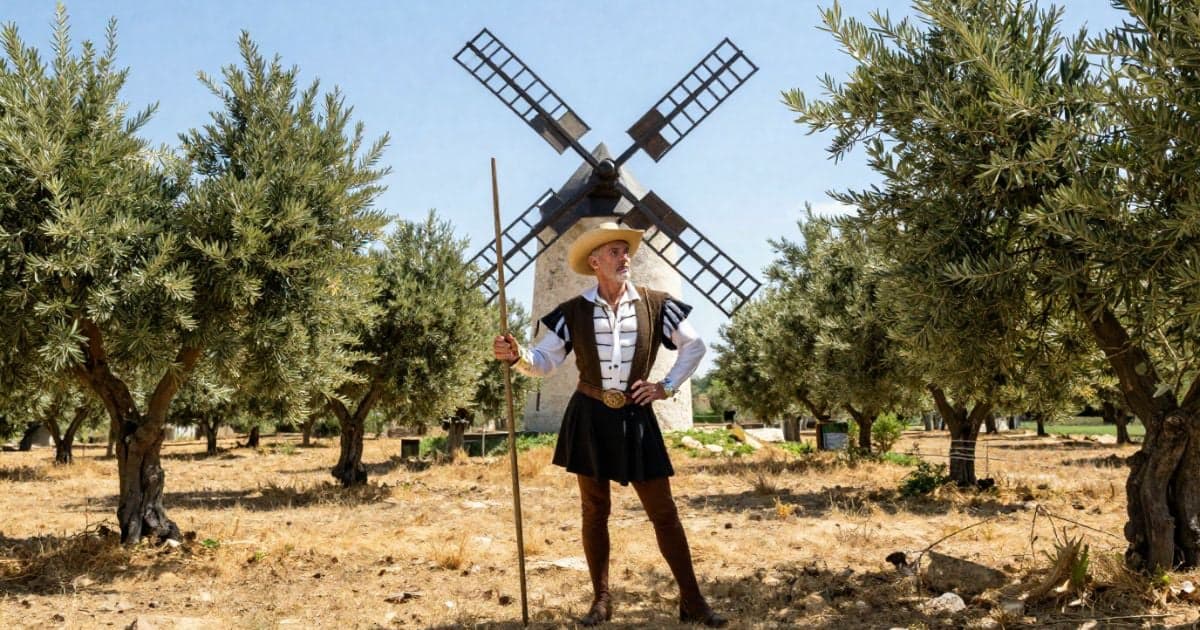
In Chapter 8 they come in sight of thirty or forty windmills. Quixote tells Sancho that Fortune is arranging matters better than they could have shaped their desires themselves, and that thirty monstrous giants stand on the plain, whose spoils will begin their fortune. Sancho asks what giants. Quixote points at the long arms. Sancho says they are windmills. Quixote charges. A sail catches the lance. Rocinante and the rider go down. The lance is in pieces.
Sancho's line is the audit the method keeps postponing: no one could have mistaken them but one who had something of the same kind in his head. Quixote's reply keeps the aim innocent. The sage Friston, who already carried off his study and books, has turned the giants into mills to rob him of the glory. Win, and the calling is confirmed. Lose, and an enchanter stole the win. Hill teaches readers to hunt a later benefit inside a failure. Cervantes writes that hunt as a story nothing on the plain is allowed to correct.
The source · Chapter 8
“Fortune is arranging matters for us better than we could have shaped our desires ourselves.”Don Quixote, Chapter 8 (public-domain text on Wide Reads)
Each of us is the maker of his own Fortune
The sentence people think the success shelf invented is spoken, in Chapter 118, by a beaten man leaving Barcelona. He looks back at the beach where the Knight of the White Moon threw him and Rocinante to the earth. Here Troy was, he says. Then he gives Sancho the common saying: each of us is the maker of his own Fortune. He has been the maker of his. He lacked prudence. His self-confidence made him pay dearly, because Rocinante's strength could not match the bulk of the knight who beat him.
He says the success sentence and the correction in the same breath, and he still plans a year at home before he returns to arms. The belief has a receipt. It has not yet resigned.
The source · Chapter 118
“Each of us is the maker of his own Fortune. I have been that of mine; but not with the proper amount of prudence, and my self-confidence has therefore made me pay dearly.”Don Quixote, Chapter 118 (public-domain text on Wide Reads)
Last year's nests
In Chapter 126 a fever keeps him in bed six days. Friends offer a new story — shepherds, dogs, an eclogue — the way a method offers a fresh aim when the old one breaks. He wakes lucid. He is no longer Don Quixote of La Mancha but Alonso Quixano, whose way of life won him the name of Good. Amadis and the whole troop of knight-errantry are odious to him. He calls for the notary.
Sancho weeps and begs him to live, to blame a badly girthed saddle, to remember that the man conquered today can be conqueror tomorrow. Quixote stops him. In last year's nests there are no birds this year. He was mad; now he is in his senses. The will clears Sancho's accounts, leaves the estate to his niece, and forbids her to marry a man who knows the books. Then he dies.
Hill's promise is that the conceived aim, believed long enough, becomes the fortune. Cervantes' last page is a man returning his name, settling the squire's wages, and closing the shelf so no false sequel can ride the knight out again. Hill writes a book that tells you belief will pay. Cervantes already wrote the believer, the bill, and the morning the believer gave the name back.
The source · Chapter 126
“In last year's nests there are no birds this year. I was mad, now I am in my senses; I was Don Quixote of La Mancha, I am now, as I said, Alonso Quixano the Good.”Don Quixote, Chapter 126 (public-domain text on Wide Reads)
Bring this to the table
When a plan fails, do you change the aim, or do you explain the failure in a way that leaves the aim exactly where it was?
Common Questions
Search questions this collision answers — what readers ask about Hill's conceive-and-believe line, the windmills, and the morning Don Quixote gives the name back.
Is Think and Grow Rich based on Don Quixote?
Hill does not cite Cervantes. The collision is structural. Both describe a mind that chooses one aim, repeats it until the aim feels like fact, and explains failure in a way that leaves the aim standing. Cervantes published the case in 1605. Hill packaged the method in 1937 and attached a payoff the novel refuses.
What does Napoleon Hill actually say about conceiving and believing?
In the 1937 book, writing about Thomas Edison, Hill says the mind could produce anything the mind could conceive and believe. The shorter line people repeat now adds a word that sentence does not carry: achieve. The success shelf turned a claim about what the mind can picture into a guarantee that the picture will pay.
Why does Don Quixote charge the windmills?
In Chapter 8 he tells Sancho that Fortune is arranging matters better than they could have shaped their desires, and that thirty giants stand on the plain. Sancho says they are windmills. Quixote charges, the lance shatters, and he blames the sage Friston for turning giants into mills to rob him of the glory. The aim stays true. The field is declared enchanted.
What happens when Don Quixote gives the name back?
In Chapter 126 a fever follows the defeat on the Barcelona beach. He wakes lucid, says he is no longer Don Quixote of La Mancha but Alonso Quixano the Good, and calls the books of knight-errantry odious. Sancho begs him to rise and live another story. He answers that in last year's nests there are no birds this year, makes his will, and dies.
Why compare Think and Grow Rich and Don Quixote?
Because millions meet the method through Hill first. Placed beside Cervantes, the method keeps the useful part (a clear aim changes how you spend a day) and loses the guarantee (belief itself produces the fortune). The novel shows what the guarantee costs when the aim is borrowed from books and the world stays an inn, a mill, and a beach.
One hundred and twenty-six chapters. One name given back.
Don Quixote is the case Hill's method never itemises: a definite aim taken from books, a helmet retired from testing, a plain full of mills, and a deathbed that returns the name. We walk all one hundred and twenty-six chapters in plain language, with audio. The first chapter's narration is free. The rest is $2.99 a month, every book on the shelf.