Teaching Meditations
by Marcus Aurelius (180)
Teaching Map
This guide is not only for literature teachers. Parents, tutors, book clubs, and anyone reading Meditations together can use it to open conversation — not just recap plot. Each Why it matters note is a question-starter: ask toward a Collision (two views meet and something shifts), a Reframe (the same facts suddenly mean something different), or a Recognition (what was always there finally becomes visible). The map shows how the book breaks into stages, which anchor scenes to lean on, and where each Lesson fits — whether you are planning a term or a single evening.
Book I–III
Chapters 1–3 · Teachers, time, discipline
Roll call: Verus, Rusticus, Antoninus
“Of my grandfather Verus I have learned to be gentle and meek, and to refrain from all anger and passion.…”
Why it matters
Ask a question — toward Collision, Reframe, or Recognition.
Performing self-made success isolates you from the people and principles that actually keep you effective. Before he claims any imperial rank, Marcus credits his grandfather Verus for gentleness and Rusticus for the day he admitted his life needed correction and took up Epictetus. Name your teachers out loud before you claim credit, so authority rests on gratitude instead of performance.
Building Earned Authority
“Of my grandfather Verus I have learned to be gentle and meek, and to refrain from all anger and passion.…”
Why it matters
Ask a question — toward Collision, Reframe, or Recognition.
Performing self-made success isolates you from the people and principles that actually keep you effective. Before he claims any imperial rank, Marcus credits his grandfather Verus for gentleness and Rusticus for the day he admitted his life needed correction and took up Epictetus. Name your teachers out loud before you claim credit, so authority rests on gratitude instead of performance.
Morning Preparation for Difficult People
“Of my grandfather Verus I have learned to be gentle and meek, and to refrain from all anger and passion.…”
Why it matters
Ask a question — toward Collision, Reframe, or Recognition.
Performing self-made success isolates you from the people and principles that actually keep you effective. Before he claims any imperial rank, Marcus credits his grandfather Verus for gentleness and Rusticus for the day he admitted his life needed correction and took up Epictetus. Name your teachers out loud before you claim credit, so authority rests on gratitude instead of performance.
Time already delayed
“Remember how long thou hast already put off these things, and how often a certain day and hour as it…”
Why it matters
Ask a question — toward Collision, Reframe, or Recognition.
You can spend years telling yourself you will fix your habits once life calms down, but the delay itself becomes the habit. Marcus asks how long he has already put off inner work and tells himself to treat every action as if it were his last. Stop waiting for perfect conditions and start the reckoning today, before crisis removes the choice.
Facing Mortality Without Panic
“Remember how long thou hast already put off these things, and how often a certain day and hour as it…”
Why it matters
Ask a question — toward Collision, Reframe, or Recognition.
You can spend years telling yourself you will fix your habits once life calms down, but the delay itself becomes the habit. Marcus asks how long he has already put off inner work and tells himself to treat every action as if it were his last. Stop waiting for perfect conditions and start the reckoning today, before crisis removes the choice.
Getting Up and Doing the Work
“Remember how long thou hast already put off these things, and how often a certain day and hour as it…”
Why it matters
Ask a question — toward Collision, Reframe, or Recognition.
You can spend years telling yourself you will fix your habits once life calms down, but the delay itself becomes the habit. Marcus asks how long he has already put off inner work and tells himself to treat every action as if it were his last. Stop waiting for perfect conditions and start the reckoning today, before crisis removes the choice.
Separating What You Control
“Remember how long thou hast already put off these things, and how often a certain day and hour as it…”
Why it matters
Ask a question — toward Collision, Reframe, or Recognition.
You can spend years telling yourself you will fix your habits once life calms down, but the delay itself becomes the habit. Marcus asks how long he has already put off inner work and tells himself to treat every action as if it were his last. Stop waiting for perfect conditions and start the reckoning today, before crisis removes the choice.
Book IV–VIII
Chapters 4–8 · Inner fortress, duty, control
Inner fortress without the seashore
“That inward mistress part of man if it be in its own true natural temper, is towards all worldly chances…”
Why it matters
Ask a question — toward Collision, Reframe, or Recognition.
You cannot wait for quieter circumstances to feel steady; the retreat has to live inside you first. Marcus says you may retire into yourself at any time, and that tumult comes from opinion within, not from objects outside. Pause, withdraw attention inward, and separate what happened from the story that makes it unbearable.
Controlling the Inner Fortress
“That inward mistress part of man if it be in its own true natural temper, is towards all worldly chances…”
Why it matters
Ask a question — toward Collision, Reframe, or Recognition.
You cannot wait for quieter circumstances to feel steady; the retreat has to live inside you first. Marcus says you may retire into yourself at any time, and that tumult comes from opinion within, not from objects outside. Pause, withdraw attention inward, and separate what happened from the story that makes it unbearable.
Warm bed and a man's work
“In the morning when thou findest thyself unwilling to rise, consider with thyself presently, it is to go about a…”
Why it matters
Ask a question — toward Collision, Reframe, or Recognition.
The hardest leadership test often happens before anyone else is awake, when comfort whispers that you were made for ease. Marcus catches himself unwilling to rise and argues that he was born for a man's work, not for pleasure in a warm bed, while bees and vines simply do what nature requires. Treat getting up and doing your duty as the moral act it is, and deal yourself happiness through good inclinations, desires, and actions rather than waiting for easier circumstances.
Best revenge: not becoming like them
“The matter itself, of which the universe doth consist, is of itself very tractable and pliable. That rational essence that…”
Why it matters
Ask a question — toward Collision, Reframe, or Recognition.
Most professional misery comes from treating other people's decisions as if they were yours to own. Marcus says that if you mark externals as good or evil, you will complain against the gods and hate the people who seem to block you, yet only what depends on your will is truly yours; he also tells himself to see luxury food as plain carcass and wine as grape juice so glamour cannot rule him. Sort each situation into what you control and what you do not, then spend your energy only on the part that belongs to your character.
Mastering the inner fortress
“This also, among other things, may serve to keep thee from vainglory; if thou shalt consider, that thou art now…”
Why it matters
Ask a question — toward Collision, Reframe, or Recognition.
Leadership breaks when mistakes must either be hidden or become proof you are worthless. Marcus admits he cannot claim the philosopher's title and tells himself to live the rest of life as nature requires, then before each action asks whether he will repent it once done and excludes the opinion that criticism has hurt him. Examine failure as data, strip added stories from events, and take the next fitting action instead of performing remorse or chasing applause.
Book IX–XII
Chapters 9–12 · Nature, soul, departure
Soul's journey to simplicity
“O my soul, the time I trust will be, when thou shalt be good, simple, single, more open and visible,…”
Why it matters
Ask a question — toward Collision, Reframe, or Recognition.
You cannot make your peace depend on titles, moods, or outcomes that change by the hour. Marcus tells his soul that one day it will be simple and free of worldly craving, asks before each action whether nature and the common good permit it, and says to stop disputing what a good man is and actually be one. Seek stability in character and reasonable action rather than in externals you never fully controlled.
Final reflections and departure
“Whatsoever thou doest hereafter aspire unto, thou mayest even now enjoy and possess, if thou doest not envy thyself thine…”
Why it matters
Ask a question — toward Collision, Reframe, or Recognition.
Most people treat contentment like a future reward tied to outcomes they do not control. Marcus opens his last book by saying you may already enjoy what you aspire to if you stop envying yourself your own happiness, then spends the closing sections asking what the present estate of your understanding is. Stop postponing inner peace, run action and speech through fitting and true, cast away opinion, and measure the day by clarity of mind rather than by applause or survival.
Why Teach Meditations?
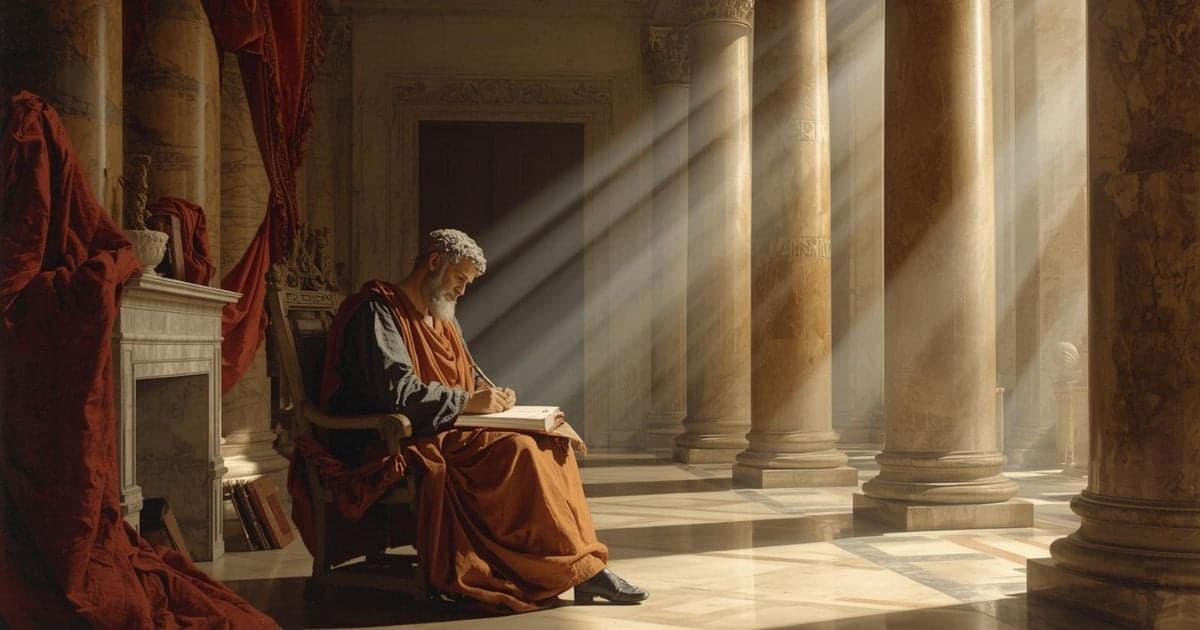
Marcus Aurelius, emperor of Rome from 161 to 180, writes twelve books of private notes to himself in Greek while campaigning on the Danube frontier during plague and war. Book I is a roll call of credit: his grandfather Verus for gentleness, his teacher Rusticus for handing him Epictetus and telling him his life needed correction, his adoptive father Antoninus Pius for ruling without vanity. The books that follow argue with a warm bed he does not want to leave, name an inner fortress that needs no travel, and return again and again to the dead, Alexander and his own mule-driver equally gone. He never meant the notebook for a reader. It is a record of a man catching himself slipping and starting again, until the final book asks what he is still deferring while there is time left to stop.
Lessons from Meditations
Six named pressures the book tests, each tied to a chapter and a deeper lesson page. Send students to one when a theme hooks them, then back to the scene that proves it.
Building Earned Authority
Credit Verus, Rusticus, and Antoninus by name: gentleness, Epictetus, and a ruler who never mistakes flattery for respect.
Controlling the Inner Fortress
Retreat into the mind Book Four trains: obstacles feed a strong fire, and you do not need the seashore if the principles are already stored.
Facing Mortality Without Panic
Sit with Hippocrates dying sick, Alexander and the mule-driver both gone, and time that will not return.
Getting Up and Doing the Work
Talk yourself out of the warm bed the way Book Five does: bees already work, rest has a stint, and duty does not.
Morning Preparation for Difficult People
Use the Granua drill before the day begins: expect the idle and the envious, and refuse to hate a stone for falling.
Separating What You Control
Keep ruling reason from becoming a slave to appetite, reputation, or other people's opinions, and release what is not yours.
Suggested Teaching Approach
1Before class: map the setup
Read Book I (Chapter 1) for Verus, Rusticus handing him Epictetus, Antoninus governing without vanity, and the Granua morning drill. You need the receipt before the campaign notes can read as self-correction instead of performance.
2Discussion starter: name the mechanism
Skip plot recall. Ask where students see this book's pressures play out in their own lives, from Roll call: Verus, Rusticus, Antoninus (Ch. 1) to Final reflections and departure (Ch. 12). Tie every answer to a chapter number, not a theme label alone.
3Modern connections: use the six lessons
Six pressures repeat across the twelve books: building earned authority by naming who actually shaped you before claiming any credit yourself, controlling the inner fortress that needs no travel or seashore, preparing each morning for people who will fail you before they arrive, separating what you control from what you do not, facing mortality without panic by sitting with the dead rather than avoiding them, and getting up to do the work when the bed is warm and duty is not optional. Each spoke ties named passages to the argument.
4Assessment: application, not recall
Essay prompts that work: compare Roll call: Verus, Rusticus, Antoninus (Ch. 1) to Best revenge: not becoming like them (Ch. 6); trace how it pays off by the ending. Pair with a current-events angle, then require a scene from the book as counterweight. Assess application, not recall. AI cannot help with lived experience.
Chapter-by-Chapter Resources
Lessons from Those Who Shaped Me
Why it matters: Performing self-made success isolates you from the people and principles that actually keep you effective. Before he claims any imperial rank, Marcus…
Time Is Running Out
Why it matters: You can spend years telling yourself you will fix your habits once life calms down, but the delay itself becomes the habit.
Time, Beauty, and Mental Discipline
Why it matters: Your attention is finite, and most people spend it tracking other people's motives instead of doing the work only they can do.
The Inner Fortress: Finding Peace Within
Why it matters: You cannot wait for quieter circumstances to feel steady; the retreat has to live inside you first. Marcus says you may retire…
Getting Out of Bed and Living Your Purpose
Why it matters: The hardest leadership test often happens before anyone else is awake, when comfort whispers that you were made for ease. Marcus catches…
The Art of Inner Control
Why it matters: Most professional misery comes from treating other people's decisions as if they were yours to own. Marcus says that if you mark…
The Universal Patterns of Human Experience
Why it matters: Fresh outrage often comes from treating an old human script as if it were invented for you alone. Marcus asks what wickedness…
Mastering Your Inner Fortress
Why it matters: Leadership breaks when mistakes must either be hidden or become proof you are worthless. Marcus admits he cannot claim the philosopher's title…
Living in Harmony with Nature
Why it matters: Much leadership suffering comes from treating settled facts like battles still worth waging. Marcus says the unjust person is impious because the…
The Soul's Journey to Simplicity
Why it matters: You cannot make your peace depend on titles, moods, or outcomes that change by the hour. Marcus tells his soul that one…
The Soul's True Powers
Why it matters: Strong reactions often come from stories the mind adds, not from the event itself. Marcus says the reasonable soul can depart saying…
The Final Reflections
Why it matters: Most people treat contentment like a future reward tied to outcomes they do not control. Marcus opens his last book by saying…
Start with one chapter
Assign Chapter 1 with the summary and audio, then open discussion with a life-skill question instead of a plot question. Expand chapter by chapter from there.