Free study guide · no paywall

Prestige · $2.99/month
Chapter audio, theme analysis, and downloads
Free study guide · no paywall
by Marcus Aurelius (180)
Gratitude, the inner fortress, and the warm bed on the Danube, mapped across twelve books and six lessons.
Start here
12 chapter summaries · 8 key figures · discussion questions · quotes · free
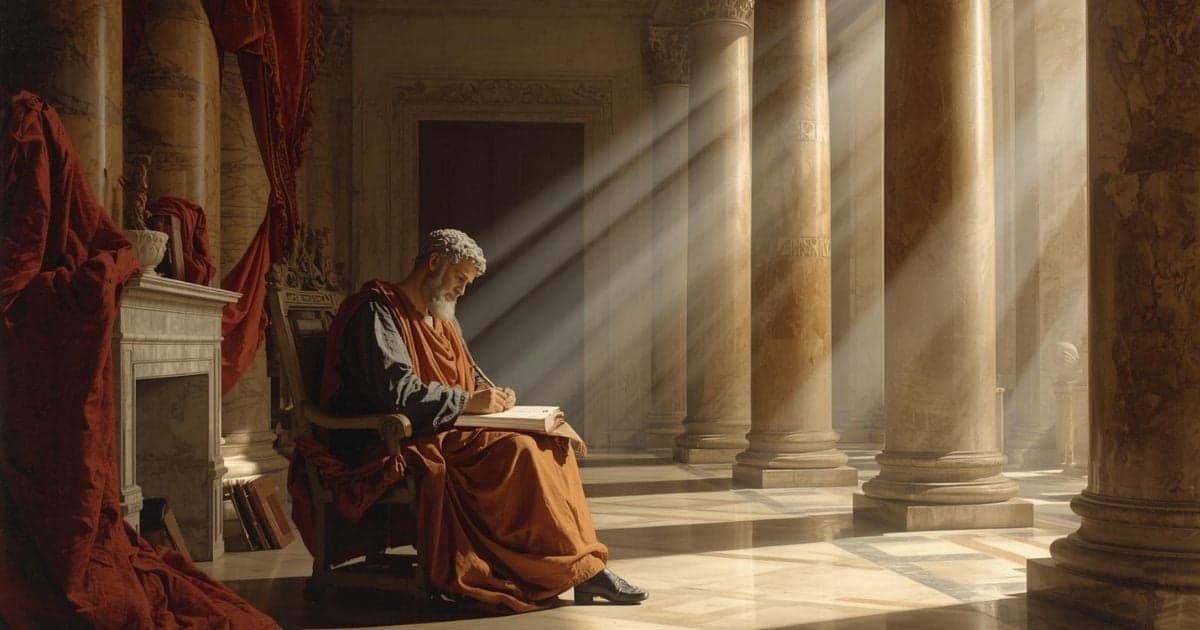
Marcus Aurelius, emperor of Rome from 161 to 180, writes twelve books of private notes to himself in Greek while campaigning on the Danube frontier during plague and war. Book I is a roll call of credit: his grandfather Verus for gentleness, his teacher Rusticus for handing him Epictetus and telling him his life needed correction, his adoptive father Antoninus Pius for ruling without vanity. The books that follow argue with a warm bed he does not want to leave, name an inner fortress that needs no travel, and return again and again to the dead, Alexander and his own mule-driver equally gone. He never meant the notebook for a reader. It is a record of a man catching himself slipping and starting again, until the final book asks what he is still deferring while there is time left to stop.
What readers search for
Twelve books of private notes Marcus Aurelius wrote to himself in Greek while campaigning on the Danube frontier in the late second century. Book I is a roll call of teachers: Verus, Rusticus with Epictetus, Antoninus governing without vanity. Later books argue with a warm bed, name the inner fortress that needs no seashore, and return to Hippocrates dying sick and Alexander gone like his mule-driver. The journal was never meant for publication. It is a man catching himself slipping and starting again.
Building Earned AuthorityNot a performance in a long robe. Marcus thanks Rusticus for telling him his life needed correction and for handing him Epictetus. The practice is ruling reason that will not become a slave to appetite, reputation, or other people's opinions; morning preparation before the idle and envious arrive; and the best revenge defined as not becoming like the people who wrong you. Power does not exempt him from the daily argument.
Separating What You ControlYour ruling reason, your judgments, and what you assent to. Book IV says the inner fortress is not a place you travel to: retreat into yourself if the principles are stored. Body, property, office, reputation, and other people's choices are not yours to command. Treat them as if they were and you will lament, find fault with gods and men, and spend the day on the wrong list.
Separating What You ControlAt Granua he writes the morning drill before the day begins: expect fools today; they act from ignorance; anger at them is as irrational as hating a stone for falling. Book I closes by naming the idle, the ungrateful, the envious, and the flatterers who want a show. The emperor does not pray for better company. He rehearses meeting them without rage.
Morning Preparation for Difficult PeopleThe dead keep returning: Hippocrates dies sick, Alexander and his mule-driver are both gone, Pompey and Caesar conquered towns and still died. Marcus does not use mortality as decoration. He uses it to shrink vanity, refuse panic, and ask what you keep deferring. The last book asks what is the present estate of your understanding and tells you to enjoy now whatever you have been putting off.
Facing Mortality Without PanicFast track
You do not have to read all 12 chapters in one sprint. These 8 beats hold the book's argument together.
Chapter 1
Roll call: Verus, Rusticus, Antoninus
Chapter 2
Time already delayed
Chapter 4
Inner fortress without the seashore
Chapter 5
Warm bed and a man's work
Chapter 6
Best revenge: not becoming like them
Chapter 8
Mastering the inner fortress
Chapter 10
Soul's journey to simplicity
Chapter 12
Final reflections and departure
Full coverage
The same surfaces readers expect from a traditional study guide — plot, characters, themes, quotes, and homework help — grouped across 3 parts, with audio and the source text on every chapter. Free, no paywall.
Plot overview
Summary, context, and why the book still matters
12 chapter summaries
Every chapter with audio narration
8 key figures
Who drives the plot and what each one does
6 lessons
Themes traced to scenes, not generic labels
15+ important quotes
Verified lines with chapter links and analysis
Discussion questions
Five per chapter, with suggested answers for class and essays
Original text
Author's words beside every summary
This is not a plot cheat sheet. Wide Reads walks Meditations as Marcus Aurelius's private journal on the frontier: a roll call of teachers, a morning drill before fools arrive, and the same argument with himself about leaving the bed. Use the book-by-book path below, follow the six lesson deep dives when a section hooks you, and open individual chapters for summaries, quotes, and audio.
For plot and theme questions about Meditations, see Common Questions on the book page.
How to use this guide
Read Book I (Chapter 1) for Verus, Rusticus handing him Epictetus, Antoninus governing without vanity, and the Granua morning drill. You need the receipt before the campaign notes can read as self-correction instead of performance.
Books II-VIII (Chapters 2-8) move from time running out through the inner fortress, the warm-bed argument, ruling reason, and the roll call of Alexander and the mule-driver. Book IV's retreat needs no seashore if the principles are already stored.
When a chapter raises a question you cannot shake, whether earned authority, what you control, difficult people at breakfast, mortality, or duty before dawn, jump to the matching lesson page, then return to the chapter list.
Plot & context
Before he writes a single victory, Marcus Aurelius lists the people who made him less vain. Grandfather Verus gets gentleness. Rusticus gets the copy of Epictetus. Antoninus Pius gets a ruler who works without a troop of guards. The notebook was written in Greek on the Danube frontier, late in the second century, while plague thinned the legions, and never meant for a reader. The emperor is trying to become a man he would still respect if the purple came off.
Marcus is Roman emperor from 161 to 180, last of the Five Good Emperors, writing notes he never meant anyone else to read. Antoninus Pius, his adoptive father, is the model of a ruler who works without vanity and never mistakes flattery for respect. Rusticus is the teacher who tells him his life needs correction, not performance, and hands him Epictetus. Grandfather Verus taught gentleness. His mother taught piety and a spare diet. Fronto showed him how envy and fraud run through courts. Each morning he prepares to meet the idle, the ungrateful, the envious, and the flatterers who want a show. The dead keep returning: Alexander and his mule-driver, Hippocrates, Socrates. Faustina is the wife he thanks the gods for. The only opponent who never leaves the page is himself.
Book One is a roll call: Verus, the tutors who kept him off circus factions, Rusticus giving him Epictetus and permission to stop playing the philosopher in a long robe, Antoninus governing with measure. At Granua he writes the morning drill: expect fools today; they act from ignorance; anger at them is as irrational as hating a stone for falling. Book Two asks how long he has already delayed the inner work. Book Four says the inner fortress is not a place you travel to: retreat into yourself if the principles are stored. Book Five is the warm-bed argument: you were born for a man's work; bees and ants already do theirs. Alexander and Pompey conquered towns and still died. The best revenge is not becoming like the people who wrong you. Waste no more time arguing what a good man should be. Be one. The last book asks what is the present estate of his understanding, and tells him to enjoy now whatever he keeps deferring.
Marcus never meant the notebook for an audience, and he never treats the repetition as failure. He writes the same pressures in different words: distraction, flattery, fear of death, rage at people who will not change, the temptation to dress virtue up instead of living it. Power does not exempt him from the morning argument. Philosophy composed for display fails. What remains is not a system. It is a picture of a man catching himself slipping and starting again, blunt and free of vanity, one day at a time.
Read the full summary on the book page →
People still arrive when power is mistaken for inner peace, when a curated morning routine replaces the harder work of meeting fools without rage, or when mortality is quoted for effect while the day stays unspent. Marcus never meant an audience. He writes the same pressures in different words: distraction, flattery, death, the temptation to dress virtue up instead of living it. This guide keeps the Danube journal tied to beds, legions, and arguments you can still recognise.
Marcus Aurelius (121-180 AD) was born Marcus Annius Verus in Rome, into a family already close to the imperial house. Antoninus Pius adopted him. He studied under Stoic teachers, including Rusticus, who introduced him to Epictetus, and he wrote the Meditations in Greek while campaigning on the Danube frontier during plague, war, and court intrigue. He ruled from 161 to 180, the last of the Five Good Emperors. The journal was never meant for publication: twelve books of notes to himself on virtue, mortality, and staying sane when power demands performance. His reign was marked by constant military pressure and the death of many of his children. The pages show not serenity performed for others but a man arguing with himself about leaving the bed and meeting fools without rage. His gift is refusing to write as if he had already arrived. He thanks teachers by name. He repeats himself because the day will ask the same thing tomorrow. He died on campaign. The notebook became one of the most used works of practical philosophy in the West, prized by readers who need discipline without theatre.
Themes with proof
Six pressures repeat across the twelve books: building earned authority by naming who actually shaped you before claiming any credit yourself, controlling the inner fortress that needs no travel or seashore, preparing each morning for people who will fail you before they arrive, separating what you control from what you do not, facing mortality without panic by sitting with the dead rather than avoiding them, and getting up to do the work when the bed is warm and duty is not optional. Each spoke ties named passages to the argument.
Credit Verus, Rusticus, and Antoninus by name: gentleness, Epictetus, and a ruler who never mistakes flattery for respect.
Of my grandfather Verus I have learned to be gentle and meek, and to refrain from all anger and passion.
Retreat into the mind Book Four trains: obstacles feed a strong fire, and you do not need the seashore if the principles are already stored.
At what time soever thou wilt, it is in thy power to retire into thyself, and to be at rest, and free…
Deep dives
Use the Granua drill before the day begins: expect the idle and the envious, and refuse to hate a stone for falling.
Betimes in the morning say to thyself, This day I shalt have to do with an idle curious man, with an unthankful…
Character guide
Who drives the plot, what each one wants, and why they matter to the argument of the book.
Roman emperor from 161 to 180 who writes in Greek to himself on campaign: not serenity performed for others but a man catching himself slipping and starting again.
Adoptive father and model ruler: works without a troop of guards, never mistakes flattery for respect, governs with measure.
Teacher who tells Marcus his life needs correction, not performance, and hands him Epictetus.
First name on the Book I roll call: gentleness and a refusal of anger.
Voice behind the journal through Rusticus: what is yours to command and what never was.
Wife Marcus thanks the gods for amid plague, war, and court intrigue.
Shows how envy and fraud run through courts; another teacher named without romance.
Recurring reminder that emperors and drivers alike are gone; the dead keep returning to shrink vanity.
Memorable lines
Verified passages with chapter links — the lines teachers and essays keep returning to.
“Of my grandfather Verus I have learned to be gentle and meek, and to refrain from all anger and passion.”
“To Rusticus I am beholding, that I first entered into the conceit that my life wanted some redress and cure.”
“Remember how long thou hast already put off these things, and how often a certain day and hour as it were, having been set unto thee by the gods, thou hast neglected it.”
“that those sins are greater which are committed through lust, than those which are committed through anger.”
“Spend not the remnant of thy days in thoughts and fancies concerning other men, when it is not in relation to some common good, when by it thou art hindered from some other better work.”
“if a man upon a sudden should ask thee, what it is that thou art now thinking, thou mayest answer This, and That, freely and boldly”
“Even as the fire when it prevails upon those things that are in his way; by which things indeed a little fire would have been quenched, but a great fire doth soon turn to its own nature, and so consume whatsoever comes in his way: yea by those very things it is made greater and greater.”
“At what time soever thou wilt, it is in thy power to retire into thyself, and to be at rest, and free from all businesses.”
“In the morning when thou findest thyself unwilling to rise, consider with thyself presently, it is to go about a man's work that I am stirred up.”
“As we say commonly, The physician hath prescribed unto this man, riding; unto another, cold baths; unto a third, to go barefoot: so it is alike to say, The nature of the universe hath prescribed unto this man sickness, or blindness, or some loss, or damage or some such thing.”
“The best kind of revenge is, not to become like unto them.”
“This is the carcass of a fish; this of a bird; and this of a hog.”
“What is wickedness? It is that which many time and often thou hast already seen and known in the world.”
“thou must propose it unto thyself, as the scaling of walls is unto a soldier.”
“let it suffice thee if all the rest of thy life, be it more or less, thou shalt live as thy nature requireth, or according to the true and natural end of thy making.”
Class & essay prep
Sample prompts drawn from the chapter guides — each with suggested answers for seminars and written work.
Why does Marcus Aurelius open Book I by thanking his grandfather Verus for gentleness and meekness rather than listing his own imperial achievements?
From Chapter 1What makes Rusticus's lesson that Marcus's life 'wanted some redress and cure' a turning point rather than just another entry on the gratitude list?
From Chapter 1In his opening challenge Marcus asks how long he has already put off inner work and missed the deadlines the gods set. Why does he treat delay itself as the first moral failure rather than waiting for a crisis?
From Chapter 2Marcus says you should go about every action as if it were your last, free from vanity and hypocrisy. What would actually change in your day if you treated one ordinary task that way?
From Chapter 2Marcus warns that your intellect may decay before you die, even while your body keeps functioning. Why does he treat mental sharpness as a separate deadline from physical death?
From Chapter 3Marcus finds beauty in cracked bread, wrinkling figs, and aging itself when you see how nature finishes things. How is that different from pretending decay does not matter?
From Chapter 3Marcus compares the disciplined mind to fire that grows from obstacles a small flame would not survive. What does that image say about strength under pressure versus avoiding difficulty?
From Chapter 4Marcus says you need no seashore or mountain retreat because you can withdraw into yourself at any moment if you have stored brief principles inside. What would those principles need to do when you call them up?
From Chapter 4Marcus talks himself out of bed by asking whether he was born to lie warm or to do a man's work while bees and ants perform what nature requires. Why is morning reluctance, for him, a vote against your own nature?
From Chapter 5Marcus describes three kinds of helpers: those who keep score, those who feel secretly owed, and those like the vine that bears fruit and moves on without applause. Which pattern do you most often use, and what does each cost?
From Chapter 5Marcus says do your duty whether you are praised or blamed, warm or cold, waking or dying, since death itself is one of life's actions. Why include death in the same list as ordinary daily tasks?
From Chapter 6Marcus strips luxury food, wine, and purple robes down to carcass, grape juice, and dyed wool so glamour cannot rule him. Where do you see status objects acquire false weight in your own environment?
From Chapter 6Marcus opens Book VII by asking what wickedness is and answering that it is what you have already seen many times in every age. Why does treating evil as familiar rather than unprecedented change how you respond to it?
From Chapter 7Marcus compares needing help to a soldier who cannot scale a wall alone but can with assistance, and says you should not be ashamed to accept it. Where do leaders today treat collaboration as weakness instead of completing the mission?
From Chapter 7Marcus admits he is incapable of the praise due a philosopher who lived that life from youth, and says fame is not worth chasing. What is left for him to pursue instead?
From Chapter 8Chapter by chapter
Grouped by 3 sections — the same structure as the book hub.
Chapters 1–3 · Teachers, time, discipline
The most powerful man in the known world opens his private journal not with victories but with debts. Marcus Aurelius lists everyone who taught him ho...
You keep telling yourself you will get serious about inner life later. Marcus confronts himself with a blunt question: how long have you already delay...
Your mind has an expiration date separate from your body. Marcus confronts himself with a second urgency beyond death: the intellect that lets you jud...
Chapters 4–8 · Inner fortress, duty, control
The inner fortress is not a place you travel to. A trained mind works like fire: obstacles that would quench a small flame feed a strong one, turning ...
The alarm finds Marcus unwilling to rise, and he talks himself through it. You were born for a man's work, not for a warm bed. Bees, trees, and ants e...
Chapters 9–12 · Nature, soul, departure
Marcus opens Book IX with a severe claim: to be unjust is to be impious. The universe made rational creatures for one another to help, more or less by...
Soul, one day you may be good, simple, single, content with providence and fit for gods and men alike. Until then live as nature requires: first as se...
The soul sees itself, orders itself, reaps its own fruit. Unlike dancers interrupted mid-act, it can finish whatever is in hand and depart saying, I h...
Using this guide
How to use Wide Reads for class, essays, and revision — and how this guide compares to traditional study sites.
Traditional study guides summarise Stoic ideas in the abstract. This guide keeps every idea tied to the passage that makes it: all twelve books, eight key figures, and Marcus's own structure from the debts of Book I to the final reflections of Book XII. Wide Reads adds Controlling the Inner Fortress and Getting Up and Doing the Work traced through named passages like the Granua morning drill and the warm-bed argument. Summaries include audio; the original text sits beside every book. Free, no paywall.
Meditations is rated intermediate difficulty. Our chapter-by-chapter analysis breaks down complex passages, explains historical context, and highlights key themes to make the text more accessible. Each chapter includes summaries, character analysis, and discussion questions to deepen your understanding.
Yes — use this reading guide alongside Meditations, not instead of it. Wide Reads exists to show you why the book still matters: lessons, chapter summaries with audio, and life skills you can carry into real life. That context can sharpen essays on themes, characters, and quotes. Always read Marcus Aurelius's original text, though. We are the guide at the trailhead; the classic is still the point.
Chapter 1 opens with names, not victories: grandfather, tutors, Rusticus with Epictetus, Antoninus working without vanity. Each chapter adds summaries, quotes, audio, and the Stoic drill that turns a private journal into a morning you can still use.
Plot, characters, and themes — plus audio, source text, and patterns you can use after class
Two ways in
Chapter by chapter, with audio. The meaning arrives because you experienced it — not because someone listed bullet points.
Start with this.
The actual words the author wrote, alongside every summary. Use the guide, then step into the source.
Then step into the source.
Either way, the door opens inward.
— and most of all, Why does this matter?
Guides, life skills, and the full library.More ways to read Meditations: guides, life skills, and the wider library.

Weekly insights from the classics. Amplify Your Mind.
We focus on public domain classics because these timeless works belong to everyone. No paywalls, no restrictions—just wisdom that has stood the test of centuries, freely accessible to all readers.
Public domain books have shaped humanity's understanding of love, justice, ambition, and the human condition. By amplifying these works, we help preserve and share literature that truly belongs to the world.
© 2026 Wide Reads™. All Rights Reserved.
Intelligence Amplifier™ and Wide Reads™ are proprietary trademarks of Arvin Lioanag.
Copyright Protection: All original content, analyses, discussion questions, pedagogical frameworks, and methodology are protected by U.S. and international copyright law. Unauthorized reproduction, distribution, web scraping, or use for AI training is strictly prohibited. See our Copyright Notice for details.
Disclaimer: The information provided on this website is for general informational and educational purposes only and does not constitute professional, legal, financial, or technical advice. While we strive to ensure accuracy and relevance, we make no warranties regarding completeness, reliability, or suitability. Any reliance on such information is at your own risk. We are not liable for any losses or damages arising from use of this site. By using this site, you agree to these terms.
Keep ruling reason from becoming a slave to appetite, reputation, or other people's opinions, and release what is not yours.
Remember how long thou hast already put off these things, and how often a certain day and hour as it were, having…
Matter is tractable; the rational essence governing it cannot do evil or be hurt. Marcus tells himself to keep doing duty whether he is praised or bla...
You may enjoy now whatever you keep deferring, if you stop envying yourself your own happiness. Forget the past. Entrust the future to Providence. Ben...