Chapter 72
When Suspicion Becomes Certainty
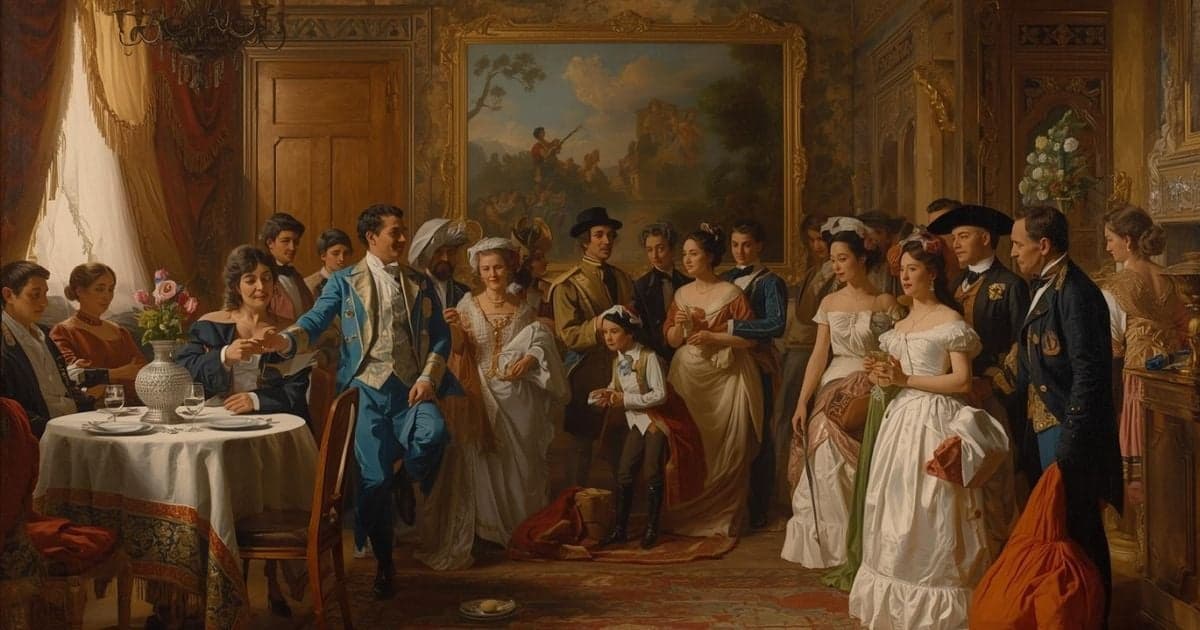
Pierre sat opposite Dólokhov and Nicholas Rostóv. As usual, he ate and drank much, and eagerly. But those who knew him intimately noticed that some great change had come over him that day. He was silent all through dinner and looked about, blinking and scowling, or, with fixed eyes and a look of complete absent-mindedness, kept rubbing the bridge of his nose. His face was depressed and gloomy. He seemed to see and hear nothing of what was going on around him and to be absorbed by some depressing and unsolved problem. The unsolved problem that tormented him was caused…
Public-domain chapter text, formatted for reading.
Master this chapter. Complete your experience
Purchase the complete book to access all chapters and support classic literature

Available in paperback, hardcover, and e-book formats
Now let's explore the literary elements.
Key Quotes & Analysis
"I challenge you!"
Context: After snatching the cantata from Dólokhov at dinner
Rage converts suspicion into irreversible public act.
In Today's Words:
Pierre shouts I challenge you and pushes back his chair. When shame finally needs an outlet, people pick the ritual their world understands instead of the conversation they avoided for months. Before you escalate, name whether you want truth or only relief from not knowing.
"How dare you take it?"
Context: He lunges when Dólokhov snatches the cantata sheet
A petty grab becomes the excuse for a challenge already loading.
In Today's Words:
Pierre shouts how dare you take it when Dólokhov grabs the paper at the club table. Small slights ignite when pride is already wounded in front of witnesses who will retell the scene. Notice which trigger you use to justify a fight you wanted before the object was ever touched.
"You shan’t have it!"
Context: He keeps the cantata sheet after Pierre reaches for it
Small theft triggers the explosion because pride was already loaded.
In Today's Words:
Dólokhov snatches the paper and says you shall not have it with a smile that dares Pierre to act. Petty provocations land hardest when you are already humiliated in front of the room. Notice which small insult you use as permission for a bigger break you wanted anyway before the evening began.
"For three minutes all had been ready, but they still delayed and all were silent."
Context: Closing image at the duel ground in Sokólniki
Machinery of honor runs while conscience still hesitates.
In Today's Words:
Everyone stands loaded in the mist while three minutes pass and nobody speaks. Formal fights feel inevitable once arranged even when every person there knows the cause is thin. If you are in that silence, ask who benefits from proceeding and who pays for the shot.
Thematic Threads
Gossip as Fuel
In This Chapter
Anonymous letter and cousin's hints make Pierre hear every toast as confirmation
Development
Moscow salon talk from earlier chapters turns private here
In Your Life:
You might replay old scenes after a rumor and treat memory as proof.
Honor Over Truth
In This Chapter
Challenge follows a snatched paper, not a confession from Hélène or Dólokhov
Development
Pierre's marriage crisis moves from doubt to duel form
In Your Life:
You might pick a public fight when a private question would actually answer you.
You now have the context. Time to form your own thoughts.
Discussion Questions
This is not a test. Five prompts guide you through the chapter, from how it opens to how it closes, so you notice context and rhythm rather than facts to memorize. Sit with each question in your own words. When you see "One way to read it," treat it as a starting point, not the only answer.
- 1
Why does Pierre challenge Dólokhov after the cantata quarrel rather than confront Hélène?
analysis • surfaceOne way to read it
The duel lets him act on suspicion without hearing his wife. Honor code offers a clearer script than marriage talk.
- 2
What does Dólokhov's advice about going to a duel with a will reveal about his mindset?
analysis • mediumOne way to read it
He treats killing intent as clarity and fear as defeat. He has made violence a discipline, not an accident.
- 3
When have you escalated a private doubt into a public confrontation?
application • mediumOne way to read it
Name the rumor and the trigger moment. Andrew maps the same shift from whisper to formal fight.
- 4
Why does Nesvítski urge Pierre to apologize while Pierre insists on proceeding?
application • deepOne way to read it
Nesvítski sees no insult worth blood. Pierre needs the duel to settle his inner verdict on Hélène.
- 5
What does the closing silence at Sokólniki suggest about duels of honor?
reflection • deepOne way to read it
Everyone is ready yet nobody speaks. Form can outrun conscience even when the cause is thin.
Critical Thinking Exercise
Track Your Certainty Pressure Points
Think of a current situation where you're feeling uncertain or suspicious about someone's behavior. Write down the actual facts you know versus the story you're telling yourself about those facts. Then identify what emotions are driving your need to 'know for sure' right now.
Consider:
- •Distinguish between what you've observed and what you've interpreted
- •Notice if your discomfort with uncertainty is pushing you toward hasty conclusions
- •Consider what you might lose by acting on assumptions versus waiting for clarity
Journaling Prompt
Write about a time when you jumped to conclusions because doubt felt too uncomfortable. What did you learn from that experience, and how might you handle similar uncertainty differently now?
Coming Up Next...
Chapter 73: The Duel's Aftermath
Dawn breaks over the snowy forest as Pierre and Dólokhov stand with loaded pistols. Pierre has never held a gun before, while Dólokhov treats the duel like a hunt. The next chapter reveals who walks away and what the aftermath costs.