Wide Reads
Literature MattersLife IndexEducators
Sign in
Where to Begin
War and Peace - The Household's Many Worlds

Leo Tolstoy

War and Peace

The Household's Many Worlds

Home›Books›War and Peace›Chapter 349
Previous
349 of 361
Next

Summary

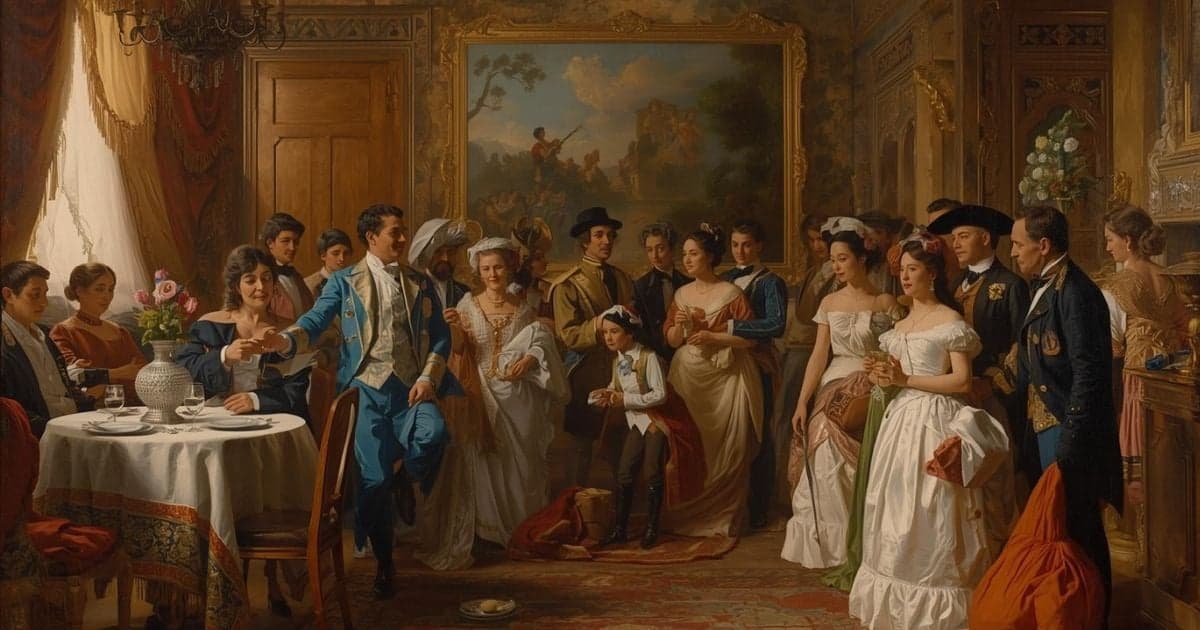
Pierre returns to Bald Hills, and Tolstoy shows us how one event - his homecoming - means something different to everyone in the household. The servants are happy because Pierre's presence improves Nicholas's mood and means holiday gifts. The children love him because he brings fun and presents. Young Nicholas adores Pierre as a hero figure, seeing in him the wisdom and kindness he wants to embody. The guests appreciate how Pierre brings people together. Even Pierre has learned to navigate these different expectations, carefully buying gifts for everyone and finding unexpected joy in family responsibilities. The chapter then shifts to the old countess, now over sixty and fundamentally changed by grief. Tolstoy presents a brutally honest portrait of aging: she no longer lives with purpose but simply exercises her bodily functions - eating, sleeping, talking, getting angry - because her body requires it. Her irritability with her companion Belova, her need for routine activities like card games, all serve as outlets for basic physical and mental needs rather than meaningful engagement with life. The family understands her condition without speaking of it, showing her patience and care while recognizing she represents what they will all become. This chapter reveals how the same household contains multiple realities and how we must adapt our understanding to each person's stage of life and perspective.

Coming Up in Chapter 350

The family dynamics continue to unfold as we see more of how this multi-generational household navigates the complex web of relationships and changing needs that bind them together.

Share it with friends

Previous ChapterNext Chapter
GO ADS FREE — JOIN US
Original text
complete·1,806 words
A

s in every large household, there were at Bald Hills several perfectly distinct worlds which merged into one harmonious whole, though each retained its own peculiarities and made concessions to the others. Every event, joyful or sad, that took place in that house was important to all these worlds, but each had its own special reasons to rejoice or grieve over that occurrence independently of the others.

For instance, Pierre’s return was a joyful and important event and they all felt it to be so.

The servants—the most reliable judges of their masters because they judge not by their conversation or expressions of feeling but by their acts and way of life—were glad of Pierre’s return because they knew that when he was there Count Nicholas would cease going every day to attend to the estate, and would be in better spirits and temper, and also because they would all receive handsome presents for the holidays.

1 / 11

Master this chapter. Complete your experience

Purchase the complete book to access all chapters and support classic literature

Read Free on GutenbergBuy at Powell'sBuy on Amazon

As an Amazon Associate, we earn a small commission from qualifying purchases at no additional cost to you.

Available in paperback, hardcover, and e-book formats

GO ADS FREE — JOIN US

Why This Matters

Connect literature to life

Skill: Reading Multiple Perspectives

This chapter teaches how to recognize that every situation contains multiple simultaneous realities based on each person's needs and circumstances.

Practice This Today

This week, notice when you're in a group situation and try to identify what each person actually needs or fears—you'll start seeing why they react so differently to the same events.

GO ADS FREE — JOIN US

Now let's explore the literary elements.

Key Quotes & Analysis

"The servants—the most reliable judges of their masters because they judge not by their conversation or expressions of feeling but by their acts and way of life"

— Narrator

Context: Explaining why the servants are happy about Pierre's return

Tolstoy points out that those who serve us often understand us better than our peers because they see our actual behavior, not our public face. Actions reveal character more than words.

In Today's Words:

The people who work for you know who you really are because they see how you act when you think no one important is watching.

"He alone could play on the clavichord that écossaise (his only piece) to which, as he said, all possible dances could be danced"

— Narrator

Context: Describing why the children love Pierre's visits

Pierre's limited musical skill doesn't matter because he brings joy and connection. Sometimes enthusiasm and willingness to participate matter more than talent.

In Today's Words:

He was the only adult who would actually get up and play music with them, even though he only knew one song.

"She did not live, she merely exercised her bodily functions"

— Narrator

Context: Describing the old countess's current state of existence

A brutally honest assessment of how aging and grief can reduce life to basic biological processes without meaning or joy. Tolstoy doesn't romanticize old age.

In Today's Words:

She wasn't really living anymore, just going through the motions because her body kept her alive.

Thematic Threads

Perspective

In This Chapter

Pierre's homecoming means something completely different to each household member based on their individual needs and circumstances

Development

Builds on earlier themes of how social position shapes worldview, now showing how personal circumstances create entirely different realities

In Your Life:

You might notice how the same workplace change affects each colleague differently based on their personal situation and career stage

Aging

In This Chapter

The countess has transformed from purposeful matriarch to someone whose body simply exercises its functions without meaningful engagement

Development

Introduced here as Tolstoy examines how aging changes fundamental relationship to life and purpose

In Your Life:

You might recognize this pattern in elderly relatives who seem irritable or demanding because basic functions have replaced meaningful goals

Adaptation

In This Chapter

Pierre has learned to navigate different expectations, buying appropriate gifts and finding joy in responsibilities he once avoided

Development

Continues Pierre's growth from awkward outsider to someone who understands social dynamics and family obligations

In Your Life:

You might see how you've learned to adapt your behavior to different family members' needs and expectations during visits or gatherings

Unspoken Understanding

In This Chapter

The family recognizes the countess's condition without discussing it, showing patience while acknowledging the reality of her decline

Development

Builds on themes of how families develop implicit communication systems and shared knowledge about difficult truths

In Your Life:

You might notice how your family handles a relative's declining abilities or changing personality without directly addressing the changes

Role Fulfillment

In This Chapter

Each person in the household has found their role in relation to Pierre's presence, from servants to children to guests

Development

Continues exploration of how people define themselves through their function within social and family systems

In Your Life:

You might recognize how you automatically fall into certain roles when returning to your childhood home or joining established social groups

GO ADS FREE — JOIN US

You now have the context. Time to form your own thoughts.

Discussion Questions

  1. 1

    Why does Pierre's return mean something completely different to each person in the household?

    analysis • surface
  2. 2

    What does the old countess's condition reveal about how aging changes our relationship to purpose and meaning?

    analysis • medium
  3. 3

    Where do you see this pattern of 'multiple realities in one situation' playing out in your workplace or family?

    application • medium
  4. 4

    How could understanding different perspectives help you navigate a current challenging relationship or situation?

    application • deep
  5. 5

    What does this chapter suggest about how we should approach people who seem difficult or unreasonable?

    reflection • deep

Critical Thinking Exercise

10 minutes

Map the Multiple Realities

Think of a recent situation where you felt frustrated because others didn't see things your way. Write down that situation, then list at least three other people involved and what reality they might have been operating from based on their current needs, pressures, or life stage. Consider what they might have been worried about or hoping for that was completely different from your concerns.

Consider:

  • •Focus on their actual circumstances and pressures, not whether you think they're right or wrong
  • •Consider their age, responsibilities, and what they have at stake in the situation
  • •Think about what success or failure means to them specifically, not to you

Journaling Prompt

Write about a time when you later realized someone's 'difficult' behavior made perfect sense from their perspective. What changed your understanding, and how might you handle similar situations differently now?

GO ADS FREE — JOIN US

Coming Up Next...

Chapter 350: The Comfort of Coming Home

The family dynamics continue to unfold as we see more of how this multi-generational household navigates the complex web of relationships and changing needs that bind them together.

Continue to Chapter 350
Previous
Pierre Returns Home to Love and Reproach
Contents
Next
The Comfort of Coming Home

Continue Exploring

War and Peace Study GuideTeaching ResourcesEssential Life IndexBrowse by ThemeAll Books
Power & CorruptionLove & RelationshipsIdentity & Self-Discovery

You Might Also Like

Anna Karenina cover

Anna Karenina

Leo Tolstoy

Also by Leo Tolstoy

The Idiot cover

The Idiot

Fyodor Dostoevsky

Explores love & romance

Moby-Dick cover

Moby-Dick

Herman Melville

Explores mortality & legacy

Dracula cover

Dracula

Bram Stoker

Explores love & romance

Browse all 47+ books

Share This Chapter

Know someone who'd enjoy this? Spread the wisdom!

TwitterFacebookLinkedInEmail

Read ad-free with Prestige

Get rid of ads, unlock study guides and downloads, and support free access for everyone.

Subscribe to PrestigeCreate free account
Intelligence Amplifier
Intelligence Amplifier™Powering Wide Reads

Exploring human-AI collaboration through books, essays, and philosophical dialogues. Classic literature transformed into navigational maps for modern life.

2025 Books

→ The Amplified Human Spirit→ The Alarming Rise of Stupidity Amplified→ San Francisco: The AI Capital of the World
Visit intelligenceamplifier.org
hello@widereads.com

WideReads Originals

→ You Are Not Lost→ The Last Chapter First→ The Lit of Love→ Wealth and Poverty→ 10 Paradoxes in the Classics · coming soon
Arvintech
arvintechAmplify your Mind
Visit at arvintech.com

Navigate

  • Home
  • Library
  • Essential Life Index
  • How It Works
  • Subscribe
  • Account
  • About
  • Contact
  • Authors
  • Suggest a Book
  • Landings

Made For You

  • Students
  • Educators
  • Families
  • Readers
  • Literary Analysis
  • Finding Purpose
  • Letting Go
  • Recovering from a Breakup
  • Corruption
  • Gaslighting in the Classics

Newsletter

Weekly insights from the classics. Amplify Your Mind.

Legal

  • Privacy Policy
  • Terms of Service
  • Cookie Policy
  • Accessibility

Why Public Domain?

We focus on public domain classics because these timeless works belong to everyone. No paywalls, no restrictions—just wisdom that has stood the test of centuries, freely accessible to all readers.

Public domain books have shaped humanity's understanding of love, justice, ambition, and the human condition. By amplifying these works, we help preserve and share literature that truly belongs to the world.

A Pilgrimage

Powell's City of Books

Portland, Oregon

If you ever find yourself in Portland, walk to the corner of Burnside and 10th. The building takes up an entire city block. Inside is over a million books, new and used on the same shelf, organized by color-coded rooms with names like the Rose Room and the Pearl Room. You can lose an afternoon. You can lose a weekend. You will find a book you have been looking for your whole life, and three you did not know existed.

It is a pilgrimage. We cannot find a bookstore like it anywhere on earth. If you read the classics, and you ever get the chance, go. It belongs on every reader's bucket list.

Visit powells.com

We are not in any way affiliated with Powell's. We are just a very big fan.

© 2026 Wide Reads™. All Rights Reserved.

Intelligence Amplifier™ and Wide Reads™ are proprietary trademarks of Arvin Lioanag.

Copyright Protection: All original content, analyses, discussion questions, pedagogical frameworks, and methodology are protected by U.S. and international copyright law. Unauthorized reproduction, distribution, web scraping, or use for AI training is strictly prohibited. See our Copyright Notice for details.

Disclaimer: The information provided on this website is for general informational and educational purposes only and does not constitute professional, legal, financial, or technical advice. While we strive to ensure accuracy and relevance, we make no warranties regarding completeness, reliability, or suitability. Any reliance on such information is at your own risk. We are not liable for any losses or damages arising from use of this site. By using this site, you agree to these terms.