Master this chapter. Complete your experience
Purchase the complete book to access all chapters and support classic literature

As an Amazon Associate, we earn a small commission from qualifying purchases at no additional cost to you.
Available in paperback, hardcover, and e-book formats
Why This Matters
Connect literature to life
This chapter teaches how to distinguish between spaces that welcome authenticity and those that require performance.
Practice This Today
This week, notice when someone changes the subject after you share something real - are you disrupting a performance, or are they genuinely uncomfortable with depth?
Now let's explore the literary elements.
Key Quotes & Analysis
"As a clever maître d'hôtel serves up as a specially choice delicacy a piece of meat that no one who had seen it in the kitchen would have cared to eat, so Anna Pávlovna served up to her guests, first the vicomte and then the abbé, as peculiarly choice morsels."
Context: Describing how Anna Pávlovna presents her guests as entertainment
This reveals how social gatherings among the elite work like theater productions. People become commodities to be consumed for entertainment, and the hostess is like a director managing the show.
In Today's Words:
Anna packaged her guests like a restaurant server hyping up the daily special - making them sound way more interesting than they actually were.
"The Duc d'Enghien had perished by his own magnanimity, and there were particular reasons for Bonaparte's hatred of him."
Context: Telling his story about Napoleon's political murder
This shows how the aristocrats view Napoleon - as someone who repays mercy with murder. It reveals their fear and moral judgment of the man who threatens their entire way of life.
In Today's Words:
The Duke died because he was too noble for his own good, and Napoleon had personal reasons to hate him.
"Do tell us all about it, Vicomte!"
Context: Encouraging the Vicomte to tell his Napoleon story
Anna knows exactly how to draw out her guests and create the entertainment her other guests expect. She's managing the social experience like a skilled host.
In Today's Words:
Come on, tell us the whole story!
Thematic Threads
Social Performance
In This Chapter
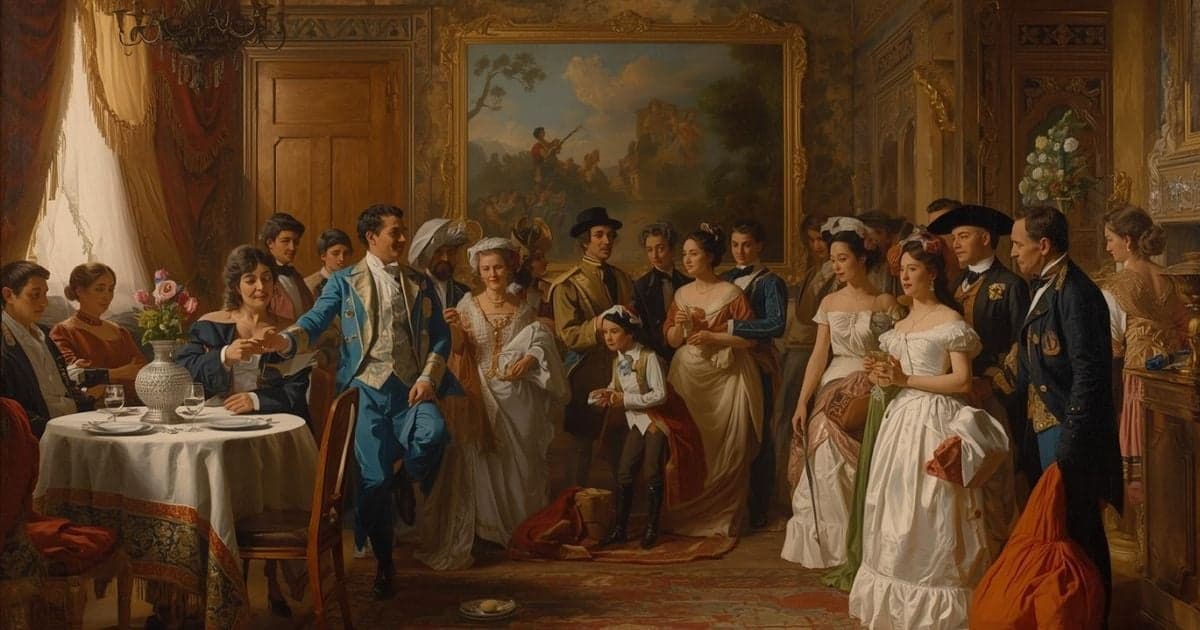
Anna Pavlovna orchestrates her salon like theater, with guests as both actors and audience playing predetermined roles
Development
Introduced here as a central mechanism of high society
In Your Life:
You might recognize this in workplace meetings where everyone performs agreement instead of sharing real concerns
Authentic vs. Performed Identity
In This Chapter
Pierre's genuine political passion contrasts sharply with Helene's calculated beauty and the Vicomte's polished storytelling
Development
Building on Pierre's earlier social awkwardness, now showing why authenticity threatens social systems
In Your Life:
You face this choice daily between showing your real self and performing the version others expect
Power Through Control
In This Chapter
Anna Pavlovna maintains her position by controlling who speaks when and what topics are allowed
Development
Introduced here as subtle social manipulation disguised as hospitality
In Your Life:
You might see this in family dynamics where one person controls conversations to maintain their authority
Class Expectations
In This Chapter
Everyone knows their role in this social hierarchy and performs it flawlessly except for Pierre
Development
Expanding from earlier chapters to show how class expectations shape behavior in group settings
In Your Life:
You navigate similar unspoken rules about how to act in different social or professional circles
The Danger of Genuine Engagement
In This Chapter
Pierre's earnest discussion threatens the salon's artificial harmony and must be quickly redirected
Development
Introduced here as a key conflict between individual authenticity and group cohesion
In Your Life:
You might hesitate to raise real concerns at work or home because it would disrupt the comfortable fiction everyone maintains
You now have the context. Time to form your own thoughts.
Discussion Questions
- 1
How does Anna Pavlovna control the flow of conversation at her salon, and what happens when Pierre tries to have a genuine political discussion?
analysis • surface - 2
Why does Anna Pavlovna see Pierre's passionate discussion as a threat to her carefully orchestrated gathering?
analysis • medium - 3
Where have you seen this pattern of performed conversations versus authentic discussions in your own life - at work, family gatherings, or social events?
application • medium - 4
When you find yourself in a group that values performance over authenticity, how do you decide whether to play along or speak your truth?
application • deep - 5
What does this chapter reveal about why some groups resist genuine emotion or honest discussion, and how does this help us understand power dynamics in social settings?
reflection • deep
Critical Thinking Exercise
Decode the Social Theater
Think of a recent social or work situation where you felt like everyone was performing rather than being genuine. Map out the 'roles' people were playing and identify who was directing the performance. What topics were off-limits? What would have happened if someone had broken character and gotten real?
Consider:
- •Notice who has the power to change topics or redirect conversations
- •Identify what the group is protecting by maintaining the performance
- •Consider the costs and benefits of authentic versus performed interactions
Journaling Prompt
Write about a time when you chose to be authentic in a situation that called for performance, or when you played a role to keep the peace. What did you learn about yourself and the group dynamics?
Coming Up Next...
Chapter 4: The Art of Social Leverage
Pierre's political enthusiasm continues to worry Anna Pávlovna, who must find new ways to manage her unruly guest. Meanwhile, the carefully maintained social harmony faces fresh challenges.