Wide Reads
Literature MattersLife IndexEducators
Sign in
Where to Begin
War and Peace - The Theater of Social Performance

Leo Tolstoy

War and Peace

The Theater of Social Performance

Home›Books›War and Peace›Chapter 153
Previous
153 of 361
Next

Summary

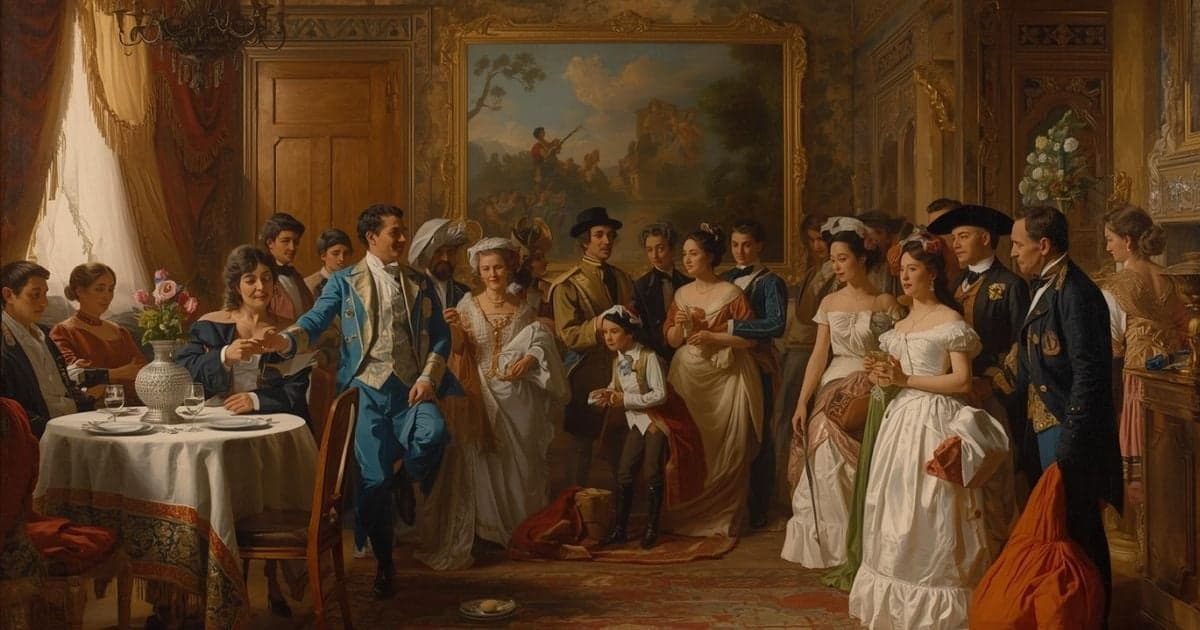
Natasha reluctantly attends the opera with the Rostovs, her heart heavy with longing for Prince Andrew. Despite looking beautiful, she feels a bittersweet sadness, wishing he could see her now when she feels ready to love him properly. At the theater, she becomes acutely aware of being watched and judged by Moscow society, who all know about her engagement and are curious about this girl making one of Russia's best matches. The opera house becomes a social fishbowl where everyone observes everyone else. Natasha spots Boris with his new fiancée Julie, realizing they're probably discussing her, but tells herself she doesn't care. She also notices the scandalous Dolokhov, recently returned from adventures in Persia, who has become the talk of Moscow society. When the beautiful Countess Bezukhova (Pierre's wife Helene) arrives, Natasha admires her stunning appearance while feeling her own emotional turmoil. The chapter captures how public spaces can amplify private pain, and how we perform social roles even when our hearts are elsewhere. Tolstoy shows us how society functions as theater, where everyone is simultaneously audience and performer, and how young people navigate the complex dance of social expectations while dealing with their own inner struggles.

Coming Up in Chapter 154

As the curtain rises and the opera begins, Natasha will find herself drawn into the performance on stage, but the real drama may be unfolding in the audience around her.

Share it with friends

Previous ChapterNext Chapter
GO ADS FREE — JOIN US
Original text
complete·1,458 words
T

hat evening the Rostóvs went to the Opera, for which Márya Dmítrievna had taken a box.

Natásha did not want to go, but could not refuse Márya Dmítrievna’s kind offer which was intended expressly for her. When she came ready dressed into the ballroom to await her father, and looking in the large mirror there saw that she was pretty, very pretty, she felt even more sad, but it was a sweet, tender sadness.

1 / 10

Master this chapter. Complete your experience

Purchase the complete book to access all chapters and support classic literature

Read Free on GutenbergBuy at Powell'sBuy on Amazon

As an Amazon Associate, we earn a small commission from qualifying purchases at no additional cost to you.

Available in paperback, hardcover, and e-book formats

GO ADS FREE — JOIN US

Why This Matters

Connect literature to life

Skill: Reading Social Undercurrents

This chapter teaches how to recognize the complex web of observation, judgment, and performance that operates in any social gathering.

Practice This Today

This week, notice when you feel 'watched' in public spaces—is it your emotional state amplifying normal social dynamics, or are people actually paying unusual attention to your situation?

GO ADS FREE — JOIN US

Now let's explore the literary elements.

Key Quotes & Analysis

"O God, if he were here now I would not behave as I did then, but differently. I would not be silly and afraid of things, I would simply embrace him, cling to him, and make him look at me with those searching inquiring eyes."

— Natasha (thinking)

Context: She's looking at herself in the mirror before going to the opera, wishing Prince Andrew could see her now

This shows how we often think we'd handle past situations better with hindsight. Natasha regrets being shy or uncertain before and wishes she could show Prince Andrew how much she's grown emotionally.

In Today's Words:

If he was here right now, I wouldn't play games or act scared - I'd just be real with him and show him exactly how I feel.

"I can't bear this waiting and I shall cry in a minute!"

— Natasha (thinking)

Context: She's trying not to think about Prince Andrew while getting ready for the opera

This captures the agony of uncertainty in relationships - not knowing when or if someone will return to your life. The waiting becomes almost unbearable, especially when you have to keep functioning normally.

In Today's Words:

This waiting is killing me and I'm about to lose it completely.

"And how can Sónya love Nicholas so calmly and quietly and wait so long and so patiently?"

— Natasha (thinking)

Context: She's comparing her own intense emotions to her cousin Sonya's steady, patient love

Natasha is learning that people love differently - some with passionate intensity, others with quiet steadiness. She's questioning whether her dramatic emotions are normal or if she should be more like Sonya.

In Today's Words:

How does Sonya make loving Nicholas look so easy and drama-free when I'm over here falling apart?

Thematic Threads

Social Performance

In This Chapter

Natasha must perform normalcy at the opera while her heart aches for Prince Andrew, aware that all of Moscow society is watching and judging her

Development

Builds on earlier themes of social expectations, now showing how public spaces become stages for private pain

In Your Life:

You might recognize this when you have to attend work meetings or family gatherings while dealing with personal crisis, feeling like everyone's watching how you handle it

Emotional Vulnerability

In This Chapter

Natasha's longing for Prince Andrew makes her hypersensitive to social dynamics and others' perceptions of her engagement

Development

Her emotional journey deepens from earlier innocent attraction to mature understanding of love's complexities

In Your Life:

This appears when major life changes—divorce, job loss, health scares—make you feel exposed and transparent in public settings

Class Observation

In This Chapter

The opera house functions as a social observatory where different levels of society watch and judge each other's behavior and choices

Development

Continues Tolstoy's exploration of how class structures create constant surveillance and performance pressure

In Your Life:

You see this at any gathering where social status matters—work parties, school events, community functions—where people size each other up

Identity Formation

In This Chapter

Natasha navigates who she is becoming while under public scrutiny, balancing her private feelings with social expectations

Development

Her character development shows the tension between authentic self and social role

In Your Life:

This emerges whenever you're transitioning—new job, new relationship, new community—and must figure out how to present yourself while still becoming who you are

Power of Reputation

In This Chapter

Characters like Dolokhov and Helene command attention through their reputations, showing how public perception creates social influence

Development

Expands on earlier themes about how reputation shapes opportunities and social positioning

In Your Life:

You encounter this in workplace dynamics, neighborhood politics, or online spaces where certain people's opinions carry more weight due to their established reputation

GO ADS FREE — JOIN US

You now have the context. Time to form your own thoughts.

Discussion Questions

  1. 1

    Why does Natasha feel like everyone at the opera is watching and judging her, even though she's just sitting with her family?

    analysis • surface
  2. 2

    How does Natasha's heartache over Prince Andrew change the way she experiences being in public?

    analysis • medium
  3. 3

    When have you felt like everyone was staring at you during a difficult time in your life? What made that feeling so intense?

    application • medium
  4. 4

    If you were Natasha's friend, how would you help her get through this public appearance when she's feeling so emotionally raw?

    application • deep
  5. 5

    What does this scene reveal about how our inner emotional state affects how we see the world around us?

    reflection • deep

Critical Thinking Exercise

10 minutes

Map Your Theater of Pain

Think of a time when you were going through something difficult and had to appear in public - work, family gathering, school event. Draw or write about that experience from two perspectives: how you felt everyone was watching you, and how things probably actually looked to others. Notice the difference between your internal experience and external reality.

Consider:

  • •Remember that most people are focused on their own concerns, not analyzing yours
  • •Consider which people in that situation actually mattered to your wellbeing
  • •Think about what support or preparation might have helped you feel less exposed

Journaling Prompt

Write about a current situation where you feel like you're performing for an audience. What would change if you focused only on the people who truly matter to your life?

Coming Up Next...

Chapter 154: The Seductive Power of Performance

As the curtain rises and the opera begins, Natasha will find herself drawn into the performance on stage, but the real drama may be unfolding in the audience around her.

Continue to Chapter 154
Previous
When First Impressions Go Wrong
Contents
Next
The Seductive Power of Performance

Continue Exploring

War and Peace Study GuideTeaching ResourcesEssential Life IndexBrowse by ThemeAll Books
Power & CorruptionLove & RelationshipsIdentity & Self-Discovery

You Might Also Like

Anna Karenina cover

Anna Karenina

Leo Tolstoy

Also by Leo Tolstoy

The Idiot cover

The Idiot

Fyodor Dostoevsky

Explores love & romance

Moby-Dick cover

Moby-Dick

Herman Melville

Explores mortality & legacy

Dracula cover

Dracula

Bram Stoker

Explores love & romance

Browse all 47+ books

Share This Chapter

Know someone who'd enjoy this? Spread the wisdom!

TwitterFacebookLinkedInEmail

Read ad-free with Prestige

Get rid of ads, unlock study guides and downloads, and support free access for everyone.

Subscribe to PrestigeCreate free account
Intelligence Amplifier
Intelligence Amplifier™Powering Wide Reads

Exploring human-AI collaboration through books, essays, and philosophical dialogues. Classic literature transformed into navigational maps for modern life.

2025 Books

→ The Amplified Human Spirit→ The Alarming Rise of Stupidity Amplified→ San Francisco: The AI Capital of the World
Visit intelligenceamplifier.org
hello@widereads.com

WideReads Originals

→ You Are Not Lost→ The Last Chapter First→ The Lit of Love→ Wealth and Poverty→ 10 Paradoxes in the Classics · coming soon
Arvintech
arvintechAmplify your Mind
Visit at arvintech.com

Navigate

  • Home
  • Library
  • Essential Life Index
  • How It Works
  • Subscribe
  • Account
  • About
  • Contact
  • Authors
  • Suggest a Book
  • Landings

Made For You

  • Students
  • Educators
  • Families
  • Readers
  • Literary Analysis
  • Finding Purpose
  • Letting Go
  • Recovering from a Breakup
  • Corruption
  • Gaslighting in the Classics

Newsletter

Weekly insights from the classics. Amplify Your Mind.

Legal

  • Privacy Policy
  • Terms of Service
  • Cookie Policy
  • Accessibility

Why Public Domain?

We focus on public domain classics because these timeless works belong to everyone. No paywalls, no restrictions—just wisdom that has stood the test of centuries, freely accessible to all readers.

Public domain books have shaped humanity's understanding of love, justice, ambition, and the human condition. By amplifying these works, we help preserve and share literature that truly belongs to the world.

A Pilgrimage

Powell's City of Books

Portland, Oregon

If you ever find yourself in Portland, walk to the corner of Burnside and 10th. The building takes up an entire city block. Inside is over a million books, new and used on the same shelf, organized by color-coded rooms with names like the Rose Room and the Pearl Room. You can lose an afternoon. You can lose a weekend. You will find a book you have been looking for your whole life, and three you did not know existed.

It is a pilgrimage. We cannot find a bookstore like it anywhere on earth. If you read the classics, and you ever get the chance, go. It belongs on every reader's bucket list.

Visit powells.com

We are not in any way affiliated with Powell's. We are just a very big fan.

© 2026 Wide Reads™. All Rights Reserved.

Intelligence Amplifier™ and Wide Reads™ are proprietary trademarks of Arvin Lioanag.

Copyright Protection: All original content, analyses, discussion questions, pedagogical frameworks, and methodology are protected by U.S. and international copyright law. Unauthorized reproduction, distribution, web scraping, or use for AI training is strictly prohibited. See our Copyright Notice for details.

Disclaimer: The information provided on this website is for general informational and educational purposes only and does not constitute professional, legal, financial, or technical advice. While we strive to ensure accuracy and relevance, we make no warranties regarding completeness, reliability, or suitability. Any reliance on such information is at your own risk. We are not liable for any losses or damages arising from use of this site. By using this site, you agree to these terms.