Wide Reads
Literature MattersLife IndexEducators
Sign in
Where to Begin
War and Peace - First Kiss in the Conservatory

Leo Tolstoy

War and Peace

First Kiss in the Conservatory

Home›Books›War and Peace›Chapter 13
Previous
13 of 361
Next

Summary

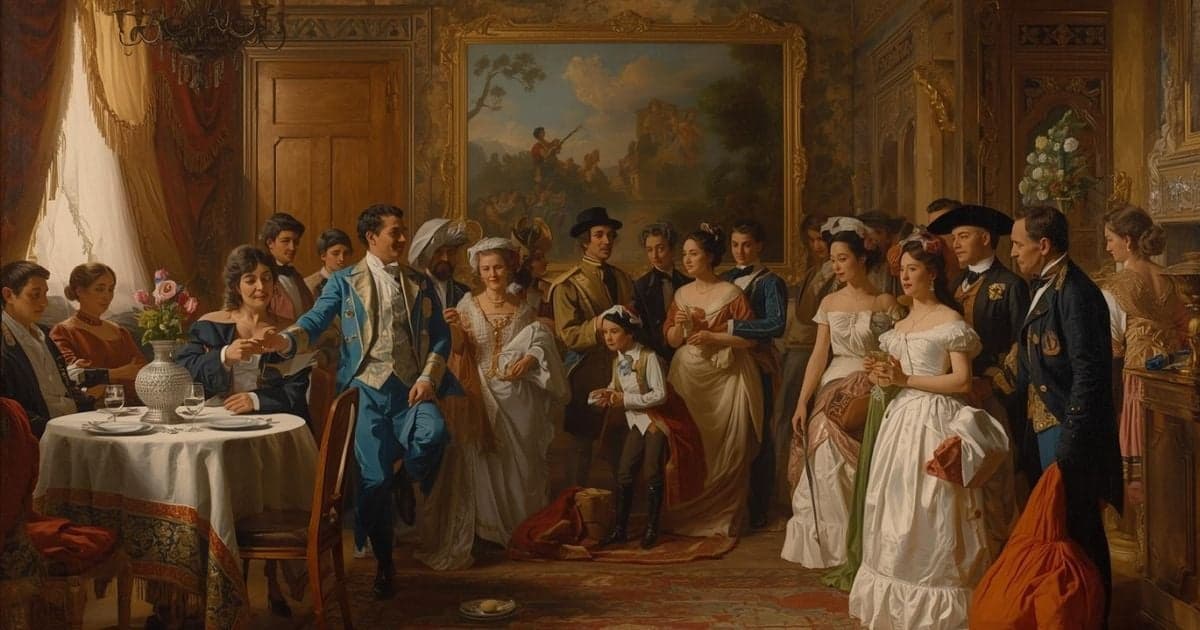
Thirteen-year-old Natasha hides in the conservatory and becomes an invisible witness to adult drama. She watches her cousin Sonya cry over Nicholas, then sees him comfort and kiss her, declaring his love. This scene of adult romance captivates Natasha completely. Inspired by what she's witnessed, she immediately seeks out Boris and recreates the scenario, leading him to the same spot and asking him to kiss her. Their childhood 'engagement' follows the adult template she just observed—Boris promises to marry her in four years when she's older. Tolstoy reveals how children absorb and mirror the emotional patterns of adults around them, often without fully understanding the weight of what they're copying. Natasha's behavior shows the natural human tendency to want what we see others having, and how powerful the role of observer can be. The conservatory becomes a stage where childhood innocence meets the first stirrings of romantic awareness. This chapter captures that pivotal moment when children begin experimenting with adult emotions and relationships, using the scripts they've witnessed. It's both sweet and slightly unsettling, showing how quickly children can move from watching to participating, often with a seriousness that mirrors but doesn't quite match adult understanding.

Coming Up in Chapter 14

The consequences of childhood promises begin to unfold as the adult world intrudes on these innocent games. The weight of expectations and social obligations starts to press down on even the youngest members of the household.

Share it with friends

Previous ChapterNext Chapter
GO ADS FREE — JOIN US
Original text
complete·726 words
W

hen Natásha ran out of the drawing room she only went as far as the conservatory. There she paused and stood listening to the conversation in the drawing room, waiting for Borís to come out. She was already growing impatient, and stamped her foot, ready to cry at his not coming at once, when she heard the young man’s discreet steps approaching neither quickly nor slowly. At this Natásha dashed swiftly among the flower tubs and hid there.

1 / 5

Master this chapter. Complete your experience

Purchase the complete book to access all chapters and support classic literature

Read Free on GutenbergBuy at Powell'sBuy on Amazon

As an Amazon Associate, we earn a small commission from qualifying purchases at no additional cost to you.

Available in paperback, hardcover, and e-book formats

GO ADS FREE — JOIN US

Why This Matters

Connect literature to life

Skill: Detecting Performed Emotion

This chapter teaches how to distinguish between genuine feelings and borrowed emotional scripts that people copy from others.

Practice This Today

This week, notice when someone's reaction seems too perfectly scripted—are they feeling it, or performing what they think the situation requires?

GO ADS FREE — JOIN US

Now let's explore the literary elements.

Key Quotes & Analysis

"She was experiencing a new and peculiar pleasure."

— Narrator

Context: When Natasha realizes she can watch the adult drama unfold without being seen

This captures the intoxicating power of being an unseen observer. Natasha discovers she can learn about adult emotions and relationships by watching secretly, giving her knowledge and a sense of control she's never had before.

In Today's Words:

She was getting a rush from being able to spy on the grown-ups.

"Let him look for me."

— Natasha

Context: When she decides not to call out to Boris but to stay hidden instead

This shows Natasha's first taste of romantic strategy and power. She's learning that withholding attention can be as powerful as giving it, a lesson she's absorbed from watching adult relationships.

In Today's Words:

I'm going to make him work for it.

"Kiss me as you kissed Sonya."

— Natasha

Context: When she leads Boris to recreate the romantic scene she witnessed

Natasha directly copies what she observed, showing how children learn relationship behaviors by imitation. She wants the same emotional experience she saw Sonya have, not understanding the deeper context or consequences.

In Today's Words:

I want what she had - do the same thing with me.

Thematic Threads

Identity Formation

In This Chapter

Natasha experiments with adult romantic identity by copying observed behaviors

Development

Building on earlier themes of children navigating adult expectations

In Your Life:

You might catch yourself adopting behaviors or attitudes that aren't truly yours but seem to work for others.

Power Dynamics

In This Chapter

Natasha discovers that certain behaviors can secure promises and attention from others

Development

Continues exploration of how different characters navigate social hierarchies

In Your Life:

You might recognize when you're using emotional manipulation or when others are using it on you.

Social Performance

In This Chapter

Both children perform adult roles without genuine understanding of their meaning

Development

Extends the theme of characters playing expected social parts

In Your Life:

You might notice when you're going through motions in relationships or work without authentic engagement.

Observation and Learning

In This Chapter

Natasha learns by watching and immediately applies what she observes

Development

Introduced here as a key mechanism for character development

In Your Life:

You might become more conscious of what behaviors you're modeling for others or copying from them.

Innocence and Experience

In This Chapter

The gap between childish imitation and adult emotional reality becomes apparent

Development

Building on earlier contrasts between youthful idealism and complex reality

In Your Life:

You might recognize areas where you're still operating from outdated or immature emotional patterns.

You now have the context. Time to form your own thoughts.

Discussion Questions

  1. 1

    What does Natasha do immediately after watching Nicholas and Sonya together, and why do you think she chooses Boris for this?

    analysis • surface
  2. 2

    Why does Natasha copy the exact sequence she witnessed - the tears, the comfort, the kiss, the promise - rather than creating her own approach?

    analysis • medium
  3. 3

    Where do you see people today copying behaviors they've observed without understanding the deeper meaning behind them?

    application • medium
  4. 4

    How can you tell the difference between genuine feelings and performed emotions in yourself or others?

    application • deep
  5. 5

    What does this chapter reveal about how we learn to navigate relationships and power dynamics?

    reflection • deep

Critical Thinking Exercise

10 minutes

Script Detective: Identify Your Borrowed Behaviors

Think of a situation where you acted in a way that felt 'not quite you' - maybe at work, in a relationship, or with family. Write down what you did, then trace it back: whose behavior were you copying? What did you think that behavior would get you? Now imagine how you might handle the same situation using your authentic voice instead of a borrowed script.

Consider:

  • •Consider whether the behavior actually achieved what you hoped it would
  • •Think about whether the person you copied was genuinely successful or just appeared to be
  • •Notice if you felt satisfied or empty after using the borrowed behavior

Journaling Prompt

Write about a time when someone copied your behavior or communication style. How did it feel to see your patterns reflected back at you? What did this teach you about the behaviors you model for others?

Coming Up Next...

Chapter 14: Family Dynamics and Social Maneuvering

The consequences of childhood promises begin to unfold as the adult world intrudes on these innocent games. The weight of expectations and social obligations starts to press down on even the youngest members of the household.

Continue to Chapter 14
Previous
Young Hearts on Display
Contents
Next
Family Dynamics and Social Maneuvering

Continue Exploring

War and Peace Study GuideTeaching ResourcesEssential Life IndexBrowse by ThemeAll Books
Power & CorruptionLove & RelationshipsIdentity & Self-Discovery

You Might Also Like

Anna Karenina cover

Anna Karenina

Leo Tolstoy

Also by Leo Tolstoy

The Idiot cover

The Idiot

Fyodor Dostoevsky

Explores love & romance

Moby-Dick cover

Moby-Dick

Herman Melville

Explores mortality & legacy

Dracula cover

Dracula

Bram Stoker

Explores love & romance

Browse all 47+ books

Share This Chapter

Know someone who'd enjoy this? Spread the wisdom!

TwitterFacebookLinkedInEmail

Read ad-free with Prestige

Get rid of ads, unlock study guides and downloads, and support free access for everyone.

Subscribe to PrestigeCreate free account
Intelligence Amplifier
Intelligence Amplifier™Powering Wide Reads

Exploring human-AI collaboration through books, essays, and philosophical dialogues. Classic literature transformed into navigational maps for modern life.

2025 Books

→ The Amplified Human Spirit→ The Alarming Rise of Stupidity Amplified→ San Francisco: The AI Capital of the World
Visit intelligenceamplifier.org
hello@widereads.com

WideReads Originals

→ You Are Not Lost→ The Last Chapter First→ The Lit of Love→ Wealth and Poverty→ 10 Paradoxes in the Classics · coming soon
Arvintech
arvintechAmplify your Mind
Visit at arvintech.com

Navigate

  • Home
  • Library
  • Essential Life Index
  • How It Works
  • Subscribe
  • Account
  • About
  • Contact
  • Authors
  • Suggest a Book
  • Landings

Made For You

  • Students
  • Educators
  • Families
  • Readers
  • Literary Analysis
  • Finding Purpose
  • Letting Go
  • Recovering from a Breakup
  • Corruption
  • Gaslighting in the Classics

Newsletter

Weekly insights from the classics. Amplify Your Mind.

Legal

  • Privacy Policy
  • Terms of Service
  • Cookie Policy
  • Accessibility

Why Public Domain?

We focus on public domain classics because these timeless works belong to everyone. No paywalls, no restrictions—just wisdom that has stood the test of centuries, freely accessible to all readers.

Public domain books have shaped humanity's understanding of love, justice, ambition, and the human condition. By amplifying these works, we help preserve and share literature that truly belongs to the world.

A Pilgrimage

Powell's City of Books

Portland, Oregon

If you ever find yourself in Portland, walk to the corner of Burnside and 10th. The building takes up an entire city block. Inside is over a million books, new and used on the same shelf, organized by color-coded rooms with names like the Rose Room and the Pearl Room. You can lose an afternoon. You can lose a weekend. You will find a book you have been looking for your whole life, and three you did not know existed.

It is a pilgrimage. We cannot find a bookstore like it anywhere on earth. If you read the classics, and you ever get the chance, go. It belongs on every reader's bucket list.

Visit powells.com

We are not in any way affiliated with Powell's. We are just a very big fan.

© 2026 Wide Reads™. All Rights Reserved.

Intelligence Amplifier™ and Wide Reads™ are proprietary trademarks of Arvin Lioanag.

Copyright Protection: All original content, analyses, discussion questions, pedagogical frameworks, and methodology are protected by U.S. and international copyright law. Unauthorized reproduction, distribution, web scraping, or use for AI training is strictly prohibited. See our Copyright Notice for details.

Disclaimer: The information provided on this website is for general informational and educational purposes only and does not constitute professional, legal, financial, or technical advice. While we strive to ensure accuracy and relevance, we make no warranties regarding completeness, reliability, or suitability. Any reliance on such information is at your own risk. We are not liable for any losses or damages arising from use of this site. By using this site, you agree to these terms.