Wide Reads
Literature MattersLife IndexEducators
Sign in
Where to Begin

The Dance That Changes Everything — War and Peace

War and Peace - The Dance That Changes Everything

Leo Tolstoy

War and Peace

The Dance That Changes Everything

Home›Books›War and Peace›Chapter 122: The Dance That Changes Everything
Previous
122 of 361
Next

Analysis by the Wide Reads editorial team·Reviewed against the source text·Updated December 11, 2025

Summary

The Dance That Changes Everything

War and Peace by Leo Tolstoy

0:000:00
Listen to Next Chapter

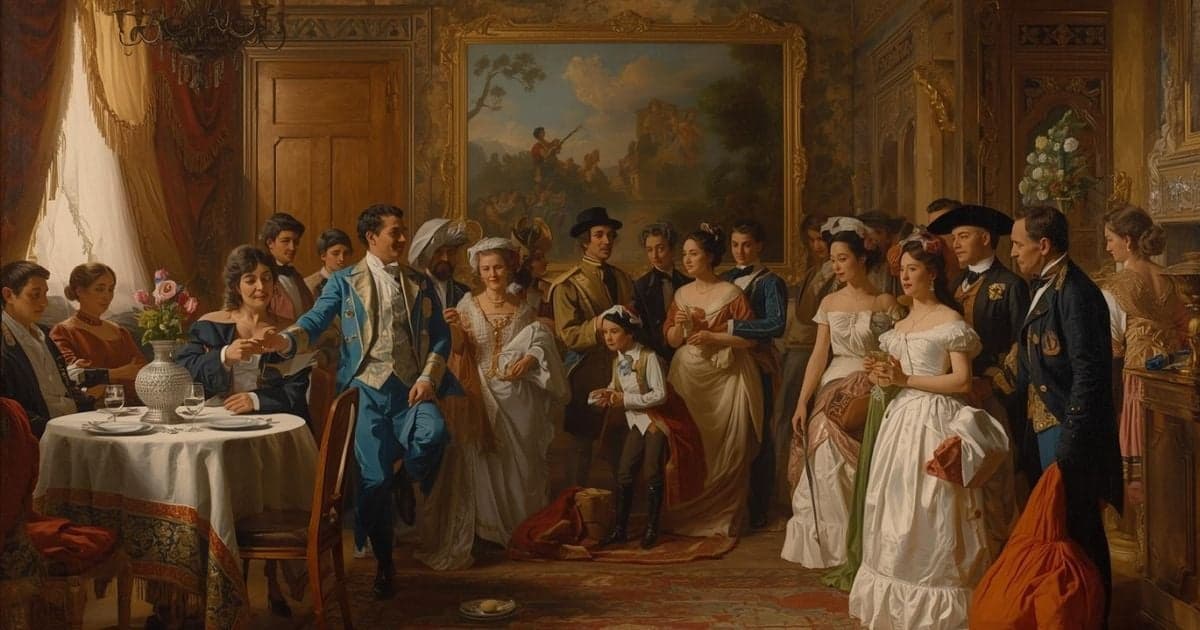
At the Emperor's ball Natásha stands with her mother and Sónya while partners fill the floor; the polonaise turns festive music into something like grief in her ears, and Andrew passes without recognizing her while Anatole and Borís look through her.

Pierre spots her face braced for despair or rapture, nudges Andrew to ask the young Rostóva to waltz, and Andrew remembers their window talk before offering his arm; she becomes radiant as they dance, second couple in the circle, her feet moving as if on their own.

Andrew sought escape from clever talk and the Emperor's restraint, yet holding her close revives him; when he leaves the floor the wine of her charm has risen to his head and he breathes deeply, watching others, surprised by joy he did not expect.

In this chapter: Terms Characters Key Quotes Themes Modern Story

Why This Matters

Connect literature to life

Skill: Spotting the Excluded

High-status rooms punish invisibility fast. Natásha hears the polonaise turn sad while Pierre tells Andrew to ask the young Rostóva, and one waltz flips despair into radiance. Before you settle into the inner circle, notice who is still standing at the wall.

Coming Up in Chapter 123

The waltz ends, but its effects linger. Andrew and Natasha's brief encounter has awakened something in both of them, setting in motion feelings that will reshape their futures in ways neither can imagine.

Share it with friends

PreviousPrevious ChapterNextNext Chapter
Original text
1,392 wordscomplete

Chapter 122

The Dance That Changes Everything

Suddenly everybody stirred, began talking, and pressed forward and then back, and between the two rows, which separated, the Emperor entered to the sounds of music that had immediately struck up. Behind him walked his host and hostess. He walked in rapidly, bowing to right and left as if anxious to get the first moments of the reception over. The band played the polonaise in vogue at that time on account of the words that had been set to it, beginning: “Alexander, Elisaveta, all our hearts you ravish quite...” The Emperor passed on to the drawing room, the crowd made…

Public-domain chapter text, formatted for reading.

Master this chapter. Complete your experience

Purchase the complete book to access all chapters and support classic literature

Buy at Powell'sBuy on Amazon

Available in paperback, hardcover, and e-book formats

Now let's explore the literary elements.

Key Quotes & Analysis

"The strains of the polonaise, which had continued for a considerable time, had begun to sound like a sad reminiscence to Natásha’s ears."

— Narrator

Context: Natásha still without a partner as the polonaise drags on

Exclusion turns celebration into humiliation for the watcher.

In Today's Words:

Tolstoy says the polonaise, which had gone on a long time, began to sound like a sad reminiscence to Natásha while others danced. The same music that signals joy for insiders can feel like mockery when you are left at the wall. Before you judge your mood at a party, check whether the room has actually included you.

"You always dance. I have a protégée, the young Rostóva, here. Ask her,"

— Pierre

Context: Pierre catches Andrew near the circle and points out Natásha

Pierre acts as bridge when power and pride miss the excluded girl.

In Today's Words:

Pierre tells Andrew he always dances and asks him to invite his protégée, young Rostóva, standing nearby. One secure friend can redirect attention without making a speech about inclusion. When you have standing in a room, notice who is braced for humiliation before the music moves on.

"I have long been waiting for you,"

— Narrator (Natásha's smile)

Context: Andrew asks her to waltz and her threatened tears become joy

A single invitation rewrites the whole evening for her.

In Today's Words:

Natásha's smile seems to say she has long been waiting for Andrew when he finally asks her to waltz after Pierre's nudge. Relief can arrive as one gesture from someone who actually looked. Do not underestimate how much a timed invitation can change someone's night.

"scarcely had he embraced that slender supple figure and felt her stirring so close to him and smiling so near him than the wine of her charm rose to his head"

— Narrator

Context: Closing beat after their waltz

Andrew came to escape politics and leaves unexpectedly stirred.

In Today's Words:

Andrew meant only to dance and escape talk, yet holding Natásha close, feeling her smile near him, the wine of her charm went to his head and revived him. People often arrive with one motive and leave altered by proximity they did not plan for. Track what actually shifted you, not only what you intended.

Thematic Threads

Wallflower Spiral

In This Chapter

Natásha watches partners chosen while Andrew and Borís pass without seeing her

Development

Debut terror peaks before Pierre redirects Andrew

In Your Life:

You might feel invisible at a work event until one person with standing pulls you into the room.

Unexpected Renewal

In This Chapter

Andrew dances to escape politics and leaves revived by Natásha's unguarded charm

Development

Ball rescue foreshadows his later awakening to her world

In Your Life:

You might help someone for convenience and discover your own mood lifted afterward.

You now have the context. Time to form your own thoughts.

Discussion Questions

This is not a test. Five prompts guide you through the chapter, from how it opens to how it closes, so you notice context and rhythm rather than facts to memorize. Sit with each question in your own words. When you see "One way to read it," treat it as a starting point, not the only answer.

  1. 1

    Why does the polonaise feel painful to Natásha before she dances?

    ▶One way to read it

    She remains without a partner while others pair off, so music meant for celebration sounds like grief to her.

    analysis • surface
  2. 2

    What role does Pierre play in Andrew's decision to ask Natásha?

    ▶One way to read it

    He notices her distress, points out the young Rostóva, and urges Andrew to dance with his protégée.

    analysis • medium
  3. 3

    When have you seen one introduction change someone's night?

    ▶One way to read it

    Name who was excluded and who bridged them in. Andrew maps Pierre nudging Andrew at the Emperor's ball.

    application • medium
  4. 4

    Why is Andrew surprised after the waltz?

    ▶One way to read it

    He sought escape from political talk but leaves revived, the wine of her charm rising to his head.

    application • deep
  5. 5

    What does Natásha's smile suggest when Andrew finally asks her?

    ▶One way to read it

    Her threatened tears turn to joy as if she had long been waiting, though she feared no one would ask.

    reflection • deep

Critical Thinking Exercise

10 minutes

Spot the Invisible Person

Think about the last three social situations you were in - work meeting, family gathering, community event, or even just waiting somewhere. Write down who was standing alone, looking uncomfortable, or being unconsciously ignored. Then identify what small action could have included them. This isn't about fixing everyone's problems, but about developing your 'exclusion radar' like Pierre had.

Consider:

  • •Sometimes the excluded person isn't obviously distressed - they might just be quietly invisible
  • •Your own social comfort level affects whether you notice others' discomfort
  • •Small gestures of inclusion often cost nothing but can completely shift someone's experience

Journaling Prompt

Write about a time when someone included you when you felt left out, or when you wish someone had noticed you were struggling socially. What did that inclusion mean to you, or what would it have meant?

Coming Up Next...

Chapter 123: The Magic of Being Fully Present

The waltz ends, but its effects linger. Andrew and Natasha's brief encounter has awakened something in both of them, setting in motion feelings that will reshape their futures in ways neither can imagine.

Continue to Chapter 123
Previous
Natasha's First Ball
Contents
Next
The Magic of Being Fully Present
Keep exploring

Continue Exploring

Study guides, teaching tools, themes, and the full library.More ways to read War and Peace: study guides, teaching tools, and the wider library.

  • War and Peace Study Guide
  • Teaching Resources
  • Essential Life Index
  • Browse by Theme
  • All Books

What this chapter teaches

Theme analyses that draw on this chapter and apply it to modern life.

  • Building Authentic RelationshipsForm genuine connections that transcend social expectations in Tolstoy
Power & CorruptionLove & RelationshipsIdentity & Self-Discovery

You Might Also Like

Anna Karenina cover

Anna Karenina

Leo Tolstoy

Also by Leo Tolstoy

The Idiot cover

The Idiot

Fyodor Dostoevsky

Explores love & romance

Moby-Dick cover

Moby-Dick

Herman Melville

Explores mortality & legacy

Noli Me Tángere cover

Noli Me Tángere

José Rizal

Explores systems thinking

Browse all 106+ books

Share This Chapter

Know someone who'd enjoy this? Spread the wisdom!

TwitterFacebookLinkedInEmail

Go further with Prestige

Unlock study guides and downloads, early access, and exclusive content — and support free access for everyone.

Subscribe to PrestigeCreate free account
Intelligence Amplifier
Intelligence Amplifier™Powering Wide Reads

Exploring human-AI collaboration through books, essays, and philosophical dialogues. Classic literature transformed into navigational maps for modern life.

2025 Books

→ The Amplified Human Spirit→ The Alarming Rise of Stupidity Amplified→ San Francisco: The AI Capital of the World
Visit intelligenceamplifier.org
hello@widereads.com

WideReads Originals

→ You Are Not Lost→ The Last Chapter First→ The Lit of Love→ Wealth and Poverty→ Wisdom for the Wounded
Arvintech
arvintechAmplify your Mind
Visit at arvintech.com

Navigate

  • Home
  • Library
  • Essential Life Index
  • How It Works
  • Subscribe
  • Account
  • About
  • Contact
  • Authors
  • Suggest a Book
  • Landings

Made For You

  • Trending
  • Students
  • Educators
  • Families
  • Readers
  • Literary Analysis
  • Finding Purpose
  • Letting Go
  • Recovering from a Breakup
  • Corruption
  • Gaslighting in the Classics

Newsletter

Weekly insights from the classics. Amplify Your Mind.

Legal

  • Privacy Policy
  • Terms of Service
  • Editorial Standards
  • Cookie Policy
  • Accessibility

Why Public Domain?

We focus on public domain classics because these timeless works belong to everyone. No paywalls, no restrictions—just wisdom that has stood the test of centuries, freely accessible to all readers.

Public domain books have shaped humanity's understanding of love, justice, ambition, and the human condition. By amplifying these works, we help preserve and share literature that truly belongs to the world.

A Pilgrimage

Powell's City of Books

Portland, Oregon

If you ever find yourself in Portland, walk to the corner of Burnside and 10th. The building takes up an entire city block. Inside is over a million books, new and used on the same shelf, organized by color-coded rooms with names like the Rose Room and the Pearl Room. You can lose an afternoon. You can lose a weekend. You will find a book you have been looking for your whole life, and three you did not know existed.

It is a pilgrimage. We cannot find a bookstore like it anywhere on earth. If you read the classics, and you ever get the chance, go. It belongs on every reader's bucket list.

Visit powells.com

We are not in any way affiliated with Powell's. We are just a very big fan.

© 2026 Wide Reads™. All Rights Reserved.

Intelligence Amplifier™ and Wide Reads™ are proprietary trademarks of Arvin Lioanag.

Copyright Protection: All original content, analyses, discussion questions, pedagogical frameworks, and methodology are protected by U.S. and international copyright law. Unauthorized reproduction, distribution, web scraping, or use for AI training is strictly prohibited. See our Copyright Notice for details.

Disclaimer: The information provided on this website is for general informational and educational purposes only and does not constitute professional, legal, financial, or technical advice. While we strive to ensure accuracy and relevance, we make no warranties regarding completeness, reliability, or suitability. Any reliance on such information is at your own risk. We are not liable for any losses or damages arising from use of this site. By using this site, you agree to these terms.