Wide Reads
Literature MattersLife IndexEducators
Sign in
Where to Begin
War and Peace - The Art of Salon Politics

Leo Tolstoy

War and Peace

The Art of Salon Politics

Home›Books›War and Peace›Chapter 1
1 of 361
Next

Summary

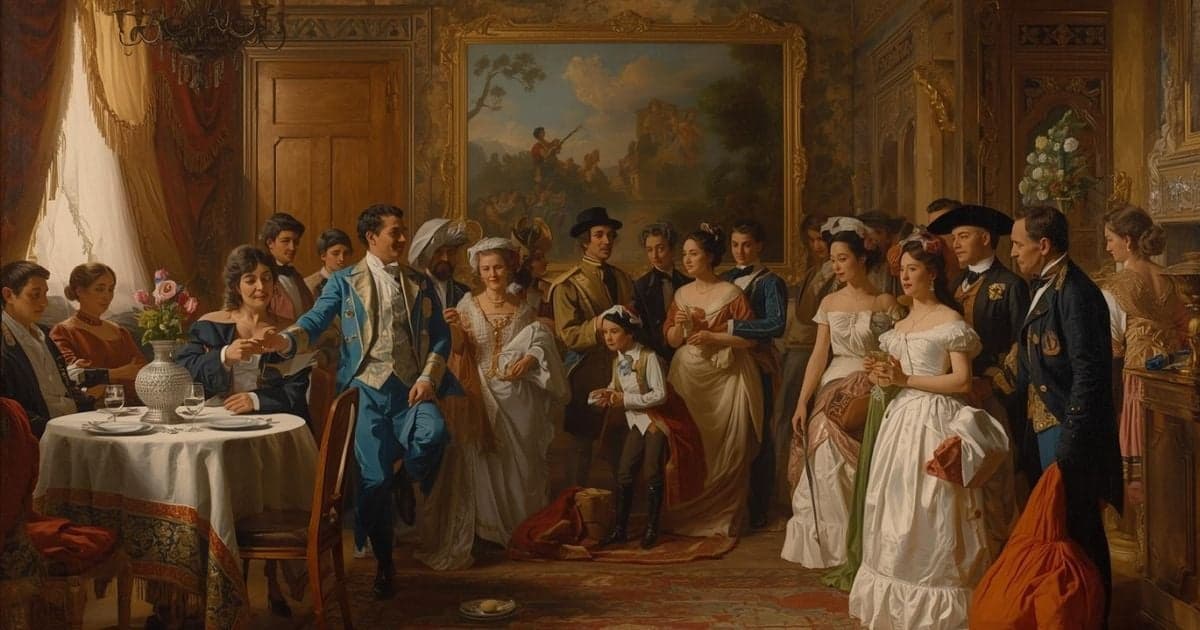
In an elegant St. Petersburg salon in 1805, we meet Anna Pavlovna Scherer, a court favorite who hosts influential gatherings during the Napoleonic Wars. She dramatically denounces Napoleon while greeting Prince Vasili Kuragin, a high-ranking official with his own agenda. Their conversation reveals the intricate dance of aristocratic society—beneath polite pleasantries lie calculated moves for power and position. Anna Pavlovna performs passionate patriotism like a social role, while Prince Vasili speaks with practiced indifference, both masters of saying what's expected rather than what they feel. The prince's real purpose emerges: he wants Anna Pavlovna's help securing a diplomatic post for his son. When that fails, he pivots to asking her to arrange a marriage between his wastrel son Anatole and the wealthy but unhappy Princess Mary Bolkonskaya. This opening chapter establishes Tolstoy's central theme—how personal ambitions drive the grand movements of history. These aren't evil people, but rather individuals navigating a system where survival depends on connections, favors, and strategic relationships. Anna Pavlovna's salon represents the broader world of the novel: a place where private desires and public duties intertwine, where the fate of nations gets decided through personal conversations, and where everyone wears a mask of civility while pursuing their own interests.

Coming Up in Chapter 2

The salon fills with more guests, each bringing their own secrets and schemes. We'll meet the mysterious visitors Anna Pavlovna mentioned, and witness how the evening's conversations reveal the complex web of relationships that will shape the coming war.

Share it with friends

Next Chapter
GO ADS FREE — JOIN US
Original text
complete·2,015 words
W

“ell, Prince, so Genoa and Lucca are now just family estates of the Buonapartes. But I warn you, if you don’t tell me that this means war, if you still try to defend the infamies and horrors perpetrated by that Antichrist—I really believe he is Antichrist—I will have nothing more to do with you and you are no longer my friend, no longer my ‘faithful slave,’ as you call yourself! But how do you do? I see I have frightened you—sit down and tell me all the news.”

It was in July, 1805, and the speaker was the well-known Anna Pávlovna Schérer, maid of honor and favorite of the Empress Márya Fëdorovna. With these words she greeted Prince Vasíli Kurágin, a man of high rank and importance, who was the first to arrive at her reception. Anna Pávlovna had had a cough for some days. She was, as she said, suffering from la grippe; grippe being then a new word in St. Petersburg, used only by the elite.

All her invitations without exception, written in French, and delivered by a scarlet-liveried footman that morning, ran as follows:

1 / 12

Master this chapter. Complete your experience

Purchase the complete book to access all chapters and support classic literature

Read Free on GutenbergBuy at Powell'sBuy on Amazon

As an Amazon Associate, we earn a small commission from qualifying purchases at no additional cost to you.

Available in paperback, hardcover, and e-book formats

GO ADS FREE — JOIN US

Why This Matters

Connect literature to life

Skill: Reading Power Dynamics

This chapter teaches how to identify when people are performing roles rather than communicating authentically, especially in hierarchical environments.

Practice This Today

This week, notice when conversations feel scripted—watch for the gap between what people say publicly versus what their actions reveal about their actual priorities.

GO ADS FREE — JOIN US

Now let's explore the literary elements.

Key Quotes & Analysis

"I really believe he is Antichrist"

— Anna Pavlovna Scherer

Context: She's dramatically denouncing Napoleon to Prince Vasili

This religious language reveals how personally threatened the Russian aristocrats feel. Anna Pavlovna isn't just discussing politics - she's performing patriotic outrage as part of her social role.

In Today's Words:

That guy is literally the devil - I can't even deal with him

"If you have nothing better to do... I shall be very charmed to see you tonight"

— Anna Pavlovna Scherer

Context: The standard invitation she sends to all her salon guests

The false modesty and careful wording show how aristocratic society operated through elaborate politeness that masked real power dynamics and obligations.

In Today's Words:

You should probably show up to my party if you know what's good for you

"Heavens! what a virulent attack!"

— Prince Vasili Kuragin

Context: His response to Anna Pavlovna's dramatic anti-Napoleon speech

His amused, detached reaction shows he's not buying her performance but knows how to play along. This reveals the gap between public posturing and private calculation.

In Today's Words:

Wow, you're really laying it on thick today, aren't you?

Thematic Threads

Class

In This Chapter

Aristocratic society operates through elaborate codes and performances that maintain social hierarchy

Development

Introduced here

In Your Life:

You might recognize this in workplace cultures where unwritten rules matter more than official policies.

Social Expectations

In This Chapter

Characters say what their roles demand rather than what they actually think or feel

Development

Introduced here

In Your Life:

You might see this in family gatherings where everyone avoids difficult topics to keep the peace.

Identity

In This Chapter

Anna Pavlovna and Prince Vasili have become their social roles so completely that authentic self may no longer exist

Development

Introduced here

In Your Life:

You might notice this when you realize you act completely differently at work versus at home versus with friends.

Human Relationships

In This Chapter

All interactions are transactional—even seemingly social conversations serve hidden agendas

Development

Introduced here

In Your Life:

You might recognize this when someone suddenly becomes friendly right before asking for a favor.

Personal Growth

In This Chapter

Characters are trapped in static roles that prevent genuine development or self-awareness

Development

Introduced here

In Your Life:

You might see this when you feel stuck playing the same role in your family or workplace regardless of how you've actually changed.

GO ADS FREE — JOIN US

You now have the context. Time to form your own thoughts.

Discussion Questions

  1. 1

    What does Anna Pavlovna actually want from her conversation with Prince Vasili, beyond discussing Napoleon?

    analysis • surface
  2. 2

    Why does Prince Vasili wait until the end of their conversation to ask for what he really wants?

    analysis • medium
  3. 3

    Where have you seen people perform passionate opinions they don't really hold to fit in or advance their goals?

    application • medium
  4. 4

    How would you handle a situation where you need something from someone who expects you to play along with their performance?

    application • deep
  5. 5

    What does this opening scene suggest about how personal ambitions shape larger historical events?

    reflection • deep

Critical Thinking Exercise

10 minutes

Decode the Real Conversation

Take a recent conversation you had at work, with family, or in a social setting where you felt like people weren't saying what they really meant. Write out what was actually said, then translate what each person probably wanted or was really thinking. Notice the gap between performance and reality.

Consider:

  • •Look for moments when the conversation felt scripted or predictable
  • •Identify what each person was trying to protect or gain
  • •Notice your own performance moments versus authentic responses

Journaling Prompt

Write about a time when you had to choose between saying what was expected and saying what you really thought. What influenced your decision? How did it turn out?

GO ADS FREE — JOIN US

Coming Up Next...

Chapter 2: The Art of Social Theater

The salon fills with more guests, each bringing their own secrets and schemes. We'll meet the mysterious visitors Anna Pavlovna mentioned, and witness how the evening's conversations reveal the complex web of relationships that will shape the coming war.

Continue to Chapter 2
Contents
Next
The Art of Social Theater

Continue Exploring

War and Peace Study GuideTeaching ResourcesEssential Life IndexBrowse by ThemeAll Books
Power & CorruptionLove & RelationshipsIdentity & Self-Discovery

You Might Also Like

Anna Karenina cover

Anna Karenina

Leo Tolstoy

Also by Leo Tolstoy

The Idiot cover

The Idiot

Fyodor Dostoevsky

Explores love & romance

Moby-Dick cover

Moby-Dick

Herman Melville

Explores mortality & legacy

Dracula cover

Dracula

Bram Stoker

Explores love & romance

Browse all 47+ books

Share This Chapter

Know someone who'd enjoy this? Spread the wisdom!

TwitterFacebookLinkedInEmail

Read ad-free with Prestige

Get rid of ads, unlock study guides and downloads, and support free access for everyone.

Subscribe to PrestigeCreate free account
Intelligence Amplifier
Intelligence Amplifier™Powering Wide Reads

Exploring human-AI collaboration through books, essays, and philosophical dialogues. Classic literature transformed into navigational maps for modern life.

2025 Books

→ The Amplified Human Spirit→ The Alarming Rise of Stupidity Amplified→ San Francisco: The AI Capital of the World
Visit intelligenceamplifier.org
hello@widereads.com

WideReads Originals

→ You Are Not Lost→ The Last Chapter First→ The Lit of Love→ Wealth and Poverty→ 10 Paradoxes in the Classics · coming soon
Arvintech
arvintechAmplify your Mind
Visit at arvintech.com

Navigate

  • Home
  • Library
  • Essential Life Index
  • How It Works
  • Subscribe
  • Account
  • About
  • Contact
  • Authors
  • Suggest a Book
  • Landings

Made For You

  • Students
  • Educators
  • Families
  • Readers
  • Literary Analysis
  • Finding Purpose
  • Letting Go
  • Recovering from a Breakup
  • Corruption
  • Gaslighting in the Classics

Newsletter

Weekly insights from the classics. Amplify Your Mind.

Legal

  • Privacy Policy
  • Terms of Service
  • Cookie Policy
  • Accessibility

Why Public Domain?

We focus on public domain classics because these timeless works belong to everyone. No paywalls, no restrictions—just wisdom that has stood the test of centuries, freely accessible to all readers.

Public domain books have shaped humanity's understanding of love, justice, ambition, and the human condition. By amplifying these works, we help preserve and share literature that truly belongs to the world.

A Pilgrimage

Powell's City of Books

Portland, Oregon

If you ever find yourself in Portland, walk to the corner of Burnside and 10th. The building takes up an entire city block. Inside is over a million books, new and used on the same shelf, organized by color-coded rooms with names like the Rose Room and the Pearl Room. You can lose an afternoon. You can lose a weekend. You will find a book you have been looking for your whole life, and three you did not know existed.

It is a pilgrimage. We cannot find a bookstore like it anywhere on earth. If you read the classics, and you ever get the chance, go. It belongs on every reader's bucket list.

Visit powells.com

We are not in any way affiliated with Powell's. We are just a very big fan.

© 2026 Wide Reads™. All Rights Reserved.

Intelligence Amplifier™ and Wide Reads™ are proprietary trademarks of Arvin Lioanag.

Copyright Protection: All original content, analyses, discussion questions, pedagogical frameworks, and methodology are protected by U.S. and international copyright law. Unauthorized reproduction, distribution, web scraping, or use for AI training is strictly prohibited. See our Copyright Notice for details.

Disclaimer: The information provided on this website is for general informational and educational purposes only and does not constitute professional, legal, financial, or technical advice. While we strive to ensure accuracy and relevance, we make no warranties regarding completeness, reliability, or suitability. Any reliance on such information is at your own risk. We are not liable for any losses or damages arising from use of this site. By using this site, you agree to these terms.